Types of Wood Planes: A Grade and Quality Selection Guide
Discover how to evaluate quality across different types of wood planes, from blade steel grades to casting precision, for flawless lumber finishing.
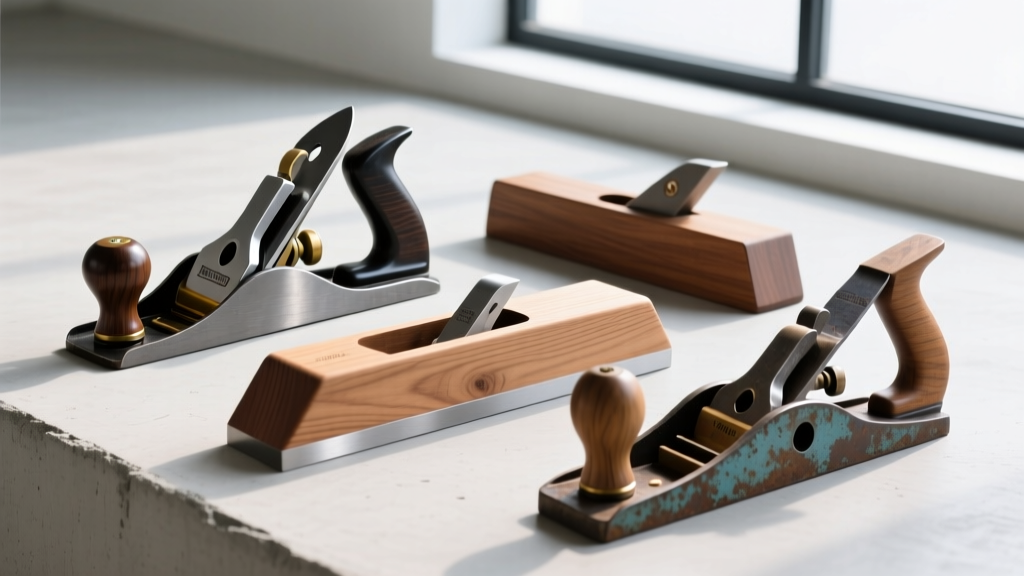
The Anatomy of a Premium Hand Plane
Selecting from the various types of wood planes requires looking past the polished wood totes and focusing on metallurgical integrity and machining tolerances. A hand plane is essentially a micro-tome for wood fibers; its ability to shear end grain or figure-rich hardwoods without tearout depends entirely on the rigidity of its casting, the precision of its frog seating, and the crystalline structure of its blade steel. When grading lumber for fine furniture or architectural millwork, the tool's quality directly dictates the surface finish, often eliminating the need for abrasive sanding that degrades wood clarity.
Blade Steel Metallurgy: O1 vs. A2 vs. PM-V11
The iron (blade) is the cutting edge of the tool, and its steel alloy determines edge retention, sharpening effort, and resistance to micro-chipping. Modern premium planes typically offer three distinct steel grades:
- O1 Tool Steel (HRC 58-60): The traditional high-carbon standard. It sharpens quickly on water stones and takes a mirror polish, making it ideal for smoothing planes used on softwoods and non-abrasive domestic hardwoods like cherry or walnut. However, it dulls rapidly when planing abrasive tropical species.
- A2 Tool Steel (HRC 60-62): An air-hardening steel that offers roughly 30% greater edge retention than O1. The trade-off is that A2 requires diamond plates or specialized ceramic stones to sharpen effectively due to its hard vanadium carbides. It is the default choice for jack and jointer planes that process rough, dirty, or highly figured lumber.
- PM-V11 (Powdered Metallurgy, HRC 62-64): A proprietary powdered steel that bridges the gap between A2's longevity and O1's ease of sharpening. Its uniform carbide distribution prevents the micro-chipping common in A2 when planing dense woods like hard maple or ipe at low angles.
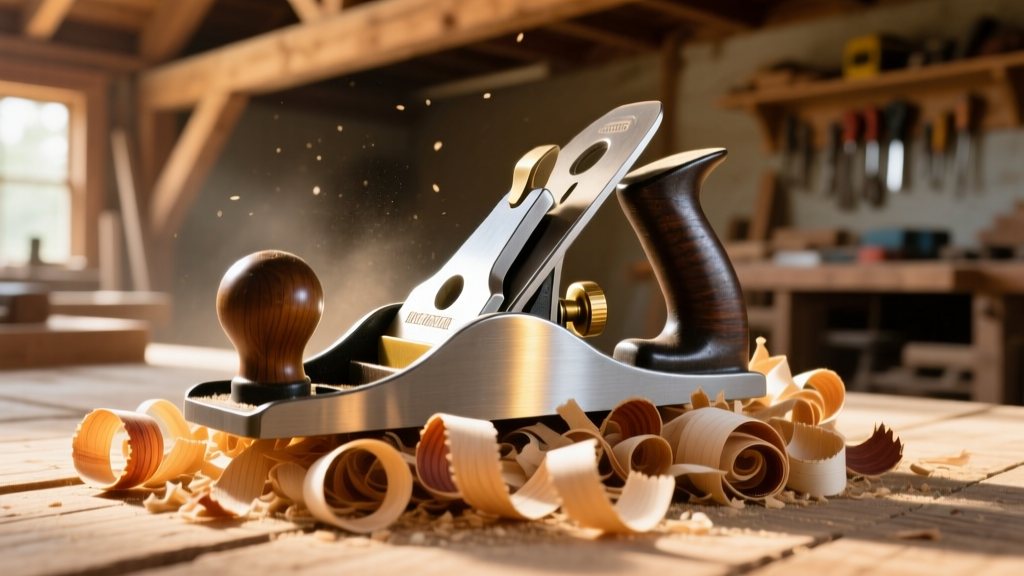
Categorizing Types of Wood Planes by Function and Grade
Wood planes are graded and categorized by their length, bedding angle, and intended stage in the lumber preparation process. Using a smoothing plane to flatten a twisted board will result in failure, just as using a jointer plane for final finishing will leave track marks.
| Plane Type | Standard Number | Primary Function | Ideal Bedding Angle |
|---|---|---|---|
| Fore / Jack Plane | No. 5 | Rough stock removal, initial flattening | 45° (Standard) or 50° (York) |
| Jointer Plane | No. 7 or 8 | Truing edges, final flattening of long boards | 45° (Standard) |
| Smoother Plane | No. 4 or 4.5 | Final surface finishing, removing mill marks | 50° (York) or 55° (High Angle) |
| Low-Angle Block | No. 60.5 | End grain trimming, chamfering | 12° Bed + 25° Bevel = 37° |
| Shoulder Plane | Various (e.g., 073) | Trimming tenon cheeks, cleaning dadoes | 18° to 20° (Low Angle) |
Casting Quality: Ductile Iron and Machining Tolerances
The body of the plane must absorb the immense lateral and vertical forces generated when shearing dense wood fibers. Budget and vintage planes are typically cast from grey cast iron. While grey iron dampens vibration well, it is brittle; a drop onto a concrete shop floor will shatter the sole or snap the tote. Premium modern manufacturers utilize ductile iron, an alloy treated with magnesium that yields and bends under extreme stress rather than fracturing.
The Frog Seating Failure Point
The frog is the cast iron wedge that holds the blade assembly to the body. In sub-par planes, the mating surfaces between the frog and the body are left rough from the sand-casting process. This uneven seating causes microscopic flexing during the cut, resulting in "chatter"—a washboard pattern left on the wood surface. High-grade planes feature fully milled frog seats, ensuring 100% metal-to-metal contact. According to Wood Magazine's Handplane Reviews, eliminating frog chatter is the single most critical tuning step for achieving glass-smooth finishes on highly figured woods.
Modern Premium vs. Vintage vs. Budget: A Buyer's Matrix
When investing in types of wood planes for professional or serious hobbyist use, the market is strictly divided into three tiers. Understanding the quality gaps between these tiers prevents costly mistakes.
- Tier 1: Modern Premium (Lie-Nielsen, Veritas, Marcou)
- Specs: Ductile iron bodies, A2 or PM-V11 blades, CNC-milled soles flat to 0.001", brass hardware, cherry or rosewood infill.
- Price Range: $250 - $450+ per bench plane.
- Verdict: Ready for use out of the box. Requires only honing the micro-bevel. The standard for professional architectural millwork and fine furniture.
- Tier 2: Mid-Range / Import Premium (WoodRiver V3, Quinn, Stanley Sweetheart)
- Specs: High-carbon steel or basic A2, thicker castings than budget lines, but soles often require 30-60 minutes of lapping on sandpaper to achieve true flatness.
- Price Range: $120 - $180.
- Verdict: Excellent value if you are willing to invest sweat equity into tuning and lapping the sole and frog.
- Tier 3: Vintage (Pre-WWII Stanley, Sargent, Millers Falls)
- Specs: Superior O1 crucible steel, but suffering from decades of rust, pitting, and worn lateral adjusters.
- Price Range: $40 - $150 (highly dependent on condition and rarity).
- Verdict: Ideal for woodworkers who enjoy restoration. As noted in Popular Woodworking Tool Guides, a properly restored vintage Stanley No. 4 will outperform a modern budget plane, but requires significant rust removal, flattening, and replacement of worn parts.
Troubleshooting Quality Defects in New and Vintage Planes
Even high-grade tools can exhibit defects from shipping or poor factory quality control. Use this diagnostic framework to identify and resolve performance failures before they damage expensive lumber.
- Symptom: The plane tracks to one side, producing uneven shavings.
Cause: The blade is not parallel to the mouth, or the lateral adjuster has excessive slop.
Fix: Check the lateral adjuster lever for play. If the mechanism is tight, the blade edge is likely out of square. Use a diamond stone to joint the edge perfectly square to the blade's sides. - Symptom: Severe tearout on interlocked grain (e.g., mahogany, sapele).
Cause: The effective cutting angle is too low, causing the blade to lever ahead of the cut and split the wood fibers.
Fix: Upgrade to a high-angle frog (50° or 55°) or apply a 10° to 15° back-bevel to your existing A2 iron. This increases the attack angle, forcing the blade to sever the fibers rather than pry them up. - Symptom: The plane requires excessive downward force and stalls in dense wood.
Cause: The mouth opening is too tight, causing shavings to jam, or the sole is convex (bellied) from uneven factory lapping.
Fix: Affix 220-grit silicon carbide paper to a verified flat granite surface plate. Lubricate with mineral oil and lap the sole using a strict figure-eight pattern until a uniform scratch pattern covers the entire perimeter, the toe, the heel, and the area immediately in front of the mouth.
"A hand plane is only as precise as the surface it registers against. If the sole is out of flat by even two-thousandths of an inch, the tool will follow the undulations of the wood rather than correcting them, rendering the finest blade steel entirely useless." — Traditional woodworking maxim on tool tuning.
Mastering the selection and tuning of these tools transforms rough-sawn lumber into architectural elements of unmatched precision. By prioritizing metallurgical grade, casting rigidity, and geometric tolerances over superficial aesthetics, woodworkers ensure their tools act as true extensions of their intent, delivering surfaces that reflect light uniformly and accept finishes flawlessly.
Written by
Elena RodriguezElena Rodriguez is a civil engineer and technical writer specializing in concrete technology, masonry systems, and ASTM/ACI compliance. She earned her B.S. in Civil Engineering from Texas A&M University and spent a decade at a materials testing laboratory, performing over 2,000 concrete compressive strength tests and masonry prism evaluations. Elena is an ACI-certified Field Testing Technician (Grade I) and a member of ASTM Committee C12 on Natural Building Stone. She currently consults on forensic engineering cases involving concrete failures and moisture intrusion. Based in San Antonio, TX, Elena is a proud member of the Society of Women Engineers (SWE) and coaches her daughter's FIRST Robotics team.
More from Elena Rodriguez
View all
Walls & Panels
Cost Analysis: Light Gauge Steel Framing Advantages and Disadvantages
Evaluate light gauge steel framing advantages and disadvantages through a strict cost analysis lens, comparing material, labor, and lifecycle expenses.
Aug 4, 2026

Walls & Panels
Gypsum Board Types: Exact Specifications, Thickness & Dimensions
Compare standard, Type X, and moisture-resistant gypsum board types. Get exact specifications, thicknesses, dimensions, and ASTM standards for your project.
Aug 4, 2026

Fire Resistance
Best Fire-Resistant Outdoor Decking Materials: 2026 Buyer Guide
Discover the best fire-resistant outdoor decking materials for 2026. Compare Class A PVC, aluminum, and hardwood options for WUI compliance and safety.
Aug 4, 2026