Cost to Build a 100 Ft French Drain 8 Ft Deep: Full Breakdown
Discover the true cost to build a 100 ft French drain 8 ft deep. Includes pricing, OSHA shoring requirements, and deep-trench material specs.
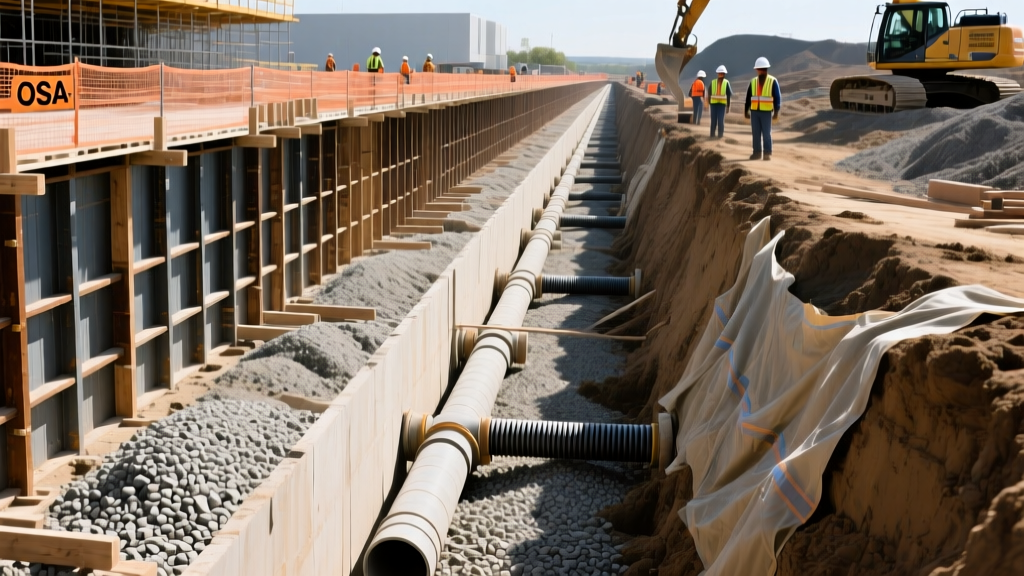
The Reality of an 8-Foot Deep French Drain
When homeowners and contractors research French drains, the vast majority of guides focus on shallow trenches ranging from 18 to 24 inches deep. However, specifying an 8-foot deep French drain fundamentally changes the project from a standard landscaping task into a heavy civil excavation. An 8-foot depth is typically required for deep foundation hydrostatic relief, basement waterproofing on sloped lots, or relieving pressure behind tall retaining walls.
The average cost to build a 100 ft French drain 8 ft deep ranges from $8,500 to $14,500, translating to $85 to $145 per linear foot. This is significantly higher than shallow drains ($20 to $40 per linear foot) due to the mandatory safety protocols, heavy machinery requirements, and specialized deep-burial materials required to prevent pipe crushing under immense soil loads.
Under OSHA Standard 1926.652, any trench 5 feet or deeper requires a protective system (shoring, shielding, or sloping) unless excavated entirely in stable rock. An 8-foot trench without a trench box or hydraulic shoring is a severe collapse hazard and an OSHA violation that carries heavy fines. This safety requirement is the primary driver of the cost premium for deep drainage systems.
Total Cost Breakdown for 100 Linear Feet
The following matrix details the estimated costs for a 100-foot run at an 8-foot depth in standard soil conditions (loam/clay mix). Prices reflect current heavy equipment rates and material costs.
| Project Phase | Low Estimate | High Estimate | Cost Drivers |
|---|---|---|---|
| Mobilization & Permits | $800 | $1,500 | Equipment transport, local grading permits |
| Excavation & Shoring | $4,500 | $7,500 | Mid-size excavator, trench box rental/operation |
| Materials (Pipe, Rock, Fabric) | $1,800 | $2,800 | SDR 35 PVC, washed river rock, non-woven geotextile |
| Backfill & Compaction | $900 | $1,500 | Mechanical tamping in 2-foot lifts |
| Spoil Removal (Off-site) | $500 | $1,200 | Dump truck hauling, landfill tipping fees |
| TOTAL (100 Linear Feet) | $8,500 | $14,500 | $85 - $145 per linear foot |
Material Specifications for Deep Trenches
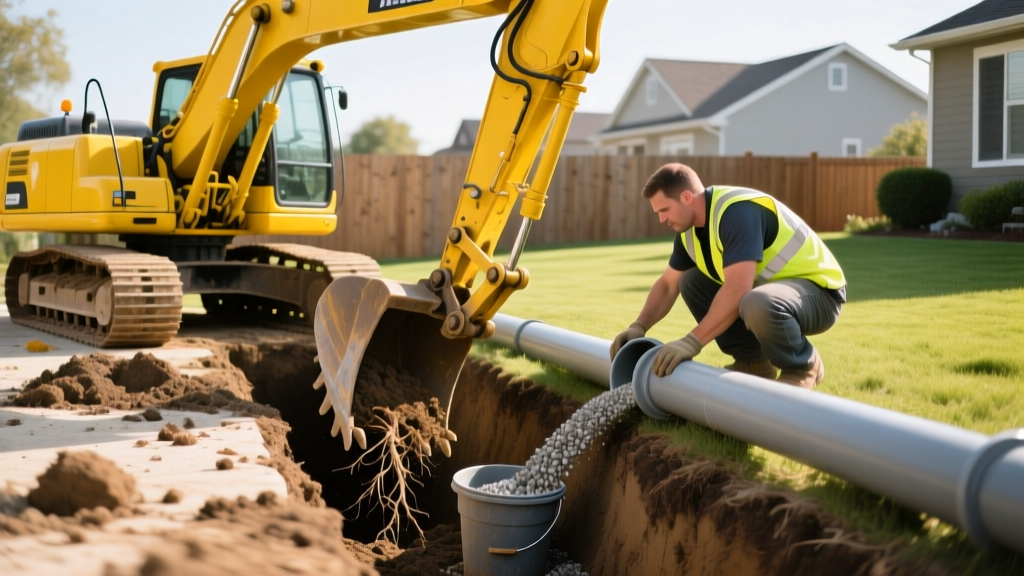
You cannot use standard corrugated black pipe for an 8-foot burial. At this depth, the vertical soil pressure exceeds 1,000 pounds per square foot. If the gravel envelope shifts or settles, standard pipe will ovalize and collapse. According to engineering guidelines supported by the Plastic Pipe Institute, deep burial requires high-stiffness piping.
- Primary Pipe: Use 4-inch or 6-inch SDR 35 PVC (ASTM D3034) or Schedule 40 PVC. SDR 35 provides a stiffness factor (PS46) designed specifically for deep gravity sewer and drainage applications where soil loads are immense.
- Drainage Aggregate: 3/4-inch to 1-inch washed river rock. Never use crushed limestone or gravel with fines. Crushed stone compacts and acts like concrete over time, destroying the permeability of the drain bed. Washed rock maintains permanent void space.
- Filter Fabric: 4 oz to 6 oz non-woven geotextile fabric (e.g., Mirafi 140N or equivalent). Woven fabrics are designed for soil stabilization and will quickly clog with silt in a high-flow drainage application. Non-woven fabric allows water to pass while blocking fine soil particles.
- Bedding Sand: A 4-inch layer of coarse masonry sand beneath the pipe is mandatory to distribute the point loads of the rock and prevent the rigid PVC from resting on hard, uneven subgrade surfaces.
Step-by-Step Excavation and Installation Flow
Executing an 8-foot trench requires a precise sequence to maintain structural integrity and safety.
- Subsurface Utility Locating: Before any digging, contact 811 or your local utility locating service. An 8-foot depth will easily sever buried electrical lines, sewer laterals, or gas mains if they are not accurately marked.
- Excavation and Shoring Deployment: A mid-size excavator (e.g., CAT 315 or John Deere 160) digs the trench to a width of 24 to 36 inches. A steel trench box is lowered into the excavation. The excavator operator must dig ahead of the box, and the box is dragged forward to protect the worker inside.
- Subgrade Preparation: The trench floor is leveled and compacted. A 4-inch bed of coarse sand is laid and screeded to a consistent 1% minimum slope (1/8 inch per foot) toward the daylight point or dry well.
- Pipe and Envelope Assembly: The non-woven geotextile is laid into the trench, draping up the sides. The SDR 35 PVC is placed on the sand bed. Washed river rock is poured over and around the pipe to a height of 12 inches above the pipe crown.
- Fabric Enclosure and Backfilling: The geotextile fabric is folded over the top of the rock envelope, creating a complete "burrito" wrap to prevent soil intrusion. The remaining 5+ feet of the trench is backfilled with native soil in 2-foot lifts, with each lift mechanically tamped to prevent future surface subsidence.
Hidden Costs and Edge Cases
The baseline cost assumes standard soil and straightforward site access. Several edge cases can rapidly inflate the budget for a 100-foot deep drain.
Bedrock Encountered
If the excavator hits bedrock or large glacial boulders before reaching 8 feet, trenching costs will spike by $50 to $120 per linear foot. This requires a hydraulic hammer attachment and significantly slows production rates.
High Water Table
Digging 8 feet down often intersects the local water table. If the trench fills with water during excavation, you must rent and operate trash-water dewatering pumps ($150-$300/day) to keep the trench dry enough to lay the pipe bedding properly.
Heavy Clay Soils
Clay acts as a barrier to water. In heavy clay, the trench must be widened to 36 or 48 inches to provide a larger gravel envelope, increasing excavation volume, shoring requirements, and aggregate costs by up to 40%.
Restricted Access
If fences, trees, or structures prevent a mid-size excavator from accessing the trench line, contractors must use a mini-excavator. Mini-excavators struggle to reach 8-foot depths efficiently and require frequent repositioning of shoring systems.
DIY vs. Professional Contractor Matrix
While a shallow French drain is a common weekend DIY project, an 8-foot deep trench is strictly a professional undertaking.
| Factor | DIY Attempt | Professional Contractor |
|---|---|---|
| Safety & Shoring | Extremely high risk of cave-in; shoring rental and operation is complex for amateurs. | OSHA-compliant trench boxes and trained operators ensure zero collapse risk. |
| Equipment Access | Rental yards rarely rent mid-size excavators to non-professionals without heavy insurance. | Fleet ownership or commercial rental accounts ensure the right machine is on site. |
| Pipe Integrity | High likelihood of improper bedding leading to pipe crushing under 8 feet of soil. | Laser levels and proper sand bedding guarantee structural pipe support. |
| Liability | Homeowner assumes 100% liability for utility strikes or property damage. | Contractor carries general liability and workers' compensation insurance. |
Frequently Asked Questions
How long will an 8-foot deep SDR 35 PVC French drain last?
When installed with a proper non-woven geotextile wrap and washed river rock, an SDR 35 PVC deep drain will last 50 to 100 years. The PVC is impervious to rot, and the deep burial protects it from UV degradation and surface load fracturing.
Do I need an engineered stamp for an 8-foot drainage trench?
In most municipalities, standard drainage trenches do not require a structural engineering stamp, but they do require a grading and excavation permit. However, if the 8-foot trench is located within 10 feet of a building foundation or a retaining wall, the local building department will likely require a geotechnical engineer's review to ensure the excavation won't undermine the existing structure's footing.
Can I tie roof downspouts into an 8-foot deep French drain?
Yes, but it requires a separate solid PVC conveyance line dropped down to the 8-foot depth, which then connects to the perforated French drain via a wye fitting. Dumping roof water directly into the top of an 8-foot gravel trench from the surface will wash topsoil into the gravel envelope, clogging the system within a few seasons.
Written by
Marcus ChenMarcus Chen is a licensed structural engineer (PE) and building materials analyst with over 12 years of experience across residential, commercial, and industrial construction. He holds a Master of Science in Civil Engineering from UC Berkeley and spent six years at Thornton Tomasetti before transitioning to independent consulting and technical writing. Marcus specializes in material selection for seismic-prone regions, concrete reinforcement strategies, and lifecycle cost analysis. His work has been cited by the American Concrete Institute (ACI) and the Structural Engineers Association of California (SEAOC). When he is not on a job site or at his desk, you will find him hiking the Sierra Nevada or restoring a 1920s craftsman bungalow in Oakland, CA.
More from Marcus Chen
View all
Construction Cost
How Much Did the Eiffel Tower Cost to Build?
How much did the Eiffel Tower cost to build in 1889? We adjust for inflation and compare its budget to modern skyscraper construction.
Aug 4, 2026

Fire Resistance
What Is a Fire Resistant Material? Testing & Certification Guide
Discover what is a fire resistant material through ASTM and UL testing. Learn how fire ratings, certifications, and assemblies work in construction.
Aug 4, 2026

Construction Cost
How Much Did the Burj Khalifa Cost to Build?
How much did the Burj Khalifa cost to build? We break down the $1.5B project and extract 5 money-saving strategies for your next build.
Jul 30, 2026