How Much Did Alligator Alcatraz Cost to Build? 2026 Scope Calculator
Discover how much an Alligator Alcatraz costs to build. Our size and scope calculator breaks down concrete, mesh, and filtration costs for secure enclosures.
Decoding the 'Alligator Alcatraz' Concept
In the specialized world of exotic animal containment, the term 'Alligator Alcatraz' is not a single geographic location, but rather an industry moniker for a maximum-security, commercial-grade crocodilian enclosure. These structures are designed to house large, dangerous apex predators with zero margin for structural failure or escape. When private sanctuary developers and zoo engineers ask us how much did alligator alcatrz cost to build, they are often surprised to learn that the expenses far exceed those of standard residential or commercial swimming pools. The discrepancy lies in the extreme structural loads, specialized life-support systems, and rigorous federal compliance standards required for apex reptile containment.
This size and scope calculator breaks down the exact material specifications, engineering requirements, and 2026 market pricing for constructing a high-security alligator habitat. Whether you are estimating for a private estate sanctuary or a municipal zoological park, the metrics below provide a concrete baseline for your budget.
Unlike standard pools, large-scale gator enclosures often sit at or below the water table. A 10,000-square-foot basin emptied for maintenance can generate millions of pounds of hydrostatic uplift pressure. Failure to install a network of hydrostatic relief valves and a reinforced structural slab will result in catastrophic shell cracking or complete basin displacement.
Baseline Size and Scope Parameters
To calculate accurate costs, we must first define the physical footprint of a standard 'Alcatraz-class' enclosure. The baseline model for this calculator assumes a mixed-use habitat designed for up to 15 adult American Alligators (Alligator mississippiensis).
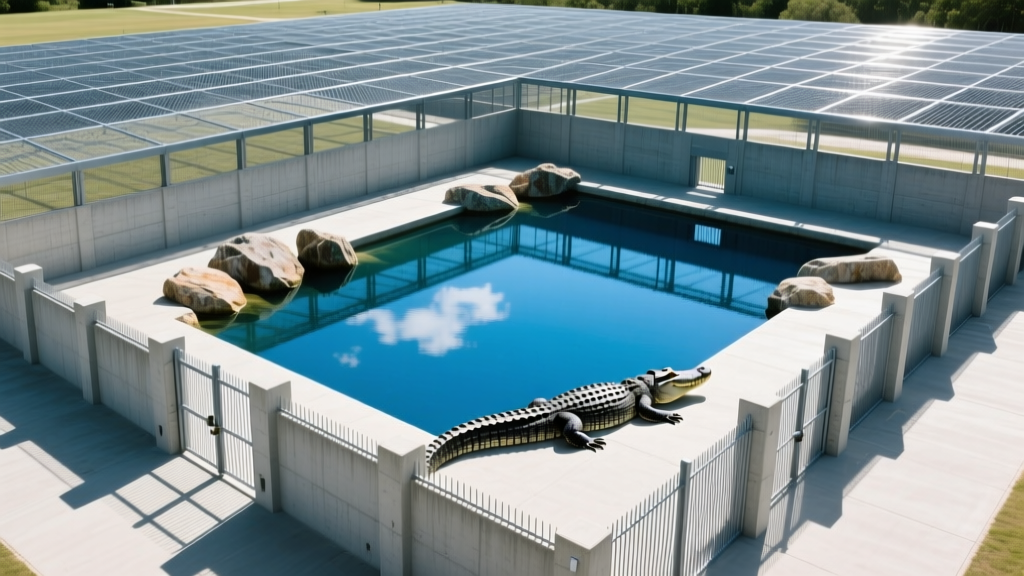
- Total Footprint: 12,000 square feet (8,000 sq ft water surface / 4,000 sq ft land basking area).
- Water Volume: 180,000 gallons (assuming an average depth of 6 feet, with a 10-foot deep central trench for thermal refuge).
- Perimeter Containment: 8-foot-high cantilevered retaining walls with a 2-foot inward-angled anti-climb overhang.
- Overhead Security: 100% roof coverage using heavy-gauge welded wire mesh to prevent climbing escapes and protect against unauthorized human entry.
Material Specifications and Unit Costs
Standard pool materials like fiberglass or vinyl liners are entirely unsuitable for crocodilian enclosures. Alligators possess immense bite force and claw strength, requiring structural concrete and marine-grade metals. According to guidelines referenced by the American Shotcrete Association, wet-mix structural shotcrete is the industry standard for complex, organic-shaped aquatic habitats due to its high compressive strength and adaptability.
| Component | Specification (2026 Standards) | Estimated Cost |
|---|---|---|
| Basin Shell (Shotcrete) | 6-inch min. thickness, 5,000 PSI, #5 rebar on 12-inch centers | $145,000 - $185,000 |
| Interior Coating | Heavy-duty, abrasion-resistant polyurea or epoxy (dark tint) | $28,000 - $42,000 |
| Perimeter Walls | Poured concrete cantilever walls with smooth anti-climb caps | $65,000 - $90,000 |
| Overhead Mesh Roof | 316L Stainless Steel, 3/16-inch wire, 2x2 inch grid | $55,000 - $75,000 |
| Basking Hardscape | Reinforced artificial rockwork (GFRC) over structural footings | $40,000 - $60,000 |
Life Support Systems: Filtration and Thermal Regulation
An enclosure is only as viable as its life-support system. Alligators produce massive amounts of biological waste, requiring commercial aquaculture-grade filtration rather than residential pool equipment. Furthermore, as ectotherms, they require precise thermal gradients to digest food and maintain immune function.
Commercial Filtration Matrix
For a 180,000-gallon system, you must achieve a minimum turnover rate of 6 hours. This requires oversized commercial bead filters or moving bed biofilm reactors (MBBR). Expect to spend between $45,000 and $70,000 on primary filtration, UV sterilization arrays, and commercial-grade variable frequency drive (VFD) circulation pumps.
Thermal Regulation Infrastructure
Heating 180,000 gallons of water to a baseline of 78°F during winter months requires commercial boiler systems with titanium heat exchangers (to resist corrosion from water treatments). Additionally, basking spots must be equipped with high-wattage infrared ceramic emitter arrays. Total HVAC and plumbing rough-in costs typically range from $60,000 to $95,000.
Expert Insight: Never use standard copper or cupro-nickel heat exchangers in crocodilian habitats. The biological acids and necessary water treatments will degrade copper rapidly, leading to toxic heavy metal leaching that is fatal to reptiles. Always specify solid titanium or marine-grade stainless steel exchangers.
The Hidden Costs: Permitting and Federal Compliance
Building an 'Alligator Alcatraz' is not just a construction project; it is a heavily regulated biological facility. In the United States, facilities housing crocodilians must comply with strict federal and state guidelines. The USDA APHIS Animal Welfare Act mandates specific structural redundancies, double-door entry systems (sally ports), and specialized drainage protocols to prevent cross-contamination and ensure handler safety.
Furthermore, facilities seeking accreditation from the Association of Zoos and Aquariums (AZA) must meet even more stringent spatial and environmental enrichment standards. Budget an additional $15,000 to $30,000 for specialized architectural engineering stamps, environmental impact studies, and federal permitting fees.
Total Cost Estimation Matrix (2026)
The following matrix provides a comprehensive look at total project costs based on the scale and intended use of the facility. These figures include excavation, materials, labor, and life-support systems, but exclude land acquisition.
| Facility Tier | Size / Capacity | Primary Use Case | Total Estimated Cost |
|---|---|---|---|
| Tier 1: Private Sanctuary | 4,000 sq ft / 4-6 Adults | Private rescue, basic USDA compliance | $180,000 - $240,000 |
| Tier 2: Standard Alcatraz | 12,000 sq ft / 10-15 Adults | Commercial exhibit, high-security estate | $420,000 - $580,000 |
| Tier 3: AZA Zoo-Grade | 25,000+ sq ft / Breeding Colony | Institutional breeding, public zoological park | $950,000 - $1.4M+ |
Step-by-Step Construction Sequence
Executing a project of this magnitude requires strict adherence to a phased construction timeline. Rushing the curing process or installing life-support systems before the shell is fully sealed will result in catastrophic cost overruns.
- Phase 1: Earthwork and Hydrostatic Mitigation (Weeks 1-4)
Excavation of the basin, installation of a gravel sub-base, and deployment of hydrostatic relief valves connected to a perimeter sump pump system. - Phase 2: Steel Reinforcement and Plumbing Rough-In (Weeks 5-8)
Tying the #5 rebar grid. All commercial plumbing lines (drains, returns, vacuum lines) are pressure-tested and suspended within the rebar matrix before concrete application. - Phase 3: Shotcrete Application and Curing (Weeks 9-12)
Pneumatic application of 5,000 PSI wet-mix shotcrete. The shell must undergo a continuous 28-day wet-curing process to achieve maximum compressive strength and prevent shrinkage cracking. - Phase 4: Hardscape and Perimeter Walls (Weeks 13-18)
Forming and pouring the cantilevered perimeter walls. Installation of Glass Fiber Reinforced Concrete (GFRC) basking rocks and land topography. - Phase 5: Coating and Life-Support Integration (Weeks 19-24)
Application of the polyurea interior coating. Installation of commercial bead filters, titanium heat exchangers, and the 316L stainless steel overhead mesh roof.
Final Estimator Takeaway
Building an 'Alligator Alcatraz' is an exercise in extreme structural engineering and biological life-support design. While the baseline materials mirror those of commercial aquatics, the necessity for 316L stainless steel, titanium heat exchangers, and heavy-gauge shotcrete pushes the cost per square foot to roughly $45 to $65 for a fully realized, USDA-compliant facility. Always allocate a minimum 15% contingency fund for subsurface soil remediation and specialized federal inspection requirements.
Written by
James ThorntonJames Thornton is a construction industry veteran with 25 years of hands-on experience in wood framing, lumber grading, and residential building codes. He started as a framing carpenter in rural Oregon, earned his ICC Residential Building Inspector certification, and eventually became a senior plan reviewer for the City of Portland Bureau of Development Services. James holds a B.S. in Wood Science & Technology from Oregon State University and is a certified lumber grader through the West Coast Lumber Inspection Bureau (WCLIB). He has inspected over 3,000 residential construction sites and authored the city's internal guide on advanced framing techniques (2x6 at 24" O.C.). James lives in Bend, OR, where he builds custom timber-frame cabins and competes in lumberjack sports.
More from James Thornton
View all
Insulation
Best Home Insulation Materials: Complete 2026 Guide
Compare top home insulation materials for 2026. Find R-values, installed costs per square foot, and best uses for fiberglass, spray foam, and mineral wool.
Aug 4, 2026

Sustainable Building
Certify Your Green Building Material for LEED and WELL
Step-by-step guide to certifying a green building material for LEED v5 and WELL v2. Master EPDs, HPDs, and VOC limits for 2026 project specifications.
Aug 4, 2026

Stone & Masonry
Veneer Stacked Stone Panels: Interior Design & Style Showcase
Discover how veneer stacked stone panels transform interiors. Explore modern design profiles, material pairings, and technical installation specs.
Aug 4, 2026