How Much Would It Cost to Build an Amusement Park? (2026 Guide)
Calculate how much it costs to build an amusement park in 2026. Break down size, scope, ride pricing, and infrastructure for regional and mega-parks.
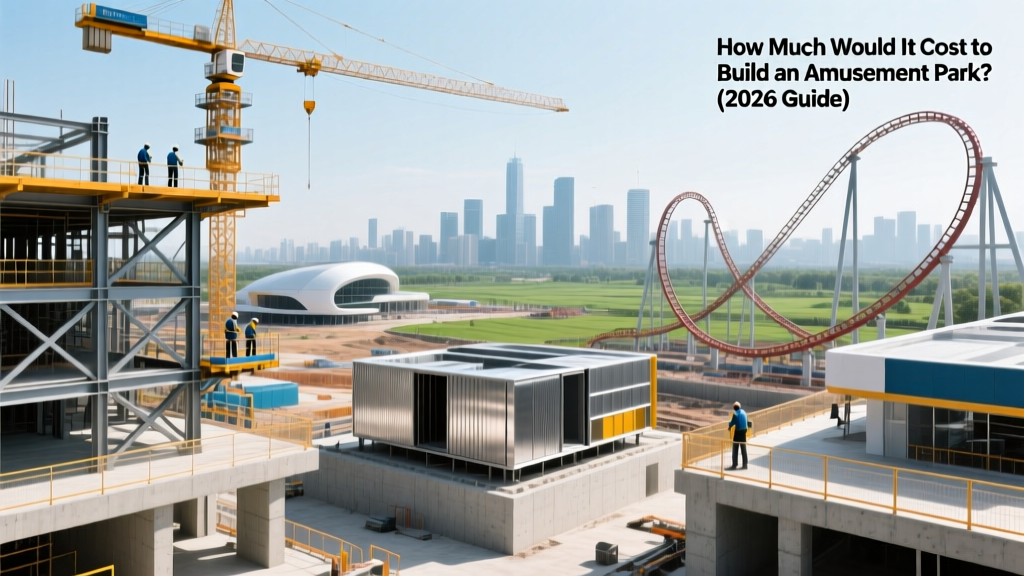
The Amusement Park Cost Calculator: Sizing Your Scope
Estimating the capital expenditure for a new amusement park requires moving far beyond simple per-square-foot commercial construction metrics. Unlike standard retail or warehouse developments, theme parks are highly specialized environments where heavy civil engineering intersects with bespoke entertainment manufacturing. According to the International Association of Amusement Parks and Attractions (IAAPA), modern park development costs are heavily dictated by the intended market capture, intellectual property (IP) integration, and the thrill-threshold of the ride portfolio.
To accurately determine how much it would cost to build an amusement park, developers must utilize a size and scope calculator that segments projects into three distinct tiers. This framework accounts for 2026 material costs, specialized ride manufacturer pricing, and the massive hidden infrastructure required to support thousands of daily guests.
- Tier 1 (FEC / Micro-Park): $20 Million – $75 Million (10–30 Acres)
- Tier 2 (Regional Theme Park): $150 Million – $600 Million (50–150 Acres)
- Tier 3 (Mega-Destination Resort): $1.5 Billion – $3.5+ Billion (300+ Acres)
Tier 1: Family Entertainment Centers & Micro-Parks (10–30 Acres)
Small-scale parks and Family Entertainment Centers (FECs) focus on high-capacity, low-footprint attractions. These projects typically avoid massive earthworks and custom steel coasters, relying instead on catalog flat rides and standard dark rides. Site work for a 20-acre FEC in 2026 averages $2.5M to $4M per acre, heavily dependent on local grading requirements and utility tap fees.
Typical Attraction Portfolio & Costs
- Family Carousels & Scramblers: Manufacturers like Bertazzon or Zamperla offer catalog models ranging from $600,000 to $1.2M, including installation and standard theming.
- Go-Kart Tracks: Elevated electric kart tracks (e.g., from K1 Speed or similar commercial suppliers) cost between $150 and $250 per linear foot, including the rail system, pit area, and charging infrastructure.
- Interactive Dark Rides: Trackless or guided-track interactive shooters (using suppliers like Sally Dark Rides or ETF Ride Systems) start around $8M for a 10,000-square-foot show building, scaling up to $15M with advanced animatronics and projection mapping.
Tier 2: Regional Theme Parks (50–150 Acres)
Regional parks compete on a multi-state level and require a signature thrill portfolio to drive season pass sales. The construction cost shifts dramatically here, as custom-engineered roller coasters and heavily themed immersive lands become mandatory. Land acquisition and heavy civil site work (retention ponds, massive parking structures, and arterial road realignment) often consume 25% to 30% of the total budget before a single ride footer is poured.
Major Attraction Pricing Matrix (2026 Estimates)
The cost of a roller coaster is not just the track and trains; it includes the control building, queue integration, and specialized foundations. Below is a breakdown of standard regional park anchor attractions.
| Ride Category | Manufacturer Examples | Estimated 2026 Cost Range | Foundation & Site Impact |
|---|---|---|---|
| Wooden Terrain Coaster | Great Coasters Int'l (GCI), The Gravity Group | $6M – $12M | Shallow spread footings; massive timber footprint. |
| Steel Wing / Dive Coaster | Bolliger & Mabillard (B&M) | $18M – $26M | Deep pile foundations required for high-G inversions. |
| Hybrid I-Box Coaster | Rocky Mountain Construction (RMC) | $10M – $16M | Requires demolition/retrofit of existing wood or new steel bases. |
| Launched Intamin Mega | Intamin, Mack Rides | $22M – $35M+ | Massive power draw; requires dedicated substations and catch cars. |
| Water Flume / Log Ride | Hopkins, Mack Rides | $8M – $14M | Requires 500k+ gallon water treatment and filtration vaults. |
Tier 3: Mega-Destination Resorts (300+ Acres)
Building a mega-destination on the scale of Universal Epic Universe or Disney's newer international gates pushes budgets into the billions. At this scope, the cost to build an amusement park is dominated by subterranean infrastructure (utilidors), IP licensing fees, and on-site hotel ecosystems. Themed facades in these parks are not simple fiberglass skins; they are structural steel and glass-fiber reinforced concrete (GFRC) buildings designed to withstand hurricane-force winds while looking like ancient ruins or futuristic cities. Themed concrete pathways (stamped, scored, and chemically stained) in these environments cost between $22 and $35 per square foot, vastly exceeding standard commercial flatwork.
Hidden Infrastructure & Heavy Civil Costs
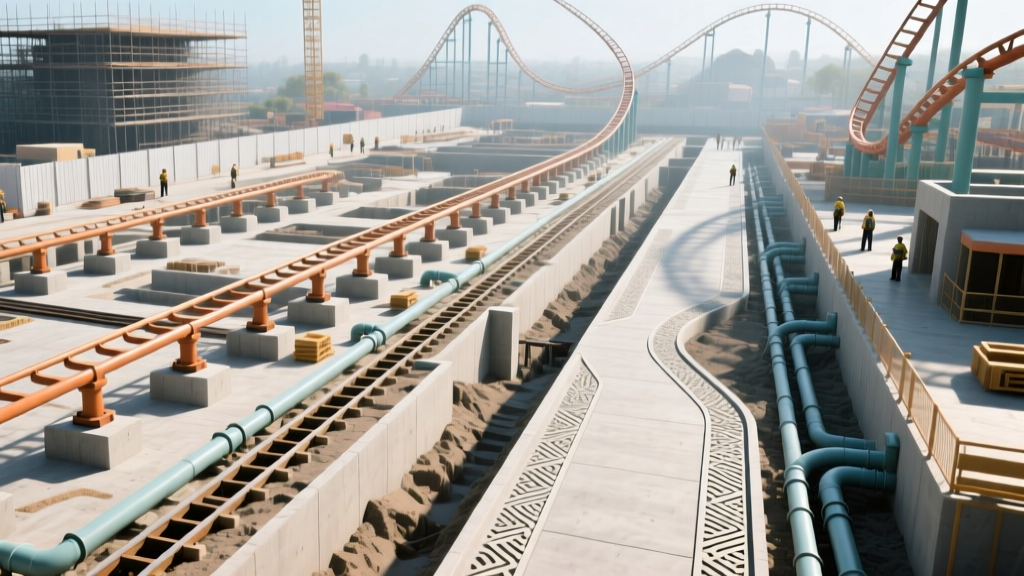
The most common failure point in amusement park financial modeling is underestimating the "invisible" infrastructure. A 100-acre regional park operating at peak capacity with multiple high-draw coasters and water rides requires a municipal-grade utility grid.
A single modern launched coaster can draw upwards of 3 to 5 megawatts (MW) of instantaneous power during the launch sequence. A mid-sized park typically requires a dedicated 15MW to 25MW electrical substation. Budget $4M to $8M for substation construction, high-voltage trenching, and utility easement acquisition before considering the park's internal distribution network.
Essential Site Work Line Items
- Soil Stabilization & Micropiling: If the site features karst topography or high water tables, ride footers (especially for 200-foot-tall coasters) require deep friction piles. Expect to add $2M–$5M for specialized geotechnical engineering and piling.
- Queue Shade Structures: Modern parks mandate shaded switchback queues. Tensile fabric structures (using materials like Serge Ferrari or HDPE shade sails) cost $45 to $75 per square foot installed, including steel cantilever supports.
- Water Treatment Facilities: Log flumes and rapids rides require commercial-grade filtration (e.g., Neptune-Benson systems). A single major water ride requires a $1M+ pump house and UV/ozone sanitation vault to meet local health department codes.
Regulatory Compliance and ASTM Safety Standards
Amusement park construction is strictly governed by the ASTM F24 Committee on Amusement Rides and Devices. Compliance is not an afterthought; it dictates material selection and engineering tolerances from day one. For example, all structural steel on roller coasters must undergo Non-Destructive Testing (NDT), such as ultrasonic and magnetic particle inspection, on 100% of critical welds. Furthermore, ride control systems must utilize dual-redundant, fail-safe PLCs (Programmable Logic Controllers) that meet specific SIL (Safety Integrity Level) ratings. Budget an additional 4% to 7% of the total ride hardware cost specifically for third-party engineering peer reviews, NDT testing, and state-level permitting inspections.
Phasing Strategy: The Smart Way to Fund Expansion
According to Blooloop industry analysis, the most financially viable approach to building a new theme park in the current economic climate is aggressive phasing. Rather than opening a 100-acre park all at once, developers are building a 40-acre "Gate 1" with high-capacity infrastructure (oversized water mains, extra electrical capacity, and paved expansion pads). This reduces initial capital exposure while allowing the park to generate operating cash flow to fund Gate 2. When calculating your scope, always design the central utility hub to handle 150% of the opening-day load to prevent multi-million-dollar retrofitting costs during phase two.
Frequently Asked Questions
How long does it take to build a regional amusement park?
From initial land clearing to the ribbon-cutting, a 100-acre regional park typically requires 30 to 42 months of active construction. Major roller coasters alone require 12 to 18 months for foundation curing, track erection, and test cycling.
What is the most expensive part of building a theme park?
While signature rides are expensive, heavy civil site work (grading, drainage, utilities) and themed show buildings (which require complex HVAC and acoustic treatments) often consume the largest share of the budget in highly immersive parks.
Do I need to pay for IP licensing to build a park?
No. Original IP or generic themes (e.g., "Wild West" or "Space") avoid licensing fees. However, licensing recognizable movie or cartoon franchises can cost millions in upfront guarantees plus 5% to 10% of gross merchandise and food revenue within that themed land.
Written by
Elena RodriguezElena Rodriguez is a civil engineer and technical writer specializing in concrete technology, masonry systems, and ASTM/ACI compliance. She earned her B.S. in Civil Engineering from Texas A&M University and spent a decade at a materials testing laboratory, performing over 2,000 concrete compressive strength tests and masonry prism evaluations. Elena is an ACI-certified Field Testing Technician (Grade I) and a member of ASTM Committee C12 on Natural Building Stone. She currently consults on forensic engineering cases involving concrete failures and moisture intrusion. Based in San Antonio, TX, Elena is a proud member of the Society of Women Engineers (SWE) and coaches her daughter's FIRST Robotics team.
More from Elena Rodriguez
View all
Walls & Panels
Cost Analysis: Light Gauge Steel Framing Advantages and Disadvantages
Evaluate light gauge steel framing advantages and disadvantages through a strict cost analysis lens, comparing material, labor, and lifecycle expenses.
Aug 4, 2026

Walls & Panels
Gypsum Board Types: Exact Specifications, Thickness & Dimensions
Compare standard, Type X, and moisture-resistant gypsum board types. Get exact specifications, thicknesses, dimensions, and ASTM standards for your project.
Aug 4, 2026

Fire Resistance
Best Fire-Resistant Outdoor Decking Materials: 2026 Buyer Guide
Discover the best fire-resistant outdoor decking materials for 2026. Compare Class A PVC, aluminum, and hardwood options for WUI compliance and safety.
Aug 4, 2026