Cost to Build a Basic AR-15 From Parts: 2026 Regional Price Guide
Analyze the true cost to build a basic AR-15 from parts in 2026. Compare regional pricing, FFL fees, compliance costs, and tooling across US states.
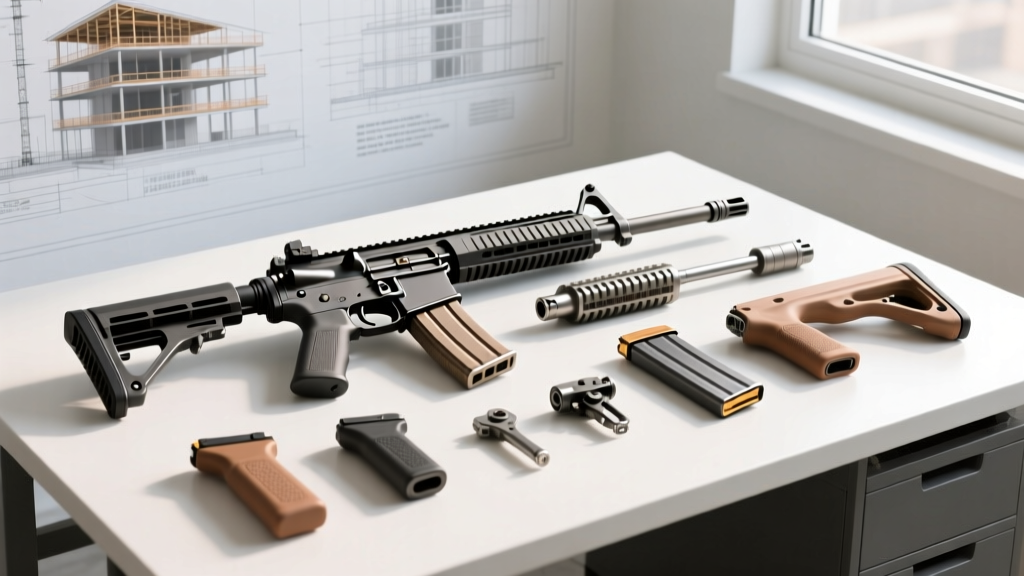
The Baseline: National Average Bill of Materials (BOM)
While forum archives and search trends show massive historical interest in the cost to build basic ar-15 from parts 2024, the economic reality of 2026 requires a highly localized approach. Inflation in CNC machining sectors, shifts in freight logistics, and evolving state-level compliance mandates mean a single national average is virtually useless for precise budgeting. To establish a baseline, we must first look at the raw component costs before regional modifiers are applied.
The following Bill of Materials (BOM) represents a reliable, entry-level 16-inch 5.56 NATO direct-impingement build using reputable, non-boutique manufacturers (e.g., Aero Precision, BCM, Faxon Firearms). Prices reflect Q1 2026 retail averages.
| Component | Example Model | 2026 Avg. Price |
|---|---|---|
| Stripped Lower Receiver | Aero Precision M4E1 | $110 - $130 |
| Stripped Upper Receiver | Aero Precision M4E1 | $75 - $95 |
| Lower Parts Kit (LPK) | BCM w/ Enhanced Trigger | $85 - $115 |
| Bolt Carrier Group (BCG) | BCM Gunfighter (MPI) | $135 - $160 |
| Barrel (16" 5.56 NATO) | Faxon Gunner Profile | $150 - $180 |
| Handguard (15" M-LOK) | Bravo Company MCMR | $90 - $120 |
| Buffer Tube Assembly | Magpul MOE Mil-Spec Kit | $55 - $75 |
| Charging Handle | Radian Raptor-SD | $45 - $60 |
| Muzzle Device | BCM Gunfighter Compensator | $35 - $45 |
| Total Base Parts | $780 - $980 |
This $780–$980 range is your starting point. However, where you physically reside will dictate the final out-the-door price, sometimes adding upwards of 30% to the total build cost.
Regional Price Variations: Where You Live Dictates Your Build
The United States operates as a patchwork of firearm regulations and tax structures. Building from parts does not bypass state-level restrictions; the lower receiver is legally the firearm and must be routed through a Federal Firearms License (FFL) holder, triggering local point-of-sale laws.
The Compliance-Heavy West Coast & Northeast
Builders in California, New York, New Jersey, and Washington face severe financial penalties disguised as compliance requirements. In California, for example, standard AR-15 configurations are restricted. Builders must opt for a "Featureless" build or use a magazine lock.
- Magazine Locks (e.g., Patriot Mag Release): Adds $40–$60 and requires specialized LPK pins.
- Fin Grips / Featureless Stocks: Sparc Industries AFG or Thorsden Customs stock adds $60–$150.
- Fixed Magazine Hardware: Requires modifying the lower receiver or buying specialized takedown pins ($25).
- Mandatory Safety Certificates & DROS Fees: California's Dealer Record of Sale (DROS) fee adds $37.19, plus the FFL's transfer fee.
According to the NRA-ILA State Gun Laws database, these restricted states also cap magazine capacities (usually 10 rounds), meaning standard 30-round PMAGs cannot be shipped to your local FFL, forcing builders to purchase compliant, restricted-capacity magazines at a premium.
The Gun-Friendly South & Midwest
States like Texas, Florida, Arizona, and Ohio represent the most cost-effective environments for an AR-15 parts build. Without the need for featureless compliance parts, builders can utilize standard MIL-SPEC LPKs, standard pistol grips, and telescoping stocks (like the Magpul CTR). Furthermore, these states often host major industry distributors. Proximity to Primary Arms (Texas) or Palmetto State Armory (South Carolina) frequently results in free or heavily subsidized ground shipping on heavy items like barrels and receiver sets, saving $40–$80 in freight costs compared to West Coast buyers.
Hidden Variables: FFL Fees, Taxes, and Freight
When ordering parts online, only the stripped lower receiver legally requires an FFL transfer. The upper receiver, barrel, and LPK can be shipped directly to your door. This creates a distinct regional pricing split.
FFL Transfer Fees
Your local gun store charges a fee to process the lower receiver. In competitive, gun-friendly markets (Midwest/South), FFL transfer fees average $20 to $30. In highly regulated, high-overhead markets (Northeast/West Coast), FFLs charge $80 to $150 to handle the paperwork, background checks, and mandatory waiting periods that tie up their inventory space.
State and Local Sales Tax
A $130 lower receiver bought online is subject to your local FFL's point-of-sale tax rate. A builder in Portland, Oregon (0% sales tax) saves $10+ on the lower alone compared to a builder in Los Angeles (9.5%+ sales tax). When factoring in the total build cost, a 10% tax variance on a $1,000 project shifts the budget by $100.
Data Highlight: The True Out-The-Door Cost
Standard Build in Houston, TX: $850 (Parts) + $25 (FFL) + $70 (8.25% Tax on Lower) + $0 (Compliance) = $945 Total
Featureless Build in Los Angeles, CA: $960 (Parts + Compliance hardware) + $110 (FFL + DROS) + $95 (9.5% Tax on Lower) = $1,165 Total
Result: The exact same functional rifle costs 23% more to assemble in California due to regional legislative and tax friction.
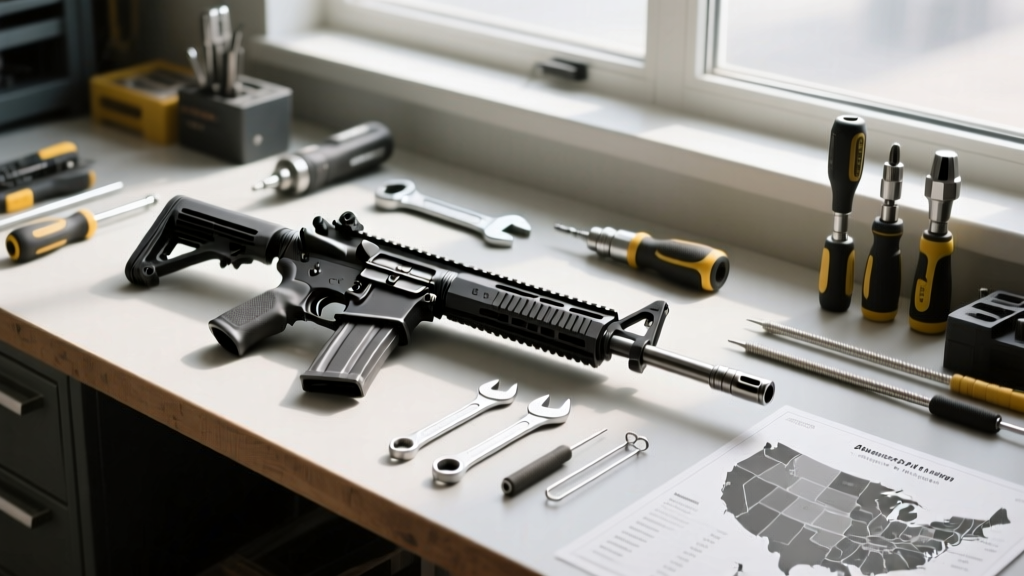
Armorer Tooling: The Upfront Regional Investment
You cannot assemble an AR-15 safely without specific armorer tools. While general hardware stores carry basic wrenches, specialized gunsmithing tools must be sourced from industry suppliers like Brownells Gunsmithing Tools. Regional availability is virtually zero outside of specialized online retailers, meaning shipping times and costs for heavy tools (like bench vises) apply universally.
- AR-15 Armorer's Wrench (e.g., Geissele or Brownells): $35 - $65. Mandatory for installing the castle nut and muzzle device.
- Upper Receiver Rod / Vise Block: $25 - $50. Prevents receiver ear shearing when torquing the barrel nut to 35-80 ft/lbs.
- Roll Pin Punch Set: $15 - $30. Standard punches will slip and mar the lower receiver when installing the bolt catch roll pin.
- Beam-Style Torque Wrench (1/2" drive): $40 - $60. Critical for timing the muzzle device and securing the handguard.
- Heavy Duty Bench Vise: $60 - $150. Required to hold the vise block securely.
Total Tooling Investment: $175 – $355. This is a sunk cost for your first build, but drops to $0 for subsequent builds.
Federal Manufacturing Regulations & Legal Framework
Before ordering parts, builders must understand federal boundaries. According to the Bureau of Alcohol, Tobacco, Firearms and Explosives (ATF), unlicensed individuals may manufacture firearms for personal use without a license, provided they are not prohibited persons and do not intend to sell the firearm.
However, the ATF strictly prohibits the assembly of rifles with foreign-made parts kits that exceed the 10 imported parts limit under 18 U.S.C. § 922(r). When sourcing budget barrels, bolts, or lower parts kits from overseas surplus vendors, builders must ensure their parts count remains compliant. Sticking to domestic manufacturers like BCM, Aero Precision, and Daniel Defense inherently bypasses 922(r) compliance headaches.
Strategic Sourcing Framework for 2026
To minimize regional cost penalties, execute your build using this phased purchasing strategy:
- Phase 1: Direct-to-Consumer Heavy Freight. Order the upper receiver, barrel, handguard, and buffer tube assembly directly to your home. These parts do not require an FFL. Look for free-shipping thresholds from major online retailers to absorb the heavy freight costs of steel barrels.
- Phase 2: The FFL-Routed Lower. Purchase the stripped lower receiver and have it shipped to a local FFL with a pre-negotiated, flat-rate transfer fee. Call the FFL before buying to confirm their current transfer fee and waiting period policies.
- Phase 3: Small Parts Consolidation. Buy the LPK, BCG, charging handle, and muzzle device in a single consolidated order to minimize multiple shipping charges. If you live in a restricted state, add your mag-lock or fin-grip hardware to this specific cart to ensure all compliance parts arrive simultaneously.
By decoupling the heavy, non-regulated components from the serialized lower receiver, builders in high-tax, high-freight states can effectively shave 10% to 15% off their total build cost, bringing the 2026 reality closer to the national baseline.
Written by
David NakamuraDavid Nakamura is a licensed architect (AIA) and construction technology writer focused on sustainable building methods, mass timber engineering, and high-performance building envelopes. He holds a Master of Architecture from the University of Washington and is a certified Passive House Consultant (CPHC). David spent eight years at the Seattle firm Mithun, where he led the design of three LEED Platinum projects, before founding his own practice specializing in net-zero residential design. He serves on the editorial advisory board of GreenBuilder Magazine and has authored peer-reviewed papers on cross-laminated timber (CLT) connections for the Journal of Structural Engineering. In his spare time, David teaches woodworking at Pratt Fine Arts Center and kayaks the Puget Sound.
More from David Nakamura
View all
Construction Cost
Labor Cost to Build a Deck Per Sq Ft: 2026 Installation Guide
Discover the exact labor cost to build a deck per sq ft in 2026. This installation guide breaks down contractor rates, complexity factors, and hidden fees.
Aug 4, 2026

Construction Cost
How Much Does It Cost to Build a 3 Bedroom House? Financing Guide
Learn exactly how much it costs to build a 3 bedroom house and explore 2026 financing options, construction loan types, and budget frameworks for your build.
Aug 4, 2026

Construction Cost
Cost to Build a Tennis Court: 2026 Guide
How much does it cost to build a tennis court in 2026? Breakdowns for asphalt, concrete, and synthetic surfaces plus fencing and lighting.
Jul 30, 2026