How Much Does It Cost to Build a Basketball Court? Budget Guide
Discover how much it costs to build a basketball court. Explore pricing for concrete, asphalt, and sport tiles, plus labor and site prep budgets.
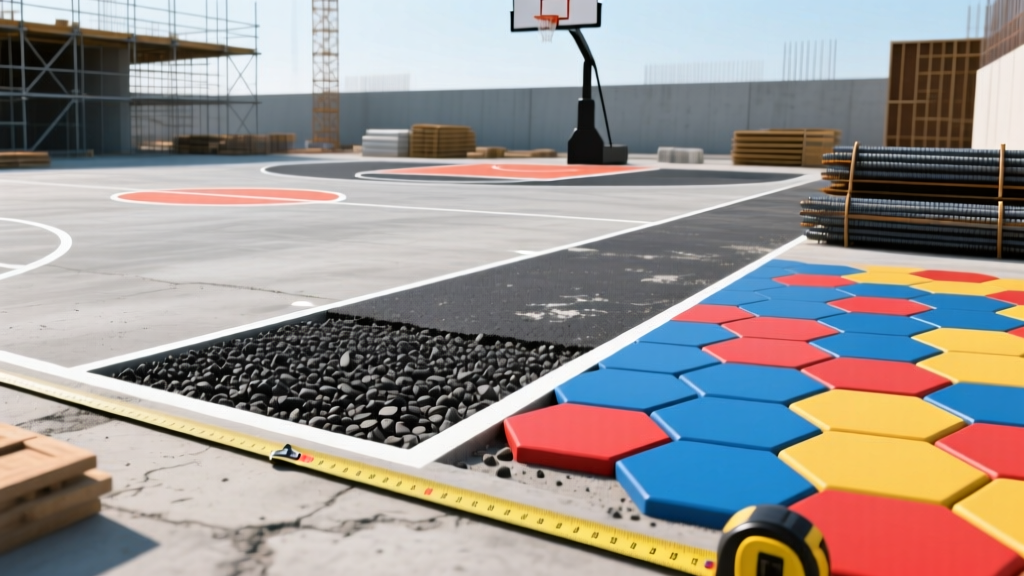
The True Cost of Building a Basketball Court: A Budget Planner's View
When calculating how much it costs to build a basketball court, the final price tag is dictated by three primary variables: site topography, surface material, and perimeter accessories. For a standard residential full court (84 feet by 50 feet, totaling 4,200 square feet), total construction costs typically range from $18,500 to $48,000. A half-court (30 feet by 40 feet, totaling 1,200 square feet) generally costs between $7,500 and $19,000. These figures encompass excavation, base preparation, surfacing, and standard equipment installation.
Quick Budget Summary (2026 Averages)
- Half-Court (1,200 sq ft): $7,500 – $19,000
- Full-Court (4,200 sq ft): $18,500 – $48,000
- Concrete Pad Base: $6 – $10 per sq ft
- Acrylic Sport Surfacing: $2.50 – $4.50 per sq ft
- Modular Tile Overlay: $3.00 – $5.50 per sq ft (materials only)
Site Preparation and Base Construction Costs
The most frequent cause of budget overruns in court construction is inadequate site preparation. A basketball court requires a perfectly level, stable subgrade to prevent cracking and water pooling. If your lot is sloped, you will need to factor in cut-and-fill earthwork or the construction of retaining walls.
Excavation and Grading
Expect to pay between $1,500 and $4,000 for site clearing and rough grading. The soil must be compacted to a minimum of 95% Modified Proctor density. If the native soil is highly expansive (such as heavy clay), contractors will need to excavate an additional 6 to 12 inches and import a structural fill, adding $2.00 to $3.50 per cubic yard for engineered fill material.
Expert Insight: Never skip the soil compaction test. According to guidelines from the American Sports Builders Association (ASBA), improper subgrade compaction is the leading cause of differential settlement in asphalt and concrete sports courts, resulting in structural cracks that are nearly impossible to repair permanently.
The Aggregate Base
Before pouring concrete or laying asphalt, a 4-inch to 6-inch base of crushed angular aggregate (typically 3/4-inch minus gravel) must be spread and mechanically compacted. This base ensures proper drainage and load distribution. Budget approximately $1.20 to $1.80 per square foot for the aggregate base installation.
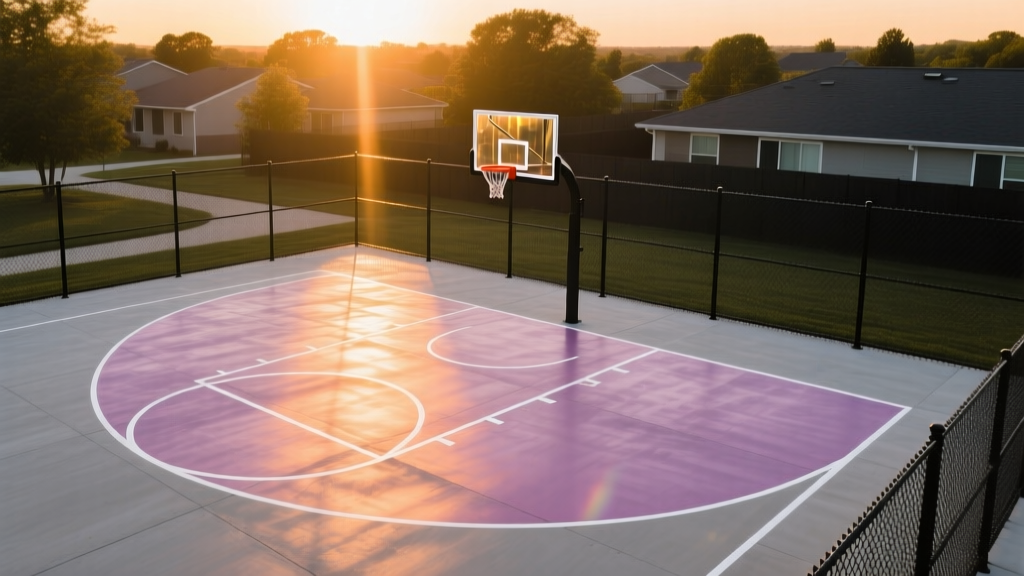
Surface Material Comparison Matrix
The playing surface is the largest line item in your budget. While bare concrete is an option, it lacks the necessary traction and shock absorption for safe play, making a specialized coating or overlay mandatory for a proper court.
| Surface System | Total Installed Cost (per sq ft) | Lifespan | Maintenance Level | Best Use Case |
|---|---|---|---|---|
| Concrete + Acrylic Coat | $9.00 – $14.50 | 20–30 years | Low (Reseal every 5 yrs) | Permanent residential courts |
| Asphalt + Acrylic Coat | $7.50 – $11.00 | 12–15 years | Medium (Crack filling) | Budget-conscious full courts |
| Concrete + Modular Tiles | $11.50 – $17.00 | 15–20 years (tiles) | Very Low | High-traffic, multi-sport courts |
Deep Dive: The Concrete Standard
For a permanent residential court, a 4-inch thick concrete slab is the industry standard. The mix design should be a minimum of 4,000 PSI air-entrained concrete (air entrainment is critical in freeze-thaw climates to prevent surface spalling). The slab must include fiber mesh reinforcement and be finished with a medium broom texture to provide a mechanical key for the acrylic surfacing system. Control joints should be saw-cut every 10 to 12 feet in a grid pattern to control shrinkage cracking. Brands like Plexipave or SportMaster offer multi-layer acrylic systems that include a cushion layer, color coats, and a UV-stable finish line paint, adding roughly $2.50 to $4.50 per square foot over the bare concrete cost.
Deep Dive: Modular Polypropylene Tiles
If you want superior shock absorption and a professional aesthetic, modular interlocking tiles (such as those manufactured by VersaCourt) are the premium choice. These tiles cost between $3.00 and $5.50 per square foot for the materials alone. However, they require an impeccably flat concrete substrate. If your existing driveway or pad has a variance greater than 1/4 inch over 10 feet, the tiles will flex, causing premature wear and an inconsistent ball bounce.
Hoop Systems, Fencing, and Lighting
A court is not functional without the perimeter and scoring infrastructure. These elements can account for 20% to 30% of your total budget.
In-Ground Hoop Systems
Avoid portable bases for dedicated courts; they encroach on the playing surface and lack stability. Budget $1,800 to $4,500 for a high-quality in-ground system featuring a 42-inch or 48-inch tempered glass backboard and a 4-inch Schedule 40 steel main pole. Premium models like the Goalrilla G1000 or MegaSlam 60 require a concrete anchor foundation measuring roughly 4 feet deep and 2 feet wide, which must cure for 72 hours before pole erection.
Perimeter Fencing
To keep the ball in play and protect adjacent landscaping, a 10-foot high fence is standard. Black or dark green vinyl-coated 9-gauge chain link is the preferred material because it minimizes visual glare and blends into the landscape. Expect to pay $22 to $35 per linear foot for a fully installed 10-foot chain link fence, including heavy-duty 2.5-inch terminal posts set in concrete.
Court Lighting
For evening play, you need a dedicated LED lighting package. A standard residential court requires four to six 20-foot to 30-foot poles equipped with LED fixtures delivering 30 to 50 foot-candles of illumination. Modern LED systems draw significantly less power than older metal halide fixtures and eliminate the warm-up time. A complete 4-pole LED package, including trenching for electrical conduit and panel installation, typically costs between $6,000 and $12,000.
Hidden Costs and Edge Cases in Court Construction
When finalizing your budget, allocate a 15% contingency fund for the following common edge cases:
- Retaining Walls: If your yard has a slope greater than 5%, you will need engineered retaining walls. Segmental block walls cost $35 to $60 per square foot of face area.
- Drainage Systems: A French drain or trench drain system along the perimeter of the court is essential if the court is situated at the bottom of a slope. Budget $40 to $75 per linear foot for trench drains with heavy-duty grates.
- Utility Rerouting: If your chosen site intersects with underground sprinkler lines, gas lines, or electrical conduits, rerouting these utilities can add $1,500 to $5,000 to the project.
- Permitting and HOA Fees: Municipal grading and electrical permits typically range from $250 to $800. Homeowners Associations may require architectural review fees or specific aesthetic upgrades (like masonry fence columns) that increase costs.
Step-by-Step Budget Allocation Framework
To ensure your funds are distributed correctly across the project phases, use this percentage-based allocation framework for a standard $30,000 full-court build:
- Site Prep, Grading, and Base (25% | $7,500): Earthmoving, compaction, and aggregate base.
- Concrete Slab and Surfacing (45% | $13,500): Forming, pouring, finishing, and acrylic coating.
- Fencing and Containment (15% | $4,500): Perimeter chain link and gates.
- Hoop System and Anchoring (8% | $2,400): Equipment purchase and concrete footer installation.
- Lighting and Electrical (7% | $2,100): Basic LED package and conduit trenching.
Frequently Asked Questions
Can I build a basketball court over an existing driveway?
Yes, provided the existing driveway is structurally sound, free of major cracks, and has a minimum thickness of 4 inches. You will need to power wash the surface, apply a crack-filling membrane, and then install your acrylic surfacing or modular tiles. This approach saves the $6,000 to $10,000 cost of pouring a new concrete base.
How long does the construction process take?
From initial excavation to the final coat of paint, a full-court build typically takes 3 to 5 weeks. The longest phase is often the concrete curing process, which requires a minimum of 7 to 14 days before acrylic surfacing can be applied to ensure all excess moisture has evaporated from the slab.
Does adding a basketball court increase property value?
According to real estate appraisers and data aggregated by Angi, a well-constructed, professionally surfaced sports court can increase a home's resale value, particularly in family-oriented suburban neighborhoods. However, the return on investment (ROI) rarely exceeds 50% to 70% of the construction cost; the primary value is in the lifestyle enhancement and marketability of the home.
Written by
James ThorntonJames Thornton is a construction industry veteran with 25 years of hands-on experience in wood framing, lumber grading, and residential building codes. He started as a framing carpenter in rural Oregon, earned his ICC Residential Building Inspector certification, and eventually became a senior plan reviewer for the City of Portland Bureau of Development Services. James holds a B.S. in Wood Science & Technology from Oregon State University and is a certified lumber grader through the West Coast Lumber Inspection Bureau (WCLIB). He has inspected over 3,000 residential construction sites and authored the city's internal guide on advanced framing techniques (2x6 at 24" O.C.). James lives in Bend, OR, where he builds custom timber-frame cabins and competes in lumberjack sports.
More from James Thornton
View all
Insulation
Best Home Insulation Materials: Complete 2026 Guide
Compare top home insulation materials for 2026. Find R-values, installed costs per square foot, and best uses for fiberglass, spray foam, and mineral wool.
Aug 4, 2026

Sustainable Building
Certify Your Green Building Material for LEED and WELL
Step-by-step guide to certifying a green building material for LEED v5 and WELL v2. Master EPDs, HPDs, and VOC limits for 2026 project specifications.
Aug 4, 2026

Stone & Masonry
Veneer Stacked Stone Panels: Interior Design & Style Showcase
Discover how veneer stacked stone panels transform interiors. Explore modern design profiles, material pairings, and technical installation specs.
Aug 4, 2026