How Much Does It Cost to Build a House in California? Regional Guide
Discover how much it costs to build a house in California across different regions. Get 2026 pricing data, material costs, and labor rates.
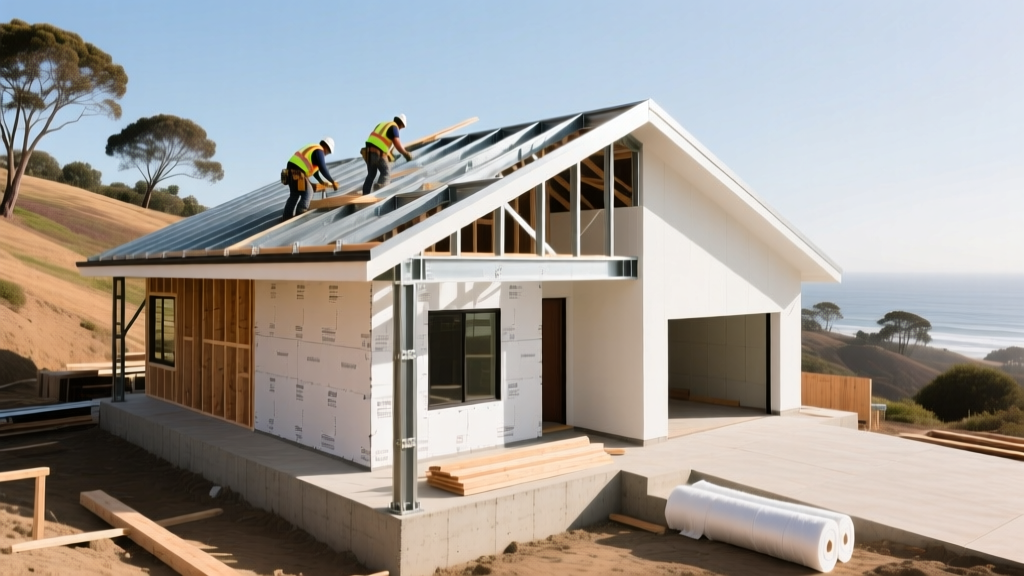
The Baseline: California Statewide Construction Averages
Calculating exactly how much it costs to build a house in California requires moving past national averages. While the U.S. median for custom home construction hovers around $150 to $200 per square foot, California's baseline starts significantly higher. As of 2026, the statewide average for a custom, single-family home ranges from $400 to $650 per square foot for hard construction costs. For a standard 2,500-square-foot residence, this translates to a baseline budget of $1,000,000 to $1,625,000 before factoring in land acquisition and soft costs.
Statewide Cost Snapshot (2,500 Sq. Ft. Custom Home)
- Hard Costs (Materials & Labor): $1,000,000 – $1,625,000
- Soft Costs (Permits, Design, Fees): $150,000 – $350,000
- Site Prep & Foundation: $45,000 – $110,000
- Total Estimated Build Cost: $1,195,000 – $2,085,000
Regional Cost Matrix: Northern vs. Southern vs. Coastal
California is not a monolith; labor rates, material logistics, and municipal impact fees vary drastically by county. The following matrix breaks down the regional cost per square foot and the primary economic drivers inflating those numbers.
| Region | Avg Cost / Sq. Ft. | Total (2,500 Sq. Ft.) | Key Cost Drivers |
|---|---|---|---|
| Bay Area / Silicon Valley | $600 – $850+ | $1.5M – $2.12M+ | Union labor premiums, extreme impact fees, seismic engineering. |
| SoCal Coastal (LA, SD, OC) | $550 – $750 | $1.37M – $1.87M | Coastal commission permits, high-end finish expectations, logistics. |
| Inland Empire / Sacramento | $350 – $500 | $875K – $1.25M | WUI fire codes, expansive soil foundations, rising material transport. |
| Central Valley / Rural North | $300 – $425 | $750K – $1.06M | Lower labor rates, well/septic requirements, agricultural zoning limits. |
Breaking Down the Hard Costs: Materials and Specialized Labor
Understanding how much it costs to build a house in California requires a granular look at hard costs, which typically consume 75% to 80% of the total construction budget.
Lumber, Concrete, and Steel Pricing
Material costs in California are subject to both global supply chain dynamics and state-specific freight surcharges. Framing lumber (SPF #2 or better) for a 2,500-square-foot home currently averages $45,000 to $65,000. However, many California builders are shifting toward cold-formed steel (CFS) framing for exterior walls to meet Wildland-Urban Interface (WUI) fire codes, which adds a 12% to 18% premium over traditional wood framing but drastically reduces insurance premiums.
Concrete pricing is heavily influenced by regional plant density. In the Bay Area, ready-mix concrete can exceed $180 per cubic yard due to environmental compliance costs at local batch plants, whereas Central Valley suppliers may charge closer to $135 per cubic yard. For a standard post-tension slab foundation requiring 120 cubic yards, the material cost alone ranges from $16,200 to $21,600.
Specialized Labor Rates by Trade
Labor represents the most volatile variable in California construction. According to the U.S. Bureau of Labor Statistics, California consistently ranks highest in the nation for construction wages. In highly regulated markets like San Francisco or Los Angeles, prevailing wage requirements on certain developments and strong union presence push rates higher.
- General Framers: $45 – $75 per hour
- Licensed Electricians: $85 – $140 per hour
- Master Plumbers: $90 – $150 per hour
- HVAC Technicians: $75 – $125 per hour
When calculating labor, factor in a 30% to 40% burden rate for workers' compensation, liability insurance, and payroll taxes, which are notably expensive in the state's construction sector.
Soft Costs and California's Regulatory Hurdles
Soft costs in California routinely account for 20% to 25% of the total project budget, significantly higher than the national average of 10% to 15%. This is driven by stringent environmental reviews, discretionary design reviews, and municipal impact fees.
"In many coastal and Bay Area municipalities, school district fees, park dedication fees, and utility connection charges alone can exceed $80,000 for a single-family lot before a single shovel hits the dirt. Always request a preliminary fee schedule from the local building department during the feasibility phase."
Title 24 and Energy Mandates
California's Building Energy Efficiency Standards (Title 24) mandate that most new low-rise residential buildings include a solar photovoltaic (PV) system sized to offset annual electrical usage. According to the California Energy Commission, the 2022 standards (which continue to dictate 2026 builds until the next code cycle) require high-efficiency insulation, dual-pane low-E windows with a U-factor of 0.28 or lower, and mandatory heat pump water heaters. Budget an additional $25,000 to $40,000 for the solar array and battery storage integration (like the Tesla Powerwall) to achieve full Title 24 compliance and net-zero readiness.
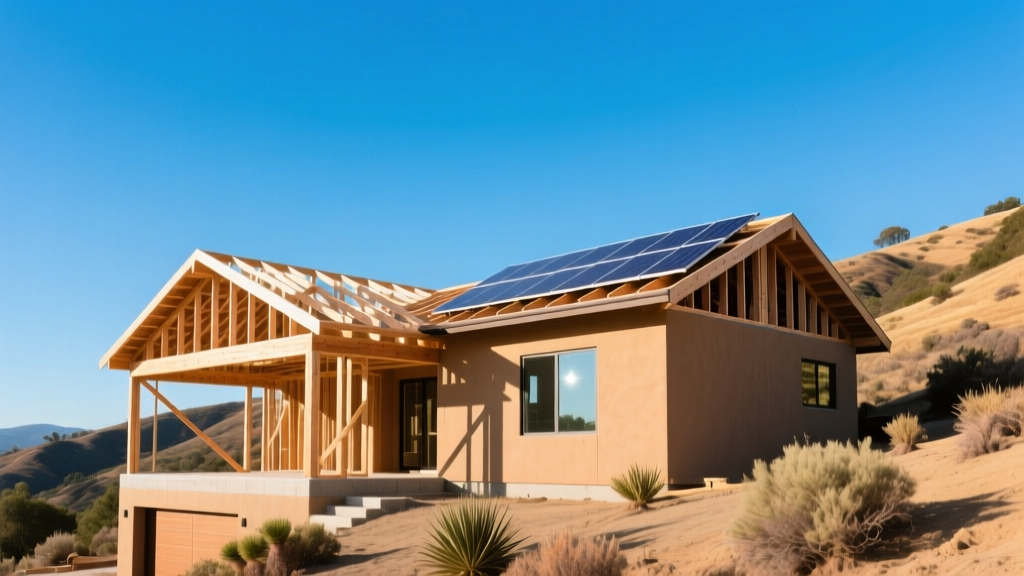
Wildfire Zone (WUI) Construction Premiums
If your build is located in a State Responsibility Area (SRA) or a designated Very High Fire Hazard Severity Zone (VHFHSZ), you must comply with California Building Code Chapter 7A. The Office of the State Fire Marshal enforces strict material standards for WUI compliance, which fundamentally alters the material cost baseline.
⚠️ WUI Material Upgrades & Cost Impact
- Roofing: Must be Class A fire-rated. Clay tile or standing seam metal roofing is required, adding $12,000 to $22,000 compared to architectural asphalt shingles.
- Siding: Combustible wood siding is prohibited. Builders must use fiber cement (e.g., James Hardie), stucco, or masonry, adding $8,000 to $15,000 to exterior cladding costs.
- Vents: All attic and crawlspace vents must be ember-resistant (e.g., Vulcan Vents or Brandguard), costing $150 to $250 per unit installed.
- Defensible Space: Landscaping and hardscaping to create a 5-foot non-combustible zone around the structure adds $5,000 to $12,000 in site work.
Actionable Strategies to Reduce California Build Costs
While you cannot control municipal fees or baseline labor rates, strategic design and material selections can compress your budget without sacrificing structural integrity or code compliance.
- Optimize the Footprint: Build up, not out. A two-story home with a 1,250 sq. ft. footprint requires 50% less foundation, 50% less roofing, and significantly less trenching for utilities than a single-story ranch of the same square footage. This alone can save $60,000 to $90,000 in hard costs.
- Utilize Prefabricated Wall Panels: Cold-formed steel or precision-cut wood wall panels manufactured off-site reduce framing labor time by up to 30%. In high-wage markets like San Jose, shaving three weeks off the framing schedule saves tens of thousands in general conditions and labor burden.
- Plumbing Core Consolidation: Design your floor plan to share a central plumbing wall between the kitchen, laundry, and primary bathroom. Reducing the total linear feet of PEX or copper piping and minimizing wall chases reduces both material and plumber hours.
- Advanced Framing Techniques (OVE): Optimum Value Engineering (OVE) or 2x6 framing at 24 inches on-center reduces lumber usage by up to 15% while increasing cavity space for thicker, cheaper batt insulation, helping you meet Title 24 requirements more affordably.
Accurately forecasting how much it costs to build a house in California demands a localized approach. By anchoring your budget to regional labor data, strictly accounting for Title 24 and WUI mandates, and engineering the footprint for vertical efficiency, you can navigate the state's complex construction landscape with financial precision.
Written by
Priya KapoorPriya Kapoor is a real estate market analyst and construction economics researcher with expertise in housing affordability, development feasibility, and infrastructure investment. She holds a Master of Regional Planning from Cornell University and previously worked as a senior analyst at CBRE's Investment Properties group, where she modeled returns for $4B in mixed-use development pipelines. Priya now runs an independent research practice advising developers, municipalities, and REITs on construction cost forecasting and market timing. She publishes the quarterly "BuildMat Market Pulse" report tracking material price indices across 12 commodity categories. Based in Austin, TX, Priya serves on the board of Habitat for Humanity Austin and is a marathon runner.
More from Priya Kapoor
View all
Construction Cost
Cost to Build a 1600 Sq Ft Home in 2026: Full Breakdown
Accurate 2026 cost to build a 1600 sq ft home—material, labor, and regional pricing breakdowns included. Plan your budget with real-time estimates.
Aug 11, 2026

Wood & Lumber
Name the Types of Wood for Pressure Treatment and Preservation
Learn how to name the types of wood best suited for pressure treatment. Compare species treatability, chemical retention levels, and 2026 preservation costs.
Aug 4, 2026

Stone & Masonry
Stone Veneer Suppliers Lindenhurst: 2026 Cost Analysis
Analyze 2026 stone veneer costs in Lindenhurst, NY. Compare local supplier pricing, delivery fees, and Suffolk County installation labor rates.
Aug 4, 2026