How Much Does It Cost to Build a Fitness App? 2026 Savings Guide
Discover exactly how much it costs to build a fitness app in 2026. Learn proven money-saving strategies, hidden cost traps, and budget frameworks.
The Real Cost to Build a Fitness App in 2026
When founders and gym owners ask, how much does it cost to build a fitness app, the answer depends entirely on architectural choices and feature scope. As of 2026, the global fitness app market continues to expand, driven by wearable integration and AI-driven coaching. According to Statista market data, health and fitness app revenues are projected to surpass $9 billion globally, making it a lucrative but highly competitive space.
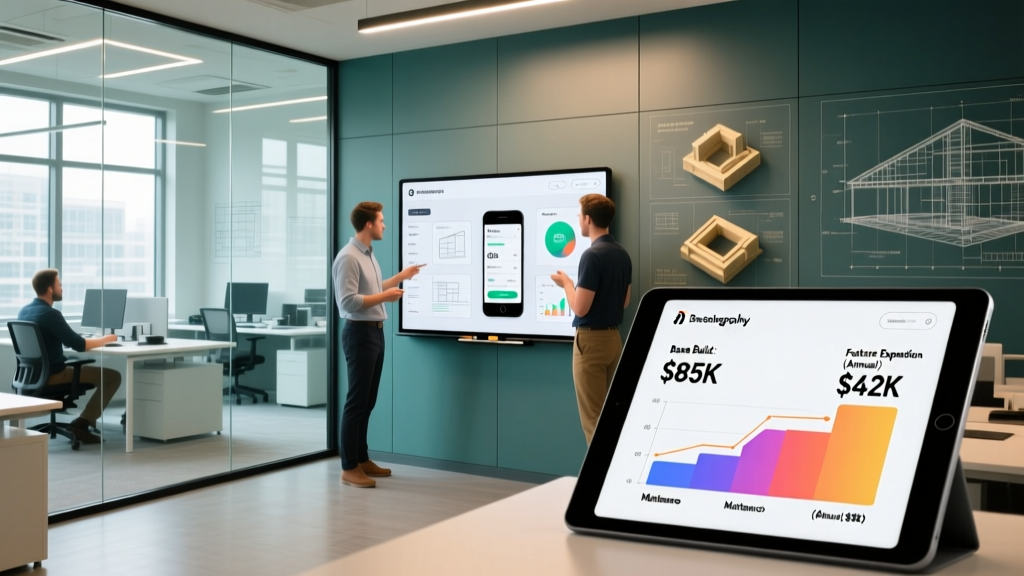
To build a competitive product without burning through capital, you must understand the baseline development tiers. Below is the current cost matrix for custom fitness app development in North America and Western Europe.
| App Tier | Core Features | Estimated Cost (2026) | Timeline |
|---|---|---|---|
| Basic MVP | User auth, manual workout logging, basic progress charts, single-platform (iOS or Android) | $25,000 - $40,000 | 2 - 3 Months |
| Mid-Level | Cross-platform, Apple HealthKit/Google Health Connect integration, video exercise library, push notifications, subscription billing | $60,000 - $110,000 | 4 - 6 Months |
| Advanced | AI form correction (computer vision), live streaming classes, social feeds, wearable API sync (Oura/Whoop), custom coaching dashboards | $150,000 - $250,000+ | 7 - 12 Months |
4 Proven Money-Saving Strategies for App Development
Knowing the baseline cost is only half the battle. The difference between a profitable launch and a stalled project lies in how you architect the build. Implement these four strategies to reduce your initial capital expenditure by 30% to 50%.
1. Mandate Cross-Platform Frameworks (Flutter or React Native)
Building native codebases in Swift (iOS) and Kotlin (Android) simultaneously doubles your frontend development costs. In 2026, cross-platform frameworks like Flutter and React Native have achieved near-native performance, rendering at 60fps to 120fps on modern devices. By writing a single codebase, you reduce frontend engineering hours by approximately 40%. For a mid-level fitness app, this single decision shifts the budget requirement from $110,000 down to roughly $65,000.
2. Leverage Backend-as-a-Service (BaaS)
Do not build a custom Node.js or Python backend from scratch unless your app requires highly complex, non-standard data processing. Utilizing a BaaS like Firebase or Supabase handles authentication, real-time databases, and push notifications out of the box. According to Firebase pricing structures, the Spark (free) and early Blaze (pay-as-you-go) tiers can support your first 10,000 active users for under $50 a month. This eliminates the need for a dedicated backend DevOps engineer during your first year of operation, saving upwards of $80,000 in salary and infrastructure overhead.
Expert Insight: If your fitness app requires strict HIPAA compliance for physical therapy or medical rehab tracking, Supabase is often preferred over Firebase due to its open-source architecture and easier deployment within private, compliant cloud environments (AWS/GCP).
3. Deploy a "Skateboard" MVP First
A "skateboard" MVP is the absolute minimum functional version of your product that delivers core value. For a fitness app, this means stripping away social feeds, gamification, and AI coaching. Your MVP should only include: secure user authentication, a structured workout builder, and one wearable data sync (Apple HealthKit). Launch this to a closed beta of 100 users. Use their retention data to secure seed funding before building the expensive "nice-to-have" features.
4. The Build vs. Buy Matrix: White-Label Alternatives
Before committing to a custom build, evaluate if a white-label API solution fits your business model. Platforms like Trainerize or TrueCoach offer API access that allows you to wrap their existing fitness infrastructure in your own branded UI.
| Criteria | Custom Build | White-Label API (e.g., Trainerize) |
|---|---|---|
| Upfront Cost | $60,000+ | $5,000 - $15,000 (UI Wrapping) |
| Time to Market | 4 - 6 Months | 4 - 8 Weeks |
| Feature Flexibility | Unlimited (You own the code) | Restricted to vendor's roadmap |
| Long-Term Margins | High (Only pay server costs) | Lower (Per-user API licensing fees) |
Hidden Cost Traps That Destroy Fitness App Budgets
Most development agencies will quote you on the frontend build but fail to forecast the operational costs of scaling a media-heavy fitness application. Avoid these two notorious budget killers.
The Video Hosting Egress Trap
If your app includes a library of on-demand workout videos, hosting them on standard AWS S3 with CloudFront is a financial landmine. Consider this scenario: You have 10,000 active users. Each user streams 10 hours of 1080p video per month (approx. 3.6GB per hour). That equals 360,000 GB (360 TB) of data egress per month. At standard AWS CloudFront egress rates of ~$0.08 per GB, your monthly video hosting bill will be $28,800.
Never use raw AWS S3 for video streaming. Use a dedicated video API like Mux or Vimeo OTT. Mux charges based on minutes of video delivered and encoding, which typically reduces high-volume streaming costs by 60% to 80% compared to raw cloud egress, while automatically handling adaptive bitrate streaming (HLS) so users on poor gym Wi-Fi don't buffer.
Premium Wearable API Access Fees
Syncing with Apple HealthKit and Google Health Connect is entirely free. However, if your marketing strategy relies on deep integration with premium hardware like Oura Rings, Whoop straps, or Garmin watches, you must access their proprietary APIs. While developer sandbox access is free, commercial API access for apps with over 1,000 users often requires an enterprise partnership agreement. These agreements frequently carry minimum annual licensing fees ranging from $5,000 to $15,000. Always factor enterprise API licensing into your Year 2 operational budget.
Step-by-Step Budget Allocation Framework
To maintain strict financial discipline, allocate your total development budget using this proven percentage framework:
- 45% - Core Engineering: Frontend (Flutter/React Native) and BaaS backend integration.
- 15% - UI/UX Design: High-fidelity prototyping, accessibility compliance (WCAG 2.1), and user testing.
- 15% - QA & Testing: Device farm testing, security audits, and beta management.
- 15% - Infrastructure & Tooling: CI/CD pipelines, video encoding setup, and first-year server/BaaS costs.
- 10% - Contingency: Reserved strictly for scope creep and third-party API pricing changes.
Understanding exactly how much it costs to build a fitness app requires looking past the initial development invoice. By leveraging cross-platform frameworks, utilizing BaaS architecture, and carefully managing video egress and API licensing, you can launch a highly competitive, scalable fitness platform without exhausting your capital reserves.
Written by
Priya KapoorPriya Kapoor is a real estate market analyst and construction economics researcher with expertise in housing affordability, development feasibility, and infrastructure investment. She holds a Master of Regional Planning from Cornell University and previously worked as a senior analyst at CBRE's Investment Properties group, where she modeled returns for $4B in mixed-use development pipelines. Priya now runs an independent research practice advising developers, municipalities, and REITs on construction cost forecasting and market timing. She publishes the quarterly "BuildMat Market Pulse" report tracking material price indices across 12 commodity categories. Based in Austin, TX, Priya serves on the board of Habitat for Humanity Austin and is a marathon runner.
More from Priya Kapoor
View all
Construction Cost
Cost to Build a 1600 Sq Ft Home in 2026: Full Breakdown
Accurate 2026 cost to build a 1600 sq ft home—material, labor, and regional pricing breakdowns included. Plan your budget with real-time estimates.
Aug 11, 2026

Wood & Lumber
Name the Types of Wood for Pressure Treatment and Preservation
Learn how to name the types of wood best suited for pressure treatment. Compare species treatability, chemical retention levels, and 2026 preservation costs.
Aug 4, 2026

Stone & Masonry
Stone Veneer Suppliers Lindenhurst: 2026 Cost Analysis
Analyze 2026 stone veneer costs in Lindenhurst, NY. Compare local supplier pricing, delivery fees, and Suffolk County installation labor rates.
Aug 4, 2026