Regional Cost to Build a Locker Room Per Square Foot (2026)
Analyze the 2026 regional cost to build a locker room per square foot, covering material matrices, HVAC codes, and labor indices across US zones.
Baseline Economics: Deconstructing the Per-Square-Foot Metric
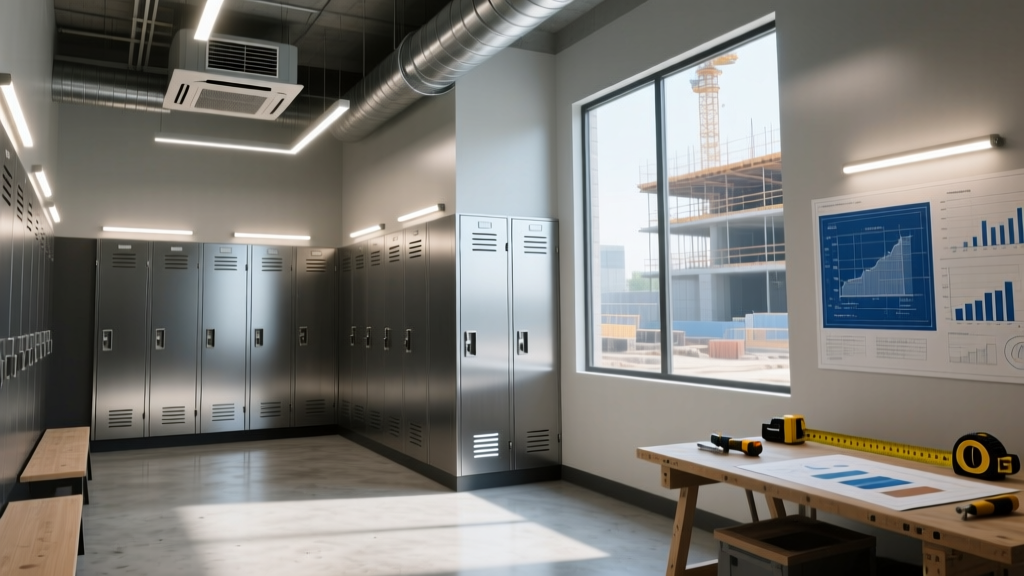
Estimating the cost to build a locker room per square foot requires moving beyond standard commercial interior build-outs. Unlike typical office or retail spaces, locker rooms are classified as high-moisture, high-abuse environments that demand specialized MEP (Mechanical, Electrical, and Plumbing) infrastructure. In 2026, the national baseline for a standard municipal or high-school athletic locker room ranges from $280 to $420 per square foot. However, high-end collegiate or private health club facilities utilizing premium finishes and advanced dehumidification systems frequently push this metric between $450 and $650 per square foot.
The primary cost drivers extend far beyond the lockers themselves. According to the Whole Building Design Guide (WBDG), the integration of continuous vapor barriers, sloped subfloors for drainage, and specialized exhaust systems accounts for nearly 40% of the total hard costs in wet-zone construction. Understanding how these costs fluctuate geographically is critical for developers, school districts, and municipal planners drafting preliminary budgets.
Regional Price Matrix: 2026 Construction Costs by US Zone
Construction labor rates, material shipping logistics, and localized building codes create significant regional pricing disparities. The following matrix outlines the estimated cost to build a locker room per square foot across four major US regions, factoring in current union and non-union labor blends.
| Region | Standard Build ($/SF) | Premium Build ($/SF) | Labor Index Multiplier | Primary Cost Drivers & Code Requirements |
|---|---|---|---|---|
| Northeast | $340 - $410 | $520 - $680 | 1.25x | High union labor density; strict HVAC energy recovery mandates; winter construction heating costs. |
| Midwest | $260 - $320 | $400 - $510 | 0.95x | Favorable labor rates; standard material availability; frost-line plumbing depth requirements. |
| South | $250 - $310 | $390 - $480 | 0.90x | Lower labor costs; high humidity requires aggressive dehumidification and anti-microbial treatments. |
| West | $360 - $450 | $550 - $750 | 1.35x | Seismic bracing for tall locker banks; Title 24 lighting/HVAC compliance; high water conservation mandates. |
Why the West Coast and Northeast Command Premiums
In California and the Pacific Northwest, seismic building codes require heavy-duty lateral bracing for any storage or locker units exceeding 48 inches in height. This necessitates custom-fabricated steel anchoring systems and reinforced blocking behind wall assemblies, adding $12 to $18 per square foot to the framing budget. Furthermore, California’s Title 24 energy code mandates advanced Dedicated Outdoor Air Systems (DOAS) with energy recovery ventilators (ERV) to handle the massive exhaust loads of a locker room without penalizing the building's overall energy footprint.
Conversely, the Northeast's premium is heavily labor-driven. Prevailing wage requirements on public school and municipal projects in states like New York and Massachusetts can inflate plumbing and electrical rough-in costs by 30% to 45% compared to the Southeast. Additionally, the density of existing infrastructure in urban Northeast projects often requires complex core-drilling and concrete sawing to route new sanitary lines, driving up site-preparation costs.
Moisture Mitigation and HVAC: The Hidden Cost Multipliers
The most frequent point of failure in locker room construction is inadequate moisture management. The EPA guidelines on mold and moisture control emphasize that maintaining indoor relative humidity below 60% is non-negotiable in wet environments. Achieving this requires specialized mechanical systems that drastically alter the per-square-foot cost.
Under ASHRAE Standard 62.1, locker rooms and shower areas require continuous mechanical exhaust at a minimum rate of 0.50 CFM per square foot. For a 2,000 SF locker room, this dictates a dedicated 1,000 CFM exhaust system. Upgrading to a variable-speed, humidity-sensing exhaust system with an integrated ERV adds approximately $22,000 to $35,000 to the mechanical contract but reduces long-term dehumidification energy loads by up to 40%.
On the architectural side, wall and ceiling finishes must withstand constant vapor exposure. Standard painted gypsum board is obsolete in wet zones. Instead, estimators must price Fiberglass Reinforced Plastic (FRP) panels (such as Crane Composites GlasLiner) or high-density polyethylene (HDPE) interlocking wall systems. FRP panels installed over moisture-resistant cement backer board cost between $14 and $22 per square foot installed. For ceilings, standard mineral fiber tiles will warp and harbor mold; estimators should specify fiberglass acoustic panels with a scrubbable, moisture-impermeable facing, which cost $9 to $14 per square foot.
Material Selection Matrix: Locker Types and Lifespan ROI
When calculating the total project cost, the lockers themselves represent a highly variable line item. Selecting the right material based on the facility's user demographic and maintenance capabilities is crucial for long-term ROI. The National Intramural-Recreational Sports Association (NIRSA) frequently highlights the shift away from traditional metal lockers in favor of synthetic alternatives in high-moisture environments.
| Locker Material | Avg. Unit Cost (36"x18"x72") | Moisture Resistance | Expected Lifespan | Best Application & Notes |
|---|---|---|---|---|
| Cold-Rolled Steel | $120 - $180 | Poor (Prone to rust) | 7 - 12 Years | Dry zones only (e.g., employee breakrooms). Requires strict humidity control and frequent touch-up painting. |
| HDPE (Solid Plastic) | $220 - $310 | Excellent (Impervious) | 20+ Years | High schools, public rec centers. Graffiti-resistant, will not dent or rust. Heavier, requires robust framing. |
| Phenolic (Compact Laminate) | $350 - $550 | Excellent (Waterproof) | 25+ Years | Collegiate, private health clubs, premium municipal. Aesthetic wood-grain or solid colors, highly durable core. |
| Wire Mesh / Welded | $180 - $240 | Excellent (Airflow) | 15 - 20 Years | Fire stations, industrial wet-works. Allows maximum airflow for drying turnout gear or wet uniforms. |
Plumbing Fixture Density and Rough-In Complexities
The plumbing scope in a locker room is disproportionately expensive relative to its square footage. A standard commercial restroom might feature 4 to 6 fixtures, whereas a 2,500-square-foot athletic locker room can easily house 20 to 30 shower heads, multiple gang sinks, and specialized floor drains. The layout and fixture selection directly impact the cost per square foot.
- Thermostatic Mixing Valves (TMV): Modern plumbing codes mandate master TMVs to prevent scalding, locking the hot water supply to a maximum of 110°F at the fixture. Commercial-grade TMVs (e.g., Zurn or Watts) cost $1,200 to $2,500 each, plus installation. A large facility may require two or three of these units.
- Shower Valves and Flow Rates: WaterSense and local conservation codes (especially in the West) restrict shower heads to 1.5 or 1.8 GPM. Time-metered push-button valves (costing $150-$250 per unit) are standard in municipal builds to prevent water waste, whereas private clubs opt for standard lever handles.
- Floor Drain Infrastructure: Trench drains are increasingly preferred over point drains for ease of maintenance and slope grading. Stainless steel linear trench drains cost $80 to $150 per linear foot, not including the concrete forming and waterproofing membrane required beneath the slab.
Flooring Systems: Balancing Hygiene, Safety, and Cost
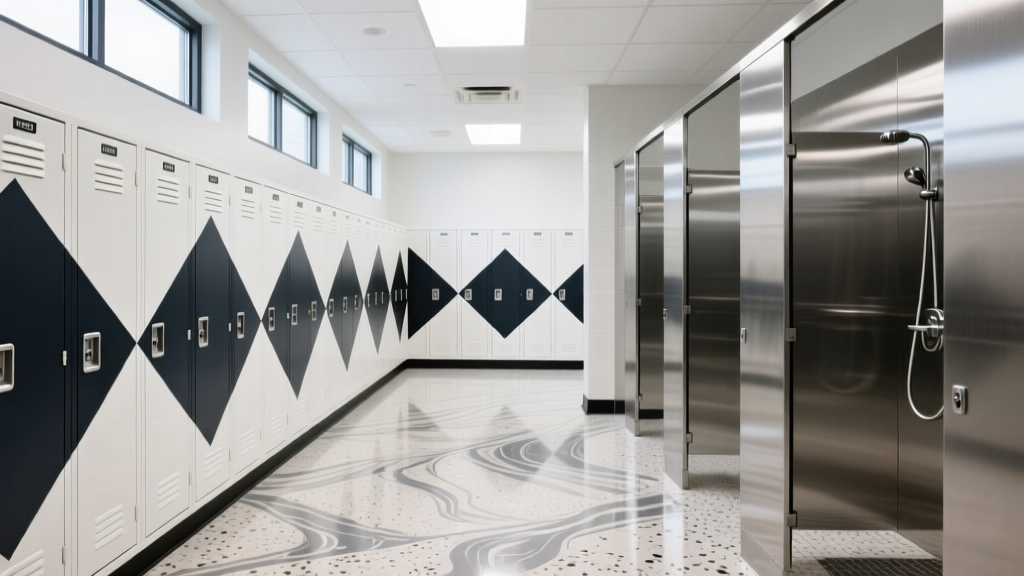
Flooring in a locker room must meet strict slip-resistance coefficients (typically a Dynamic Coefficient of Friction > 0.42 per ANSI A326.3) while resisting constant chemical cleaning and standing water. The choice of flooring system can swing the per-square-foot estimate by $15 to $30.
Epoxy Terrazzo: Priced at $28 to $42 per square foot installed, poured epoxy terrazzo is the gold standard for high-traffic, premium locker rooms. It offers a seamless surface (eliminating grout lines where bacteria hide), extreme durability, and a 40-year lifespan. However, the substrate preparation and multi-day curing process add significant labor time.
Porcelain Tile with Epoxy Grout: A more budget-conscious alternative at $16 to $24 per square foot. The critical specification here is the mandatory use of 100% solids epoxy grout rather than standard cementitious grout. Epoxy grout is non-porous, stain-proof, and impervious to the harsh quaternary ammonium cleaners used by janitorial staff. Using standard grout in a wet zone is a guaranteed callback for the general contractor within 24 months.
Strategic Value Engineering for Municipal and School Projects
For public projects operating under strict bond limitations, value engineering (VE) is essential to keep the cost to build a locker room per square foot within budget without compromising the facility's longevity. Consider the following targeted VE strategies:
- Consolidate Wet Zones: Design the layout to cluster all showers, sinks, and floor drains into a single, centralized plumbing core. Running sanitary and domestic water lines across a 100-foot slab to reach dispersed fixtures adds thousands in trenching, piping, and concrete patching.
- Utilize HDPE over Phenolic in Secondary Spaces: Reserve expensive phenolic lockers for the main varsity or public-facing areas. Use solid HDPE lockers for middle school, JV, or general physical education wings. The visual difference is minimal, but the material savings can exceed $15,000 on a medium-sized project.
- Exposed Ceilings with Vapor-Tight Fixtures: Instead of installing a drop-ceiling grid and moisture-resistant tiles, opt for an exposed structural deck painted with a high-quality, mold-inhibiting epoxy paint. Pair this with IP65-rated, vapor-tight LED linear fixtures. This eliminates ceiling maintenance, improves air circulation, and reduces material costs by $4 to $7 per square foot.
- Pre-Fabricated Shower Pans: Instead of site-built, sloped mortar beds with hot-mop waterproofing, specify pre-sloped, high-density composite shower pans (such as those by KBRS or Wedi). These drop directly into the framed space, tie into the drain assembly, and are ready for tile in hours rather than days, drastically reducing plumbing and waterproofing labor hours.
By understanding the distinct regional labor markets, adhering strictly to modern moisture and ventilation codes, and selecting materials based on lifecycle cost rather than initial purchase price, project teams can accurately forecast and control the true cost to build a locker room in 2026.
Written by
Elena RodriguezElena Rodriguez is a civil engineer and technical writer specializing in concrete technology, masonry systems, and ASTM/ACI compliance. She earned her B.S. in Civil Engineering from Texas A&M University and spent a decade at a materials testing laboratory, performing over 2,000 concrete compressive strength tests and masonry prism evaluations. Elena is an ACI-certified Field Testing Technician (Grade I) and a member of ASTM Committee C12 on Natural Building Stone. She currently consults on forensic engineering cases involving concrete failures and moisture intrusion. Based in San Antonio, TX, Elena is a proud member of the Society of Women Engineers (SWE) and coaches her daughter's FIRST Robotics team.
More from Elena Rodriguez
View all
Walls & Panels
Cost Analysis: Light Gauge Steel Framing Advantages and Disadvantages
Evaluate light gauge steel framing advantages and disadvantages through a strict cost analysis lens, comparing material, labor, and lifecycle expenses.
Aug 4, 2026

Walls & Panels
Gypsum Board Types: Exact Specifications, Thickness & Dimensions
Compare standard, Type X, and moisture-resistant gypsum board types. Get exact specifications, thicknesses, dimensions, and ASTM standards for your project.
Aug 4, 2026

Fire Resistance
Best Fire-Resistant Outdoor Decking Materials: 2026 Buyer Guide
Discover the best fire-resistant outdoor decking materials for 2026. Compare Class A PVC, aluminum, and hardwood options for WUI compliance and safety.
Aug 4, 2026