Proven Ways to Lower the Cost to Paint Commercial Building Interior
Discover actionable strategies to reduce the cost to paint commercial building interior spaces. Learn material hacks, labor optimization, and bidding tips.
The True Baseline: Commercial Painting Economics
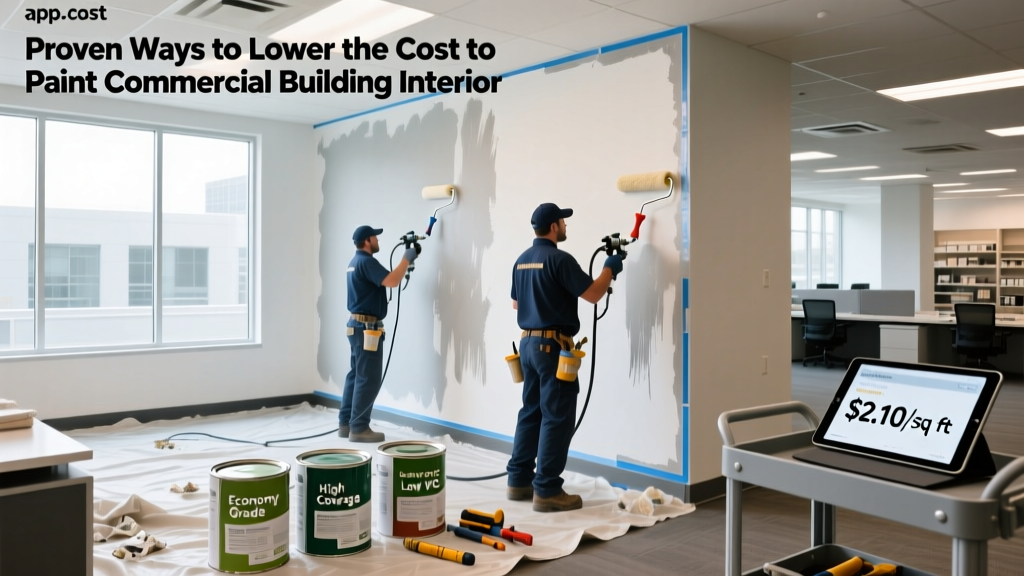
The cost to paint commercial building interior spaces typically ranges from $2.00 to $4.50 per square foot in 2026. However, facility managers who focus exclusively on the price per gallon of paint are optimizing the wrong metric. Material costs account for only 20% to 30% of a commercial painting invoice. Labor, surface preparation, equipment mobilization, and business interruption mitigation drive the remaining 70% to 80%. To genuinely reduce the cost to paint commercial building interior environments, procurement teams must optimize operational logistics, specify high-durability coatings to extend maintenance cycles, and enforce strict bidding standards.
- Labor & Operations: 65% - 75%
- Materials (Paint & Primers): 15% - 25%
- Equipment & Scaffolding: 5% - 10%
Strategic Material Selection: The Lifecycle Cost Matrix
Cheap paint is the most expensive choice a facility manager can make. Standard builder-grade acrylics require recoating every 3 to 5 years in high-traffic commercial corridors. By upgrading to scuff-resistant or waterborne epoxy systems, you increase initial material costs by roughly $0.40 per square foot but extend the recoat cycle to 8–12 years. This effectively halves the long-term cost to paint commercial building interior walls.
| Paint System | Initial Material Cost (per sq ft) | Expected Recoat Cycle | Best Commercial Application | Industry Standard Examples |
|---|---|---|---|---|
| Standard Acrylic (Eggshell/Satin) | $0.35 - $0.55 | 3 - 5 Years | Low-traffic executive offices, storage rooms | PPG Pure Performance, Sherwin-Williams ProMar 200 |
| Scuff-Resistant Acrylic | $0.70 - $1.10 | 7 - 10 Years | Corridors, healthcare facilities, schools | Benjamin Moore Scuff-X, Sherwin-Williams Duration Home |
| Waterborne Epoxy | $1.20 - $1.80 | 10 - 15 Years | Commercial kitchens, labs, warehouses | Sherwin-Williams Pro Industrial Waterbased Alkyd |
Operational Tactics to Slash Labor Premiums
Contractors routinely apply a 15% to 30% premium for night, weekend, or holiday work to accommodate ongoing business operations. Minimizing these after-hours requirements is one of the fastest ways to lower your overall invoice.
The Phased Scheduling Framework
Instead of shutting down an entire floor and paying for weekend overtime, divide the facility into micro-zones. Utilize rolling scaffolding and heavy-duty polyethylene containment barriers to isolate 2,000-square-foot sections. Paint these sections during standard evening hours (e.g., 6:00 PM to 11:00 PM) when the building is empty but standard labor rates still apply, avoiding the deep-night or weekend multipliers.
Surface Preparation: The Hidden Cost Multiplier
Skipping proper surface preparation guarantees premature coating failure, leading to blistering, peeling, and costly warranty disputes. The Master Painters Institute (MPI) and the Painting and Decorating Contractors of America (PDCA) mandate specific preparation standards for commercial warranties.
Many commercial spaces feature Level 4 drywall finishes, which are adequate for flat paint but will highlight every seam and defect under the LED lighting common in modern offices if painted with a satin or semi-gloss sheen. If you are switching from flat to satin, you must budget for a Level 5 skim coat or specify a heavy-texture acrylic that masks imperfections. Failing to do so will result in costly rework and tenant complaints.
For metal surfaces, such as exposed ductwork or structural steel, ensure the contractor includes SSPC-SP 1 (Solvent Cleaning) in their scope. Painting over unseen grease or manufacturing oils on commercial metals will cause the coating to delaminate within months, entirely negating any upfront savings.
The 'Apples-to-Apples' Bid Evaluation Checklist
When soliciting proposals, vague scopes of work lead to change orders and budget overruns. Require all bidding contractors to submit their proposals using the following standardized parameters to accurately compare the true cost to paint commercial building interior spaces:
- Mil Thickness Specification: Bids must state the target Wet Mil Thickness (WMT) and Dry Mil Thickness (DMT) per coat, verified by a mil gauge during application.
- MPI Approval: All specified primers and topcoats must carry an MPI approval number for the specific substrate (e.g., MPI #50 for interior latex on drywall).
- Containment & Protection: Explicit line items for floor protection (e.g., Ram Board vs. standard drop cloths) and HVAC vent sealing.
- Wash and Patch Allowances: A defined metric for wall washing (e.g., TSP solution) and a specific number of drywall patches per 1,000 square feet included in the base bid.
- Mobilization and Demobilization: Clear separation of setup costs, especially if the project requires phased weekend work or specialized equipment like scissor lifts.
Frequently Asked Commercial Painting Questions
Does removing popcorn or acoustic ceiling texture save money long-term?
Yes, but not in the short term. Scraping and bagging acoustic texture adds $1.50 to $3.00 per square foot to the immediate project cost and requires asbestos testing for buildings constructed before 1980. However, smooth ceilings are significantly easier and cheaper to repaint in the future, and they reflect light better, potentially reducing commercial lighting energy costs by up to 5%.
How do zero-VOC paints impact commercial project timelines?
Zero-VOC and low-VOC commercial paints (such as Benjamin Moore Eco Spec or Sherwin-Williams Harmony) allow facility managers to drastically reduce post-painting HVAC flush-out times. While the paint itself may cost 10% to 15% more per gallon, the ability to re-occupy the space 12 to 24 hours earlier often saves thousands of dollars in temporary relocation costs and lost business revenue, drastically altering the true cost to paint commercial building interior environments.
Written by
David NakamuraDavid Nakamura is a licensed architect (AIA) and construction technology writer focused on sustainable building methods, mass timber engineering, and high-performance building envelopes. He holds a Master of Architecture from the University of Washington and is a certified Passive House Consultant (CPHC). David spent eight years at the Seattle firm Mithun, where he led the design of three LEED Platinum projects, before founding his own practice specializing in net-zero residential design. He serves on the editorial advisory board of GreenBuilder Magazine and has authored peer-reviewed papers on cross-laminated timber (CLT) connections for the Journal of Structural Engineering. In his spare time, David teaches woodworking at Pratt Fine Arts Center and kayaks the Puget Sound.
More from David Nakamura
View all
Construction Cost
Labor Cost to Build a Deck Per Sq Ft: 2026 Installation Guide
Discover the exact labor cost to build a deck per sq ft in 2026. This installation guide breaks down contractor rates, complexity factors, and hidden fees.
Aug 4, 2026

Construction Cost
How Much Does It Cost to Build a 3 Bedroom House? Financing Guide
Learn exactly how much it costs to build a 3 bedroom house and explore 2026 financing options, construction loan types, and budget frameworks for your build.
Aug 4, 2026

Construction Cost
Cost to Build a Tennis Court: 2026 Guide
How much does it cost to build a tennis court in 2026? Breakdowns for asphalt, concrete, and synthetic surfaces plus fencing and lighting.
Jul 30, 2026