2026 Regional Labor Cost to Build a Shed: Price Analysis
Analyze the 2026 regional labor cost to build a shed. Compare hourly rates, foundation variables, and geographic pricing factors.
National Baseline: 2026 Shed Labor Metrics
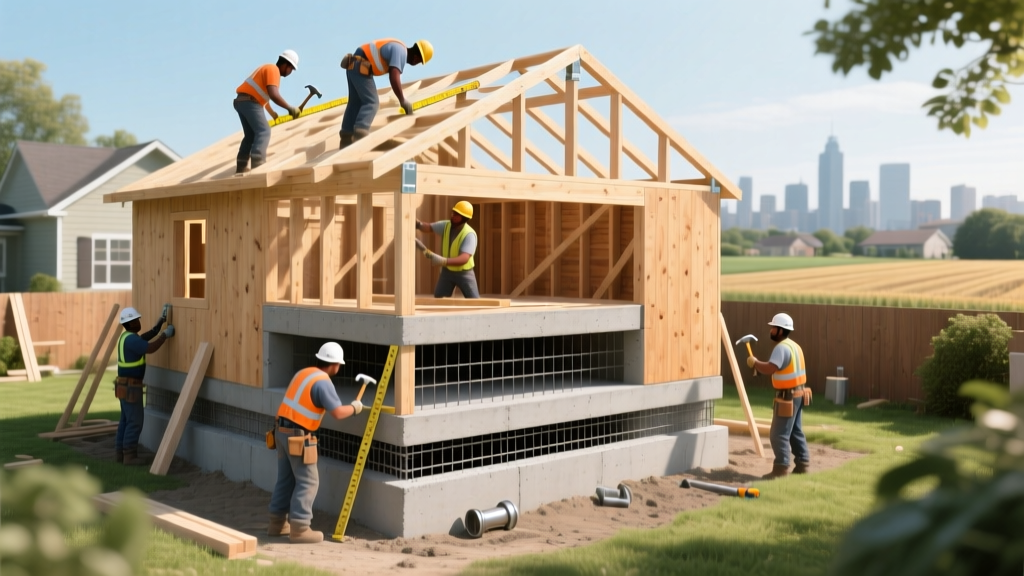
Shed construction is often mistakenly viewed as a simple weekend DIY project, but hiring professional contractors introduces significant regional labor variances. The labor cost to build a shed in 2026 is heavily influenced by local prevailing wages, union density, and municipal permitting friction. While material costs for dimensional lumber, engineered siding, and asphalt shingles remain relatively standardized across national supply chains, labor rates can fluctuate by over 150% from rural Midwest counties to coastal California municipalities.
For a standard 10x12 (120 square foot) stick-built shed with a gable roof, the national average labor cost ranges from $1,400 to $3,800. This translates to a labor-only metric of $11.50 to $31.50 per square foot. According to the Bureau of Labor Statistics (BLS), the median hourly wage for carpenters varies drastically by metro area, which directly dictates the baseline bid you will receive from local general contractors.
- Low-End (Rural/Low COL): $1,400 - $1,800 ($40-$55/hr blended crew rate)
- Mid-Range (Suburban): $2,100 - $2,800 ($60-$75/hr blended crew rate)
- High-End (Urban/High COL): $3,200 - $4,500+ ($85-$120/hr blended crew rate)
Regional Price Matrix: Labor Cost to Build a Shed by Region
Geography is the single largest determinant of your final invoice. The table below breaks down the expected labor cost to build a shed based on 2026 regional construction market data, assuming a standard 120 sq. ft. footprint with a basic gravel pad foundation.
| Region | Blended Hourly Rate | Total Labor Cost (10x12) | Primary Cost Drivers |
|---|---|---|---|
| Northeast (NY, MA, CT) | $75 - $105 | $2,800 - $4,200 | High union density, strict municipal zoning, high insurance requirements. |
| Midwest (OH, IN, IL) | $45 - $65 | $1,500 - $2,400 | Lower cost of living, non-union dominant, relaxed rural permitting. |
| South (TX, FL, GA) | $55 - $80 | $1,900 - $3,100 | High seasonal demand, heat-induced productivity loss, hurricane tie-down codes. |
| West (CA, WA, OR) | $85 - $125 | $3,400 - $5,500 | Seismic structural requirements, prevailing wage mandates, extreme permitting friction. |
The Three Geographic Drivers of Labor Variance
Understanding why your neighbor two states away paid $1,500 less for the exact same shed requires looking beneath the surface of the contractor's bid. The National Association of Home Builders (NAHB) notes that chronic skilled labor shortages continue to compress crew availability, forcing contractors in high-demand areas to charge premium mobilization rates.
1. Unionization and Prevailing Wage Mandates
In states like New York, Illinois, and Washington, a significant portion of the skilled trades workforce operates under collective bargaining agreements. Even if your shed builder is a small, non-union outfit, they must price their labor competitively against union shops to retain skilled carpenters. Furthermore, if your shed is being built on a property that requires prevailing wage compliance (such as certain municipal or HOA-managed common areas), labor costs will instantly jump by 30% to 50% to meet Department of Labor thresholds.
2. Municipal Permitting and Inspection Friction
Labor costs are not just about swinging hammers; they include the billable hours spent waiting for inspectors. In highly regulated jurisdictions (e.g., Los Angeles County or King County, WA), a contractor may need to schedule three separate inspections: footing, framing, and final. Each inspection requires a crew lead to be on-site, adding 4 to 8 billable hours of "standby time" to your labor invoice. Conversely, rural counties in Texas or Alabama often exempt sheds under 200 square feet from permitting entirely, eliminating this hidden labor sink.
3. Climate-Induced Productivity Losses
Environmental factors directly impact man-hour efficiency. In the Deep South, summer temperatures routinely force crews to adopt split shifts (working 5 AM to 11 AM, then 4 PM to 7 PM) to avoid heat exhaustion, which stretches a 3-day build into a 5-day build, increasing overhead and labor billing. In the Pacific Northwest, rain delays require contractors to build "weather days" into their labor estimates to protect their profit margins.
Scope of Work: How Foundation and Utilities Alter Labor Hours
The structural design of your shed dictates the labor timeline. Framing the walls and setting the trusses is relatively fast; it is the ground preparation and utility rough-ins that cause labor budgets to balloon.
Many homeowners assume a concrete slab is a simple upgrade from a gravel pad. However, forming, pouring, and finishing a 10x12 monolithic slab requires specialized masonry labor. Expect to add $600 to $1,100 in masonry labor alone, plus the cost of the concrete and rebar. If the site requires grading or a retaining wall to achieve a level pad, excavator operator rates ($90-$150/hr) will apply before the carpenters even arrive.
Labor Hour Estimates by Foundation Type (10x12 Shed)
- Skids on Gravel Pad: 4-6 man-hours. (Site leveling, gravel spreading, skid placement).
- Concrete Pier Blocks: 8-12 man-hours. (Digging, sonotube forming, pouring, bracket setting).
- Monolithic Concrete Slab: 18-24 man-hours. (Excavation, forming, vapor barrier, rebar tying, pouring, finishing).
Electrical and Plumbing Rough-Ins
If your shed is intended as a home office or workshop requiring power, you must hire licensed tradespeople. General carpenters cannot legally pull electrical permits in most jurisdictions. An electrician's labor rate typically ranges from $85 to $140 per hour. Running a 60-amp subpanel from your main house to a shed 50 feet away, including trenching and conduit installation, will add 12 to 16 hours of specialized electrical labor to your project.
The Contractor Bid Evaluation Framework
When soliciting bids for the labor cost to build a shed, never accept a single lump-sum number. Use this framework to deconstruct and evaluate contractor proposals to ensure you are not overpaying for hidden inefficiencies.
- Isolate Material vs. Labor: Demand a line-item breakdown. If a contractor bids $8,500 for a 10x12 shed, and you know the materials (lumber, LP SmartSide, architectural shingles) cost $3,200 at your local lumberyard, the implied labor and overhead cost is $5,300. Compare this against the regional averages above.
- Verify the Blended Crew Rate: Ask the contractor for their "blended hourly rate" (the average rate of the lead carpenter and the helpers). If they claim a blended rate of $110/hr in a low-cost-of-living area, push back or seek alternative bids.
- Scrutinize the Site Prep Clause: Ensure the bid explicitly states the condition of the site. Most labor bids assume a "clear, level site." If the contractor arrives and finds roots, rocks, or a 10% slope, they will issue a change order at a premium hourly rate. Pre-clear the site yourself to lock in the base labor rate.
- Define the Debris Removal Scope: Hauling away lumber scraps, packaging, and concrete washout is labor-intensive. Confirm whether "broom-swept cleanup and off-site disposal" is included in the base labor hours or billed as an add-on.
Strategic Timing: When to Schedule Your Build
Data from the U.S. Census Bureau's Building Permits Survey indicates that residential construction activity peaks between May and September. During this window, contractors are heavily booked, and labor premiums are at their highest. To optimize the labor cost to build a shed, schedule your project for late fall (October-November) or early spring (March-April). During these shoulder seasons, framing crews are actively seeking to fill gaps in their schedules and are often willing to negotiate their hourly rates or waive mobilization fees to keep their teams employed.
By understanding the regional mechanics of construction wages, permitting friction, and site-specific variables, you can accurately forecast the labor cost to build a shed and negotiate from a position of informed authority.
Written by
Marcus ChenMarcus Chen is a licensed structural engineer (PE) and building materials analyst with over 12 years of experience across residential, commercial, and industrial construction. He holds a Master of Science in Civil Engineering from UC Berkeley and spent six years at Thornton Tomasetti before transitioning to independent consulting and technical writing. Marcus specializes in material selection for seismic-prone regions, concrete reinforcement strategies, and lifecycle cost analysis. His work has been cited by the American Concrete Institute (ACI) and the Structural Engineers Association of California (SEAOC). When he is not on a job site or at his desk, you will find him hiking the Sierra Nevada or restoring a 1920s craftsman bungalow in Oakland, CA.
More from Marcus Chen
View all
Construction Cost
How Much Did the Eiffel Tower Cost to Build?
How much did the Eiffel Tower cost to build in 1889? We adjust for inflation and compare its budget to modern skyscraper construction.
Aug 4, 2026

Fire Resistance
What Is a Fire Resistant Material? Testing & Certification Guide
Discover what is a fire resistant material through ASTM and UL testing. Learn how fire ratings, certifications, and assemblies work in construction.
Aug 4, 2026

Construction Cost
How Much Did the Burj Khalifa Cost to Build?
How much did the Burj Khalifa cost to build? We break down the $1.5B project and extract 5 money-saving strategies for your next build.
Jul 30, 2026