How Much Does It Cost to Build a Shooting Range? Full Breakdown
Discover exactly how much it costs to build a shooting range. Detailed breakdown of indoor HVAC, outdoor earthworks, bullet traps, and 2026 pricing.
The True Cost of Building a Shooting Range
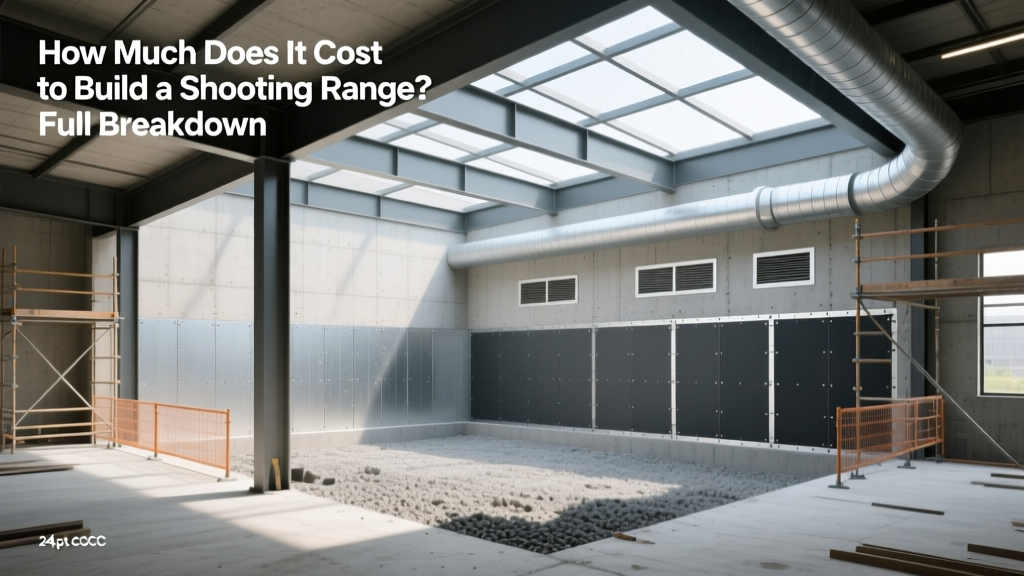
Estimating the capital expenditure for a firearms training facility requires moving beyond basic square-footage calculations. When evaluating how much it costs to build a shooting range, the final figure is dictated by environmental compliance, acoustic engineering, and specialized ballistic containment systems. In 2026, a standard 10-lane indoor commercial range typically requires an initial capital investment between $1.8 million and $3.5 million. Conversely, a fully engineered outdoor range with modern overhead baffling and compacted earthworks ranges from $120,000 to $450,000, heavily dependent on site topography and local environmental permitting.
The divergence in cost is not merely about structures; it is about air quality management and lead mitigation. Indoor facilities must operate as negative-pressure environments with hospital-grade filtration, while outdoor facilities require massive earth-moving operations to construct engineered berms and noise-containment baffles. Below is a comprehensive, line-item breakdown of the structural and mechanical costs required to build a compliant, modern range.
Indoor vs. Outdoor Range Construction Matrix
The choice between an indoor and outdoor facility fundamentally alters the budget allocation. Indoor ranges front-load costs into mechanical systems (HVAC) and acoustic treatments, while outdoor ranges allocate the majority of capital to civil engineering and earthworks.
| Cost Category | Indoor Range (10 Lanes) | Outdoor Range (10 Lanes) |
|---|---|---|
| Site Prep & Earthworks | $50,000 - $120,000 | $80,000 - $250,000 |
| HVAC & Lead Filtration | $250,000 - $450,000 | N/A (Natural Ventilation) |
| Acoustic & Soundproofing | $150,000 - $300,000 | $40,000 - $120,000 (Baffles) |
| Bullet Traps & Backstops | $60,000 - $110,000 | $30,000 - $80,000 (AR500/Earth) |
| Building / Structure | $900,000 - $2,000,000 | $15,000 - $60,000 (Shooting Line Covers) |
| Total Estimated Average | $1.8M - $3.5M | $165,000 - $510,000 |
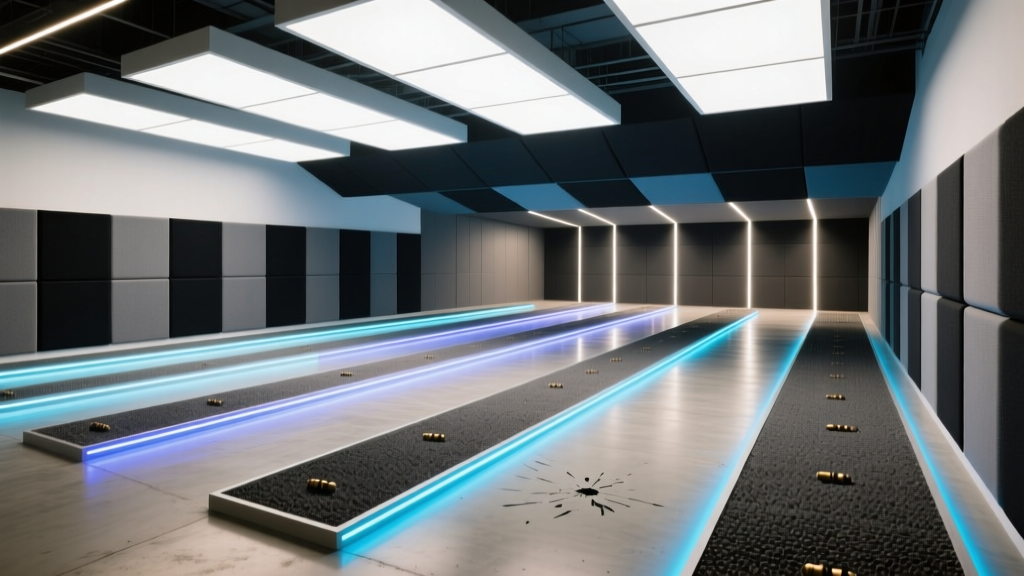
Indoor Shooting Range: Line-Item Breakdown
HVAC and Laminar Airflow Systems
The single most critical and expensive mechanical system in an indoor range is the HVAC setup. According to guidelines referenced by the OSHA Lead Standards and NIOSH, indoor firing ranges must maintain a laminar airflow velocity of at least 75 feet per minute (fpm) moving from the shooter toward the backstop. This requires massive Make-Up Air (MUA) units and specialized exhaust systems.
- Supply Air Plenums: Installed above the firing line to push air uniformly downrange. Cost: $45,000 - $85,000.
- Exhaust & HEPA Filtration: Downrange exhaust hoods pulling air through multi-stage HEPA filters to capture lead particulate before atmospheric venting. Cost: $120,000 - $220,000.
- Climate Control & Dehumidification: Essential to prevent condensation on steel backstops and maintain ammunition integrity. Cost: $60,000 - $110,000.
Bullet Traps and Ballistic Containment
Modern indoor ranges have largely abandoned traditional steel plate backstops for high-velocity rifle rounds due to the noise and lead fragmentation they cause. Instead, granular rubber traps or deceleration chamber systems are the industry standard.
- Granular Rubber Traps: Systems like the Action Target Total Containment Trap (TCT) use a vertical column of chopped rubber to decelerate bullets without fragmenting the lead. Cost: $5,500 - $7,500 per lane.
- Steel Deceleration Chambers: Angled AR500 steel plates enclosed in a box filled with rubber or sand. Better for high-volume pistol ranges. Cost: $3,500 - $5,000 per lane.
- Ceiling and Floor Baffles: AR400/AR500 steel plates suspended at specific intervals to catch ricochets from accidental discharges. Cost: $25,000 - $45,000 for a 10-lane bay.
Acoustic Treatment and STC Ratings
Gunfire generates peak sound pressure levels exceeding 160 dB. To protect the structural integrity of the building and comply with local municipal noise ordinances, the range bay must achieve a Sound Transmission Class (STC) rating of 65 or higher. This requires decoupled wall assemblies, mass-loaded vinyl (MLV), and specialized acoustic baffles suspended from the ceiling to reduce reverberation time (RT60) to under 0.5 seconds.
Outdoor Shooting Range: Earthworks & Baffling
Engineered Berms and Backstops
An outdoor range is only as safe as its earthworks. The primary backstop must be a minimum of 15 to 20 feet high, constructed from compacted, rock-free clay or soil. The presence of rocks in a backstop creates dangerous ricochets. The National Shooting Sports Foundation (NSSF) recommends specific slope geometries to ensure bullet capture and structural stability.
- Backstop Construction: A 20-foot high, 200-foot wide compacted clay berm requires roughly 15,000 cubic yards of material. At $12-$18 per cubic yard for import and compaction, expect to spend $180,000 - $270,000.
- Slope Ratios: The impact face should be a 3:1 or 2:1 slope, while the rear face requires a gentler 4:1 slope to prevent erosion and sloughing.
Overhead Baffles and Noise Containment
To limit the noise footprint and prevent stray rounds from exiting the property envelope, overhead baffles are mandatory for modern outdoor facilities. These are typically constructed from treated timber or steel I-beams supporting angled AR400 steel plates or thick rubber conveyor belting. A comprehensive baffle system for a 100-yard rifle range will cost between $60,000 and $140,000, depending on the span and steel thickness required.
Regulatory, Permitting, and Environmental Compliance
Before breaking ground, budget for the 'soft costs' of environmental impact studies and acoustic modeling. Municipalities will require an independent acoustic engineer to model the decibel footprint of the range at the nearest property line. Furthermore, local environmental agencies will mandate a Lead Management Plan (LMP). This plan dictates the frequency of HEPA-vacuum cleaning, the protocol for spent brass and lead recycling, and the eventual decommissioning of the site. Budget $25,000 to $60,000 for environmental consulting, acoustic studies, and specialized permitting fees.
Phased Construction Decision Framework
If capital is constrained, use this decision matrix to phase your construction without compromising safety or compliance:
- Phase 1 (Non-Negotiable): Ballistic containment, primary HVAC (indoor), or primary berms (outdoor). You cannot open with sub-standard safety infrastructure.
- Phase 2 (Deferrable): Retail space build-outs, advanced classroom AV systems, and exterior landscaping. These can be completed in Year 2 using operating cash flow.
- Phase 3 (Expansion): Adding automated target retrieval systems (e.g., Meggitt or Action Target) to additional lanes. Start with manual or simple motorized carriers and upgrade as membership revenue scales.
Frequently Asked Questions
Can I convert an existing warehouse into an indoor shooting range?
Yes, but the building must have a minimum clear ceiling height of 14 to 16 feet to accommodate the supply air plenums, overhead baffles, and target retrieval tracks. Additionally, the existing concrete slab must be evaluated; range floors require specialized epoxy coatings and specific sloping toward HEPA-filtered floor drains to manage lead wash-down procedures.
What is the ongoing maintenance cost for a range HVAC system?
Expect to spend $15,000 to $30,000 annually on HVAC maintenance. This includes replacing pre-filters monthly, swapping primary HEPA filters every 6 to 12 months (depending on volume), and conducting semi-annual airflow velocity testing to ensure the 75 fpm standard is maintained across all lanes.
How much does it cost to insure a commercial shooting range?
General liability and environmental pollution insurance for a commercial range typically costs between $8,000 and $25,000 annually. Premiums are heavily influenced by your safety protocols, the presence of certified Range Safety Officers (RSOs) on duty at all times, and your documented lead mitigation and cleaning logs.
Written by
James ThorntonJames Thornton is a construction industry veteran with 25 years of hands-on experience in wood framing, lumber grading, and residential building codes. He started as a framing carpenter in rural Oregon, earned his ICC Residential Building Inspector certification, and eventually became a senior plan reviewer for the City of Portland Bureau of Development Services. James holds a B.S. in Wood Science & Technology from Oregon State University and is a certified lumber grader through the West Coast Lumber Inspection Bureau (WCLIB). He has inspected over 3,000 residential construction sites and authored the city's internal guide on advanced framing techniques (2x6 at 24" O.C.). James lives in Bend, OR, where he builds custom timber-frame cabins and competes in lumberjack sports.
More from James Thornton
View all
Insulation
Best Home Insulation Materials: Complete 2026 Guide
Compare top home insulation materials for 2026. Find R-values, installed costs per square foot, and best uses for fiberglass, spray foam, and mineral wool.
Aug 4, 2026

Sustainable Building
Certify Your Green Building Material for LEED and WELL
Step-by-step guide to certifying a green building material for LEED v5 and WELL v2. Master EPDs, HPDs, and VOC limits for 2026 project specifications.
Aug 4, 2026

Stone & Masonry
Veneer Stacked Stone Panels: Interior Design & Style Showcase
Discover how veneer stacked stone panels transform interiors. Explore modern design profiles, material pairings, and technical installation specs.
Aug 4, 2026