Best Adhesive for Exterior Stone Veneer: 2026 Buyer's Guide
Discover the best adhesive for exterior stone veneer in 2026. Compare polymer-modified thinsets, polyurethanes, and masonry mortars for lasting installs.
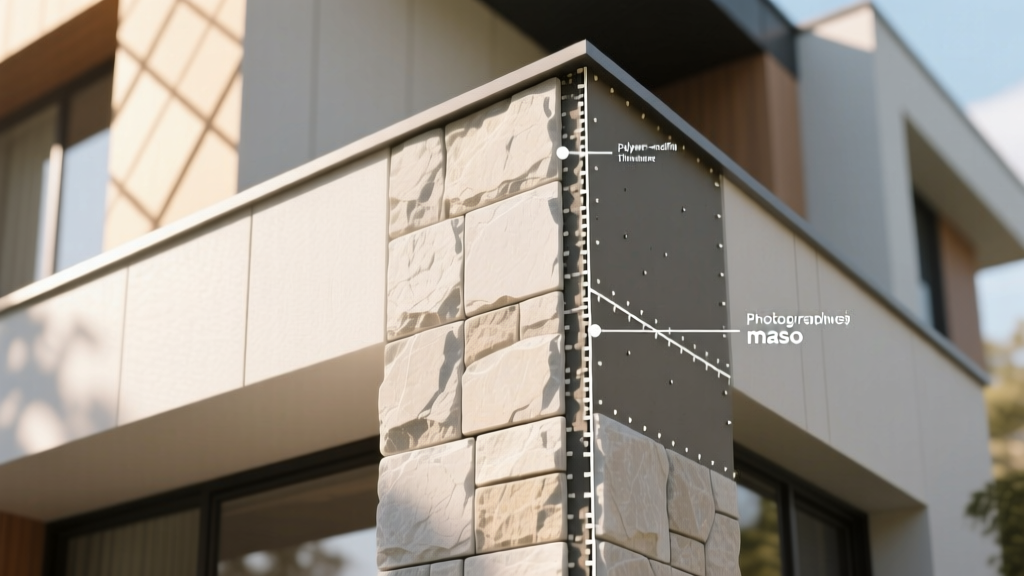
Selecting the best adhesive for exterior stone veneer requires understanding a fundamental distinction that trips up many contractors and DIYers: the difference between traditional manufactured stone veneer (MSV) and modern interlocking panel systems. The chemical composition required to bond a 4-pound mortar-bedded stone to a weather-resistive barrier is vastly different from the adhesive needed for a lightweight, EPS-backed polyurethane stone panel. Using the wrong bonding agent in exterior environments guarantees premature spalling, delamination, and catastrophic freeze-thaw failure.
The Great Divide: Mortar Beds vs. Direct-Bond Adhesives
Before purchasing any product, identify your veneer type. Traditional MSV requires a metal lath, a scratch coat of Type S masonry mortar, and a setting bed. In this scenario, the "adhesive" is actually a polymer-modified thinset mortar or a specialized veneer setting mortar. Conversely, interlocking stone panels and lightweight faux-stone veneers often utilize direct-to-substrate construction adhesives, bypassing the mortar bed entirely.
For exterior applications, standard unmodified thinsets (ANSI A118.1) are strictly prohibited. Exterior walls experience significant thermal expansion, wind-driven moisture, and structural deflection. You must specify adhesives that meet Tile Council of North America (TCNA) standards for improved modified dry-set cement mortars (ANSI A118.15) or high-performance polyurethanes designed for dynamic exterior joints.
Top Polymer-Modified Thinsets for Mortar-Bed Veneer
When installing traditional stone veneer over a properly prepared scratch coat, polymer-modified thinsets provide the necessary shear strength and flexibility. The polymers (typically acrylic or latex) create a flexible matrix that absorbs thermal shock without breaking the mechanical bond.
LATICRETE 254 Platinum
Widely considered the industry benchmark, LATICRETE 254 Platinum meets ANSI A118.15E specifications. It offers an extended open time of up to 45 minutes, which is critical when working with irregular, heavy exterior stones that require careful positioning. Its tensile strength exceeds 400 psi, and its high polymer content provides exceptional resistance to freeze-thaw cycling. Expect to pay approximately $68 per 50 lb bag in 2026.
Custom Building Products MegaLite
For large-format and heavy stacked stone veneers, MegaLite utilizes a lightweight aggregate formula that reduces the overall dead load on the exterior wall assembly by up to 40% compared to standard thinsets. It features a non-sag, non-slump profile, meaning heavy stones will not slide down the wall while the adhesive cures. It meets ANSI A118.15 and retails for roughly $62 per 30 lb bag.
Mapei Ultraflex LFT
Specifically engineered for Large and Heavy Tile (LFT), this product is ideal for thick, natural cut-stone veneers. It contains a high concentration of redispersible polymer powders that reactivate upon mixing with water, creating a highly hydrophobic bond line that resists water migration from the exterior environment.
Polyurethane Adhesives for Interlocking Panel Systems
If you are installing interlocking, dry-stack style veneer panels (often featuring a rigid foam backer), cementitious thinsets will not adhere properly to the foam substrate. Here, 100% polyurethane construction adhesives are mandatory.
Never use solvent-based rubber adhesives (like older formulations of Liquid Nails) on EPS or XPS foam-backed stone panels. The solvents will chemically melt the foam backer, destroying the panel's structural integrity and leaving you with a melted, un-bondable mess. Always verify the adhesive is labeled "Foam Board Safe" or is a 100% polyurethane formulation.
Loctite PL Premium Max: This polyurethane adhesive cures via atmospheric moisture, making it highly effective in humid exterior conditions. It remains permanently flexible and retains its bond strength in temperatures as low as -40°F. It costs roughly $13 per 28 oz tube, with each tube covering approximately 8 to 12 square feet of panel veneer, depending on the bead pattern.
Performance and Application Matrix
| Adhesive Type | Best For | ANSI / ASTM Standard | Open / Cure Time | Avg. Cost (2026) |
|---|---|---|---|---|
| Type S Masonry Mortar | Scratch coat & traditional heavy MSV | ASTM C270 | 90 min / 28 days | $18 / 80 lb bag |
| ANSI A118.15 Thinset | Setting bed for natural & manufactured stone | ANSI A118.15E | 45 min / 24 hours | $65 / 50 lb bag |
| Lightweight Polymer Thinset | Large format, heavy stacked stone | ANSI A118.15H | 30 min / 24 hours | $62 / 30 lb bag |
| 100% Polyurethane | EPS/XPS foam-backed interlocking panels | ASTM C920 | 20 min / 24-48 hours | $13 / 28 oz tube |
The Freeze-Thaw Failure Mode: Why Exterior Bonds Fail
The primary enemy of exterior stone veneer is not gravity; it is water infiltration combined with freezing temperatures. When water penetrates the microscopic capillaries of a standard cementitious bond line and freezes, it expands by 9%. This hydrostatic pressure creates internal micro-fractures. Over three to five winter cycles, these fractures propagate, leading to adhesive spalling where the stone pops cleanly off the mortar bed.
To prevent this, the Masonry Veneer Manufacturers Association (MVMA) mandates strict adherence to water management protocols. The adhesive itself must be hydrophobic. Polymer-modified thinsets (A118.15) achieve this because the acrylic polymers seal the capillary network within the cement matrix during the curing process, drastically reducing water absorption rates compared to unmodified Portland cement mixes.
Substrate Preparation: The Hidden Variable
The best adhesive in the world will fail if applied to an improperly prepared substrate. Exterior wall assemblies require a specific sequence to manage bulk water and vapor drive.
- Weather-Resistive Barrier (WRB): Apply two layers of Grade D asphalt felt paper or a high-performance fluid-applied membrane (like Henry Blue Skin) over the exterior sheathing. The dual-layer approach creates a microscopic drainage plane between the layers.
- Corrosion-Resistant Lath: Install minimum 2.5 lb self-furring galvanized metal lath. Fasten with corrosion-resistant roofing nails or staples penetrating the wall studs by at least 1 inch. Overlap horizontal seams by 1 inch and vertical seams by 2 inches.
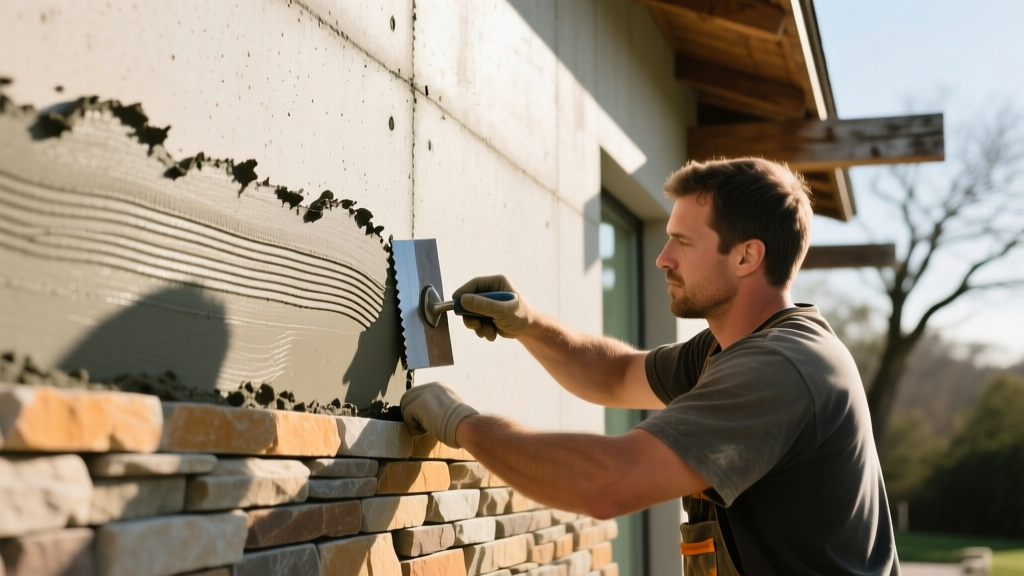
- The Scratch Coat: Apply a 1/2-inch thick layer of Type S masonry mortar. While the mortar is still plastic, "scratch" the surface horizontally with a coarse rake to create deep mechanical grooves. This scratch coat must cure for a minimum of 48 hours before any veneer adhesive or setting mortar is applied.
- Back-Buttering: When applying your polymer-modified thinset to set the stone, always "back-butter" the rear of the stone veneer with the flat side of the trowel before pressing it into the combed thinset on the wall. This ensures 95%+ adhesive coverage, eliminating air pockets where water could otherwise pool and freeze.
Cost Analysis: Adhesive vs. System Failure
Contractors frequently attempt to save money by substituting ANSI A118.15 polymer-modified thinsets with cheaper, unmodified A118.1 thinsets or standard brick mortar for the setting bed. The material savings amount to approximately $1.20 per square foot. However, the labor cost to remediate a failed exterior stone veneer wall—including scaffolding, demolition, disposal, and reinstallation—averages $38 to $45 per square foot. Specifying the correct, high-polymer adhesive represents an insurance premium of less than 3% of the total installed cost, effectively eliminating the risk of catastrophic freeze-thaw delamination.
Written by
David NakamuraDavid Nakamura is a licensed architect (AIA) and construction technology writer focused on sustainable building methods, mass timber engineering, and high-performance building envelopes. He holds a Master of Architecture from the University of Washington and is a certified Passive House Consultant (CPHC). David spent eight years at the Seattle firm Mithun, where he led the design of three LEED Platinum projects, before founding his own practice specializing in net-zero residential design. He serves on the editorial advisory board of GreenBuilder Magazine and has authored peer-reviewed papers on cross-laminated timber (CLT) connections for the Journal of Structural Engineering. In his spare time, David teaches woodworking at Pratt Fine Arts Center and kayaks the Puget Sound.
More from David Nakamura
View all
Construction Cost
Labor Cost to Build a Deck Per Sq Ft: 2026 Installation Guide
Discover the exact labor cost to build a deck per sq ft in 2026. This installation guide breaks down contractor rates, complexity factors, and hidden fees.
Aug 4, 2026

Construction Cost
How Much Does It Cost to Build a 3 Bedroom House? Financing Guide
Learn exactly how much it costs to build a 3 bedroom house and explore 2026 financing options, construction loan types, and budget frameworks for your build.
Aug 4, 2026

Construction Cost
Cost to Build a Tennis Court: 2026 Guide
How much does it cost to build a tennis court in 2026? Breakdowns for asphalt, concrete, and synthetic surfaces plus fencing and lighting.
Jul 30, 2026