Fire Rated Stone Veneer: A Buyer's Guide for Fireplaces and WUI
Compare fire rated stone veneer options for fireplaces and WUI zones. Learn ASTM E84 ratings, clearance codes, and material costs for safe installation.
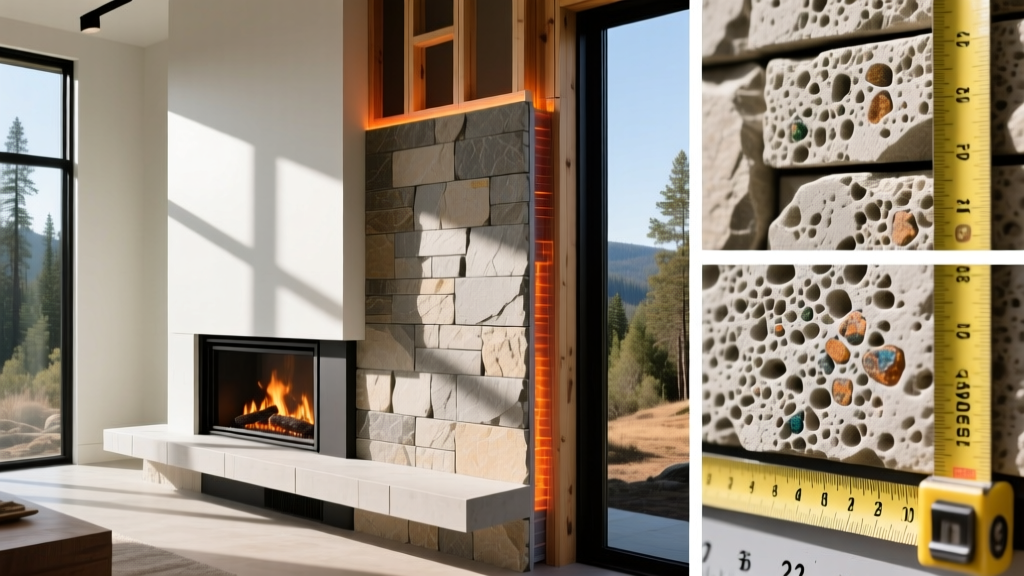
Decoding Fire Ratings: ASTM E84 vs. Non-Combustible Systems
Specifying stone veneer for high-heat or wildfire-prone environments requires navigating a complex matrix of building codes. The term "fire rated" is frequently misused in the building materials market. Natural stone and manufactured stone veneer (MSV) are inherently non-combustible, but the entire wall assembly must be evaluated for fire resistance. When evaluating fire rated stone veneer, buyers must distinguish between surface burning characteristics and structural fire endurance.
Surface flammability is measured under ASTM E84 (Standard Test Method for Surface Burning Characteristics of Building Materials). To achieve a Class A fire rating—the highest classification required for most commercial interiors and high-risk residential zones—the material must demonstrate a Flame Spread Index (FSI) of 25 or less and a Smoke-Developed Index (SDI) of 450 or less. High-quality cementitious MSV typically scores an FSI of 0 and an SDI of 10 to 20, easily securing Class A status.
Material Breakdown: Natural vs. Manufactured vs. Faux
Not all products marketed as "stone veneer" perform equally under thermal stress. Polyurethane faux stone panels, while lightweight, are fundamentally different from cementitious MSV or natural stone in fire scenarios.
| Material Type | Composition | ASTM E84 Rating | WUI Compliant? | High-Heat Suitability |
|---|---|---|---|---|
| Natural Stone Veneer | Quarried limestone, slate, granite | Class A (FSI 0) | Yes (with sealed joints) | Excellent (requires high-heat mortar) |
| Manufactured Stone (MSV) | Portland cement, aggregates, iron oxides | Class A (FSI 0-15) | Yes (with sealed joints) | Excellent (standard Type S mortar) |
| Polyurethane Faux Stone | High-density polyurethane foam | Class C or Unrated | No (melts/ignites) | Poor (strict clearance required) |
| Fiber Cement Siding (Stone Profile) | Cement, cellulose fiber, sand | Class A (FSI 0) | Yes | Good (but limited to exterior cladding) |
Wildland-Urban Interface (WUI) Compliance for Exteriors
For exterior applications in wildfire-prone regions, the International Wildland-Urban Interface Code (IWUIC) and state-specific regulations like California Building Code Chapter 7A dictate strict cladding requirements. The primary threat is not direct flame impingement, but rather wind-blown embers lodging in wall cavities or material gaps.
Sealing the Mortar Joints
When installing fire rated stone veneer in WUI zones, the installation method is just as critical as the material. Dry-stacked stone veneer profiles (which mimic stacked stone without visible mortar joints) are highly problematic in WUI zones unless the joints are fully grouted behind the visible face. According to California OSFM WUI Guidelines, exterior veneers must not have gaps that allow ember intrusion. If using a dry-stack profile, the installer must use a mortar bag to completely fill the voids between the stones from the substrate outward, ensuring a continuous, non-combustible barrier.
Substrate and Weather Barrier Requirements
In WUI zones, the weather-resistive barrier (WRB) behind the stone must be non-combustible or heavily protected. Standard asphalt-impregnated felt paper can ignite if embers penetrate the stone matrix. Best practice dictates using a fluid-applied membrane or a specialized fire-resistant WRB over continuous mineral wool insulation before applying the metal lath and mortar scratch coat.
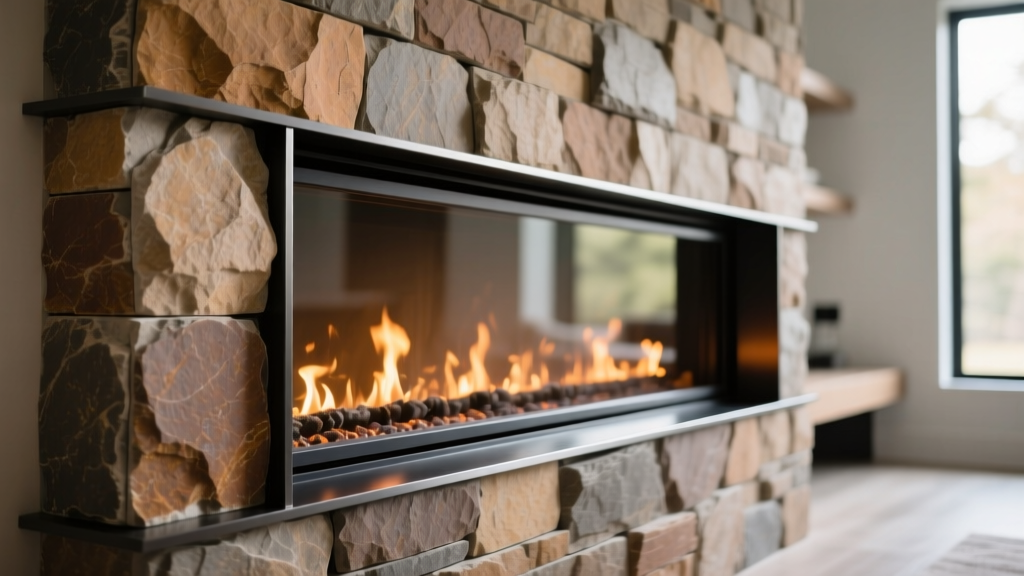
Fireplace Clearances and Installation Gotchas
Interior fireplace surrounds represent the highest concentration of thermal cycling and structural stress for stone veneer. The most common failure mode is not the stone catching fire, but the substrate delaminating or cracking due to improper material selection.
- Ban Drywall and Greenboard: Never install stone veneer over standard or moisture-resistant gypsum board (greenboard) near a firebox. The heat degrades the gypsum core, causing catastrophic adhesive failure. Use 1/2-inch or 5/8-inch cement backer board (e.g., Durock, HardieBacker) rated for continuous high-heat exposure.
- Metal Lath Weight: Use minimum 2.5 lb per square yard galvanized expanded metal lath. The thermal expansion and contraction of the fireplace surround will rip lighter lath from the substrate, taking the 10-15 lb/sq ft stone veneer with it.
- Mortar Selection: For the scratch coat and setting bed within 12 inches of the firebox opening, standard Type N mortar lacks the compressive strength and thermal resilience required. Specify Type S mortar or a polymer-modified, high-heat refractory thinset to prevent micro-cracking during rapid temperature changes.
- Expansion Joints: For floor-to-ceiling fireplace installations exceeding 12 feet in height, incorporate a horizontal soft joint filled with high-temperature silicone caulk to accommodate differential thermal expansion between the framing and the masonry veneer.
Cost Analysis & Top Brand Specifications
Pricing for fire rated stone veneer systems varies significantly based on the material origin, profile complexity, and regional labor rates. The costs below reflect 2026 market averages for a complete installed system (materials, lath, mortar, and labor).
| Product Category | Representative Brands | Material Cost (per sq. ft.) | Installed Cost (per sq. ft.) | Weight (lbs/sq. ft.) |
|---|---|---|---|---|
| Premium Manufactured Stone | Cultured Stone (Boral), Eldorado Stone | $8.50 - $14.00 | $28.00 - $42.00 | 10 - 13 lbs |
| Economy Manufactured Stone | Coronado Stone, local regional brands | $5.50 - $8.00 | $22.00 - $32.00 | 11 - 15 lbs |
| Natural Thin Veneer | Quarried limestone, slate, fieldstone | $12.00 - $24.00 | $38.00 - $65.00 | 12 - 18 lbs |
| Corner Pieces (Linear Ft) | All MSV and Natural Brands | $9.00 - $18.00 / lin. ft. | $35.00 - $55.00 / lin. ft. | N/A |
Note: Corner pieces are sold by the linear foot, while flat stones are sold by the square foot. A standard fireplace surround with two prominent corners will require calculating both metrics separately to avoid material shortages.
Buyer's Decision Framework
Use this matrix to select the correct fire rated stone veneer system based on your specific application constraints:
If your project is an Interior Zero-Clearance Fireplace...
Choose: Manufactured Stone Veneer (MSV) in a linear or ashlar profile.
Why: MSV is lighter than natural stone (reducing cantilever stress on the steel fireplace chassis) and offers uniform thickness, making it easier to maintain strict manufacturer-mandated clearances to the metal firebox surround. Use high-heat silicone at the metal-to-stone transition joint.
If your project is an Exterior Wall in a California WUI Zone...
Choose: Natural Thin Stone Veneer or fully-grouted MSV in a traditional ledge stone profile.
Why: Natural stone and fully sealed cementitious MSV provide the thermal mass and non-combustible barrier required by Chapter 7A. Avoid dry-stack profiles entirely unless the installer guarantees 100% mortar-filled voids from the WRB to the stone face. Pair with a fluid-applied fire-resistant WRB.
If your project is a Commercial Restaurant Wood-Fired Oven...
Choose: Natural high-density stone (e.g., slate or basalt thin veneer).
Why: Commercial wood-fired ovens generate ambient surface temperatures that can exceed 300°F on adjacent walls. Manufactured stone pigments can discolor or degrade under continuous, extreme ambient heat, whereas natural slate and basalt are forged in high-heat environments and will not fade or spall under commercial kitchen conditions.
Final Verification Step
Before finalizing any purchase, request the manufacturer's specific ASTM E84 test report and the ICC-ES Evaluation Report (ESR). The ESR document will explicitly state the approved substrates, required lath weights, and maximum allowable installation heights, ensuring your fire rated stone veneer system meets both local building codes and the rigorous demands of high-heat environments.
Written by
Priya KapoorPriya Kapoor is a real estate market analyst and construction economics researcher with expertise in housing affordability, development feasibility, and infrastructure investment. She holds a Master of Regional Planning from Cornell University and previously worked as a senior analyst at CBRE's Investment Properties group, where she modeled returns for $4B in mixed-use development pipelines. Priya now runs an independent research practice advising developers, municipalities, and REITs on construction cost forecasting and market timing. She publishes the quarterly "BuildMat Market Pulse" report tracking material price indices across 12 commodity categories. Based in Austin, TX, Priya serves on the board of Habitat for Humanity Austin and is a marathon runner.
More from Priya Kapoor
View all
Construction Cost
Cost to Build a 1600 Sq Ft Home in 2026: Full Breakdown
Accurate 2026 cost to build a 1600 sq ft home—material, labor, and regional pricing breakdowns included. Plan your budget with real-time estimates.
Aug 11, 2026

Wood & Lumber
Name the Types of Wood for Pressure Treatment and Preservation
Learn how to name the types of wood best suited for pressure treatment. Compare species treatability, chemical retention levels, and 2026 preservation costs.
Aug 4, 2026

Stone & Masonry
Stone Veneer Suppliers Lindenhurst: 2026 Cost Analysis
Analyze 2026 stone veneer costs in Lindenhurst, NY. Compare local supplier pricing, delivery fees, and Suffolk County installation labor rates.
Aug 4, 2026