Designing a Fireplace with Veneer Stone: Natural vs Manufactured
Compare natural and manufactured veneer stone for fireplaces. Expert analysis on costs, weight limits, heat clearance, and 2026 brands.
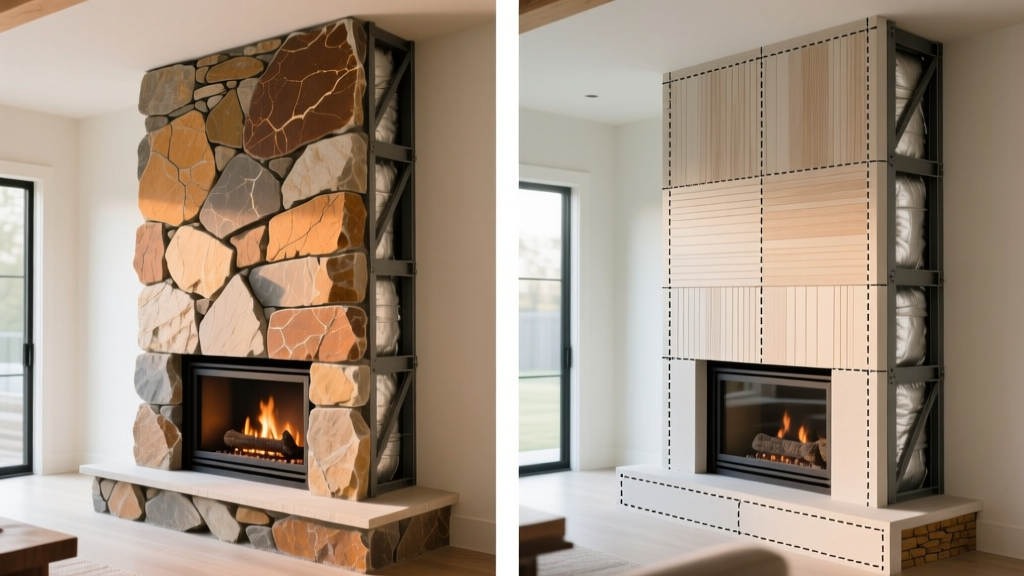
The Core Debate: Natural vs. Manufactured Veneer
When designing a fireplace with veneer stone, homeowners and contractors face an immediate fork in the road: Natural Stone Veneer (NSV) or Manufactured Stone Veneer (MSV). While both deliver the high-end aesthetic of a full-thickness masonry hearth, their structural requirements, installation methodologies, and long-term maintenance profiles differ drastically. In 2026, advancements in polyurethane casting and iron-oxide pigment stabilization have narrowed the visual gap between the two, making the decision less about aesthetics and more about engineering and budget.
Natural stone veneer is quarried and sawn to a thickness of 1 to 1.5 inches. It offers unmatched geological authenticity, unique fossilization patterns, and inherent thermal mass. Manufactured stone veneer is a cast product composed of Portland cement, lightweight aggregates, and mineral pigments, typically ranging from 0.5 to 1 inch thick. According to the Masonry Veneer Manufacturers Association, modern MSV is engineered to replicate the exact texture and color variations of regional stone profiles, from Appalachian fieldstone to Texas limestone.
Weight and Structural Load Limits
The most critical engineering factor when building a fireplace with veneer stone is dead load. Standard 2x4 wood framing at 16 inches on-center can support significant weight, but only if the load is properly transferred through the sheathing and into the foundation.
Data Highlight: Weight Comparison per Square Foot
- Natural Stone Veneer (NSV): 10 to 15 lbs per sq. ft. (A standard 60 sq. ft. fireplace surround adds 600–900 lbs of dead load).
- Manufactured Stone Veneer (MSV): 6 to 10 lbs per sq. ft. (Total dead load: 360–600 lbs).
- Mortarless Polyurethane/Stone Composite: 1 to 2 lbs per sq. ft. (Total dead load: 60–120 lbs).
Engineering Note: If your fireplace chase is framed with 2x3s or lacks continuous structural sheathing (like 1/2-inch OSB or plywood), NSV requires structural reinforcement or a transition to MSV to prevent fastener pull-through.
Cost Breakdown: Material, Labor, and Hidden Expenses
Pricing a fireplace with veneer stone requires looking beyond the per-box material cost. The preparation of the substrate—specifically the installation of a weather-resistant barrier (WRB), metal lath, and a scratch coat—accounts for a significant portion of the labor budget.
| Material Type | Material Cost (per sq. ft.) | Labor Cost (per sq. ft.) | Total Installed (60 sq. ft.) |
|---|---|---|---|
| Natural Limestone/Slate | $14.00 - $22.00 | $22.00 - $35.00 | $2,160 - $3,420 |
| Premium MSV (e.g., Eldorado) | $8.00 - $13.00 | $18.00 - $28.00 | $1,560 - $2,460 |
| Budget MSV (Big Box Store) | $5.00 - $7.50 | $18.00 - $28.00 | $1,380 - $2,130 |
| Mortarless Interlocking | $10.00 - $15.00 | $6.00 - $12.00 | $960 - $1,620 |
While budget MSV appears cheaper upfront, the high labor costs for traditional mortar application negate much of the savings. Mortarless systems command a higher material price but reduce labor time by up to 70%, making them highly cost-competitive for DIYers or budget-conscious renovations.
Heat Tolerance and Clearance Requirements
A common misconception is that because stone is non-combustible, it can be placed directly against any firebox. Both NSV and MSV are classified as non-combustible under ASTM E136 standards. However, the NFPA 211 standard for chimneys, fireplaces, and vents dictates strict clearance requirements based on the underlying framing and the fireplace insert manufacturer's specifications.
⚠️ Critical Warning: Thermal Expansion and Pigment Fading
Manufactured stone veneer relies on iron-oxide pigments for its color. If MSV is installed too close to a high-BTU gas insert without the manufacturer's specified air gap (typically 1 to 2 inches), the sustained radiant heat can bake the moisture out of the cementitious matrix, leading to micro-cracking and premature pigment fading. Furthermore, the steel firebox expands when heated. If the veneer mortar is bonded directly to the firebox steel without a flexible high-temperature silicone expansion joint, the differential expansion will crack the surrounding stones.
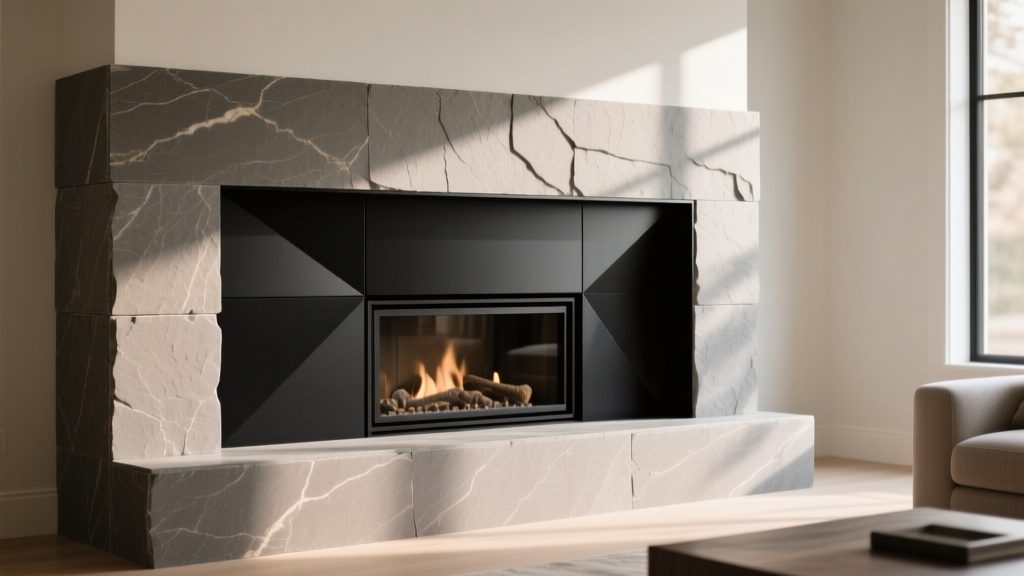
Installation Systems: Mortar vs. Mortarless
The installation methodology dictates the timeline, mess, and structural integrity of your fireplace with veneer stone.
Traditional Mortar Application (Lath and Scratch Coat)
Required for all NSV and most MSV. The process involves stapling a water-resistive barrier to the framing, attaching 2.5 lb self-furring galvanized metal lath, and applying a 1/2-inch Type S mortar scratch coat. Once cured (typically 24-48 hours), stones are applied using a fresh mortar bed and grouted or dry-stacked.
- Pros: Maximum structural adhesion; allows for custom grout lines and deep shadow profiles; industry-standard for exterior and interior wet areas.
- Cons: Highly labor-intensive; requires specialized masonry tools; generates significant dust and moisture indoors.
Mortarless and Interlocking Systems
Brands like GenStone and AirStone utilize high-density polyurethane or specialized lightweight aggregates that interlock or adhere directly to a prepared substrate using construction adhesive (e.g., Loctite PL Premium) or proprietary clips.
- Pros: Can be installed in a single afternoon; zero mortar mixing; easily cut with a standard wood-cutting miter saw; ideal for zero-clearance prefab fireplaces where weight is a concern.
- Cons: Limited to specific profiles (mostly stacked stone and flat ledge); lacks the deep, organic shadow lines of thick natural stone; adhesive failure risk if substrate is not perfectly primed and dust-free.
Edge Cases and Failure Modes
Expert masonry contractors know that a fireplace with veneer stone fails not because of the stone itself, but due to substrate and moisture mismanagement. Watch for these specific failure modes:
- Efflorescence on Interior Hearths: A white, powdery residue appears on the stone. This is caused by water-soluble salts within the Portland cement or natural stone migrating to the surface. Fix: Ensure the concrete hearth pad is fully cured and sealed before applying the scratch coat. Use a specialized masonry efflorescence cleaner, not muriatic acid, which can degrade MSV pigments.
- Corner Piece Delamination: Outside corners bear the brunt of physical impact (vacuum cleaners, firewood logs). Manufactured corner pieces have a thinner return edge. Fix: Apply a continuous bead of polymer-modified thinset behind the return edge of every corner piece, rather than relying solely on the back mortar bed.
- Hearth Pad Settling: If the veneer extends down to a floating hardwood floor, seasonal expansion of the wood will push against the stone, cracking the bottom course. Fix: Always terminate the veneer at the subfloor level or leave a 1/4-inch expansion gap concealed by baseboard or a metal Schluter profile.
Decision Matrix: Which Veneer Stone Fits Your Fireplace?
Use this framework to finalize your material selection based on your specific project constraints.
If / Then Selection Guide
- IF you are cladding a zero-clearance prefab metal firebox on a standard 2x4 framed chase... THEN choose Manufactured Stone Veneer or Mortarless Polyurethane to stay within the chase's load-bearing limits and maintain required air clearances.
- IF you are renovating a historic home with an existing full-masonry chimney breast... THEN choose Natural Stone Veneer. The existing masonry can support the 15 lb/sq. ft. dead load effortlessly, and NSV provides the authentic patina required for heritage aesthetics.
- IF you are executing a weekend DIY remodel without masonry experience... THEN choose a Mortarless Interlocking System. The learning curve for mixing Type S mortar and achieving consistent dry-stack joints is too steep for a one-off project.
- IF you live in a high-humidity environment or are installing an outdoor-rated fireplace... THEN choose Natural Stone or Premium MSV installed with a traditional lath and mortar bed to ensure freeze-thaw durability and moisture resistance.
Top 2026 Brand Recommendations for Fireplace Surrounds
For manufactured options, Eldorado Stone remains the benchmark, particularly their "Shadowledge" and "Ridgefield" profiles, which offer deep, realistic jointing. For natural stone, Real Stone Veneer provides exceptional Oklahoma Ledge Stone that is consistently sawn to a uniform 1-inch thickness, reducing mortar bed variations. For the DIY mortarless route, GenStone offers Class-A fire-rated polyurethane panels that perfectly mimic dry-stacked slate without the structural overhead.
"The biggest mistake I see in modern fireplace builds is treating the veneer as an afterthought. The substrate prep—specifically the integration of the metal lath and the curing time of the scratch coat—dictates whether that stone stays on the wall for five years or fifty." — Mark T., Certified Masonry Contractor
Ultimately, the success of your fireplace with veneer stone hinges on matching the material's physical properties to your home's framing capabilities and your tolerance for installation complexity. Prioritize substrate preparation, respect thermal expansion clearances, and select a profile that complements the architectural scale of your room.
Written by
Marcus ChenMarcus Chen is a licensed structural engineer (PE) and building materials analyst with over 12 years of experience across residential, commercial, and industrial construction. He holds a Master of Science in Civil Engineering from UC Berkeley and spent six years at Thornton Tomasetti before transitioning to independent consulting and technical writing. Marcus specializes in material selection for seismic-prone regions, concrete reinforcement strategies, and lifecycle cost analysis. His work has been cited by the American Concrete Institute (ACI) and the Structural Engineers Association of California (SEAOC). When he is not on a job site or at his desk, you will find him hiking the Sierra Nevada or restoring a 1920s craftsman bungalow in Oakland, CA.
More from Marcus Chen
View all
Construction Cost
How Much Did the Eiffel Tower Cost to Build?
How much did the Eiffel Tower cost to build in 1889? We adjust for inflation and compare its budget to modern skyscraper construction.
Aug 4, 2026

Fire Resistance
What Is a Fire Resistant Material? Testing & Certification Guide
Discover what is a fire resistant material through ASTM and UL testing. Learn how fire ratings, certifications, and assemblies work in construction.
Aug 4, 2026

Construction Cost
How Much Did the Burj Khalifa Cost to Build?
How much did the Burj Khalifa cost to build? We break down the $1.5B project and extract 5 money-saving strategies for your next build.
Jul 30, 2026