Limestone Powder Poultices: Stone Veneer Stain Removal Playbook
Master stone veneer maintenance with our limestone powder poultice playbook. Learn exact mix ratios, solvent pairings, and dust cleanup protocols.
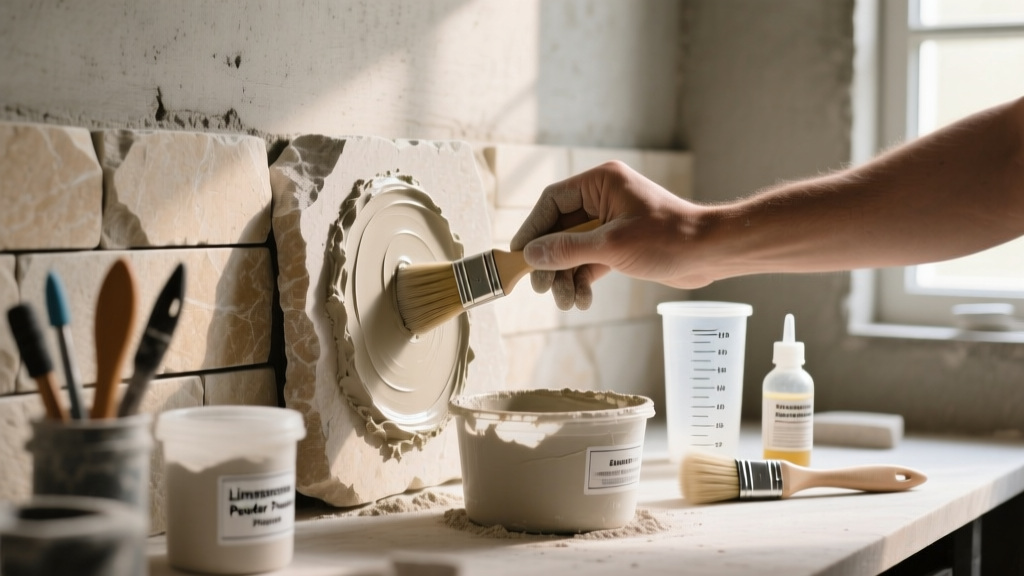
The Chemistry of Limestone Powder in Stone Maintenance
Calcium carbonate, commonly processed into fine limestone powder, is the foundational material for professional-grade stone poultices. When maintaining calcareous stone veneers—such as limestone, marble, travertine, and certain sandstones—matching the mineral composition of the cleaning agent to the substrate is critical. Limestone powder sits at a naturally alkaline pH of 8.0 to 8.5. This pH neutrality relative to calcium-based stones ensures that the poultice base will not etch, dull, or chemically degrade the veneer surface during the extended dwell times required for deep stain extraction.
Unlike diatomaceous earth or kaolin clay, which are silicate-based and can occasionally harbor trace acidic impurities, high-purity limestone powder (USP-grade calcium carbonate) provides an inert, highly porous matrix. When mixed with a targeted solvent, this matrix creates a capillary network that draws embedded contaminants out of the stone’s microscopic pores as the solvent evaporates. According to the Natural Stone Institute's care and maintenance guidelines, utilizing a chemically compatible powder base is the primary defense against secondary surface damage during stain removal procedures.
Formulating the Poultice: Solvent Matrix and Ratios
The efficacy of a limestone powder poultice relies entirely on pairing the correct chemical solvent with the specific stain type. The powder merely acts as the delivery and extraction vehicle. Below is the professional formulation matrix for 2026 commercial and residential veneer maintenance.
| Stain Category | Common Sources | Active Solvent | Powder-to-Solvent Ratio | Required Dwell Time |
|---|---|---|---|---|
| Organic | Leaf tannins, coffee, tobacco, berries | 12% Hydrogen Peroxide (40 Volume) | 2 parts powder : 1 part solvent | 24 - 48 hours |
| Lipids / Oils | Cooking grease, motor oil, cosmetics | Acetone or Mineral Spirits | 2 parts powder : 1 part solvent | 48 - 72 hours |
| Ink / Dyes | Markers, printer ink, fabric dyes | Isopropyl Alcohol (90%+) | 2.5 parts powder : 1 part solvent | 24 hours |
| Biological | Algae, mildew, moss on exterior veneer | Quaternary Ammonium Compound | 2 parts powder : 1 part solvent | 48 hours |
Never use muriatic acid, phosphoric acid, or vinegar-based cleaners as a solvent carrier for limestone powder on calcareous veneers. The acid will immediately react with the calcium carbonate powder, neutralizing the poultice, releasing carbon dioxide gas, and severely etching the stone surface beneath.
Step-by-Step Application Playbook
Proper application mechanics dictate whether a poultice extracts a stain or drives it deeper into the veneer substrate. Follow this precise sequence for optimal capillary action.
- Surface Pre-Wetting: Dampen the stained area with distilled water. This is a frequently skipped but vital step. Pre-wetting fills the immediate surface pores with water, forcing the chemical solvent to travel deeper into the stone to find the stain, rather than being absorbed uselessly into the dry surface layer.
- Mixing the Matrix: In a non-reactive glass or high-density polyethylene (HDPE) container, slowly add the solvent to the limestone powder. Stir with a wooden or plastic spatula until the mixture reaches the consistency of thick peanut butter. Allow the mixture to slake (rest) for 10 minutes so the powder fully absorbs the liquid.
- Trowel Application: Using a plastic putty knife, apply the poultice over the stain, extending the margin at least one inch beyond the visible stain boundary. Maintain a uniform thickness of 1/4-inch to 1/2-inch. Thinner layers dry too rapidly; thicker layers fail to dry completely, halting the extraction process.
- Occlusion and Venting: Cover the applied poultice with 4-mil polyethylene plastic wrap. Tape the edges securely with low-tack painter's tape to create an airtight seal. Puncture the plastic wrap every 2 inches with a pin to allow controlled, slow evaporation. This slow evaporation is the engine that pulls the stain upward.
- Extraction and Removal: After the specified dwell time, remove the plastic wrap. Allow the limestone powder to dry completely into a hard, crusty cake. Once fully desiccated, scrape the powder away with a wooden or plastic scraper. Do not use metal tools, which will gouge the veneer.
- Rinsing: Wipe the area with a clean microfiber cloth dampened with distilled water to remove residual powder dust. Allow the stone to dry for 24 hours to evaluate the extraction result. Deep organic stains often require two to three sequential applications.
Troubleshooting Common Poultice Failures
Even with precise formulations, environmental variables can compromise the extraction process. The Tile Council of North America (TCNA) Handbook outlines several environmental constraints for stone maintenance that apply directly to poultice mechanics.
- Symptom: A dark, distinct ring forms around the perimeter of the poultice after removal.
Diagnosis: Solvent migration. The chemical solvent spread laterally beneath the plastic wrap, carrying dissolved stain particles to the edge where it evaporated and deposited the contaminant.
Correction: Extend the plastic wrap boundary at least three inches past the poultice margin on the next application to push the evaporation zone into clean, unsealed stone or tape. - Symptom: The poultice dries to a powdery dust in under six hours.
Diagnosis: Rapid evaporation caused by high ambient temperatures (above 85°F), low humidity, or direct sunlight on exterior veneers.
Correction: Double-layer the plastic wrap, reduce the pin-prick ventilation frequency, and apply the poultice during cooler evening hours for exterior applications. - Symptom: The poultice remains a wet paste after 72 hours.
Diagnosis: Excessive solvent volume or application in a high-humidity, unventilated interior space.
Correction: Remove the wet poultice, discard it, and reapply with a stiffer powder-to-solvent ratio. Introduce localized airflow using an oscillating fan directed at the surface.
Post-Installation Cleanup: Removing Limestone Powder Dust
Beyond stain removal, limestone powder presents a distinct maintenance challenge during the initial installation and cutting of stone veneer. Dry-cutting or grinding limestone generates massive quantities of fine calcium carbonate dust. If this dust is allowed to mix with water or ambient moisture, it forms a dense, cementitious slurry that embeds itself deeply into the pores of adjacent unsealed stones, creating a hazy, white film that is exceptionally difficult to remove.
To manage limestone powder dust on a job site, adhere to the following dry-first cleanup protocol:
- HEPA Vacuuming: Never sweep dry limestone powder. Sweeping aerosolizes the fine particulates, allowing them to settle into the micro-fissures of surrounding veneers. Use a commercial HEPA-filtered wet/dry vacuum to extract dry dust directly from the stone surface and joints.
- Alkaline Emulsification: Once the bulk dry powder is removed, wash the surface using a heavy-duty alkaline stone cleaner (pH 9.0 to 10.0). The alkalinity helps suspend the remaining calcium carbonate particles in the water, preventing them from re-adhering to the stone.
- Agitation and Extraction: Scrub the veneer with a soft-bristle nylon brush. Immediately extract the dirty water using a wet-vac. Do not allow the wash water to air-dry on the surface, as this will redeposit the suspended limestone powder.
Cost Analysis: Bulk Formulation vs. Proprietary Kits
For contractors maintaining large-scale commercial stone veneers or extensive residential exteriors, the cost of stain removal materials significantly impacts project margins. In 2026, the pricing disparity between proprietary poultice kits and bulk raw materials is substantial.
- Proprietary Poultice Powders: Commercial brands (e.g., StoneTech, Akemi) typically retail between $25 and $35 for a 2-pound tub. This equates to roughly $12.50 to $17.50 per pound, suitable only for small, isolated residential stains.
- Bulk USP-Grade Limestone Powder: Purchasing food-grade or USP-grade calcium carbonate powder in 50-pound sacks from chemical suppliers or agricultural distributors costs between $45 and $65 per bag. This reduces the material cost to approximately $0.90 to $1.30 per pound.
By formulating poultices in-house using bulk limestone powder and sourcing solvents (like 40-volume hydrogen peroxide or acetone) from industrial chemical suppliers rather than retail hardware stores, maintenance contractors can reduce their per-application material costs by over 85%. This bulk approach is essential for bid-competitive commercial restoration projects where dozens of square feet of veneer require simultaneous stain extraction.