Stone Veneer Cost Per Square Foot: 2026 Installation Breakdown
Calculate the exact stone veneer cost per square foot for 2026. This installation guide breaks down material, prep, and labor expenses step-by-step.
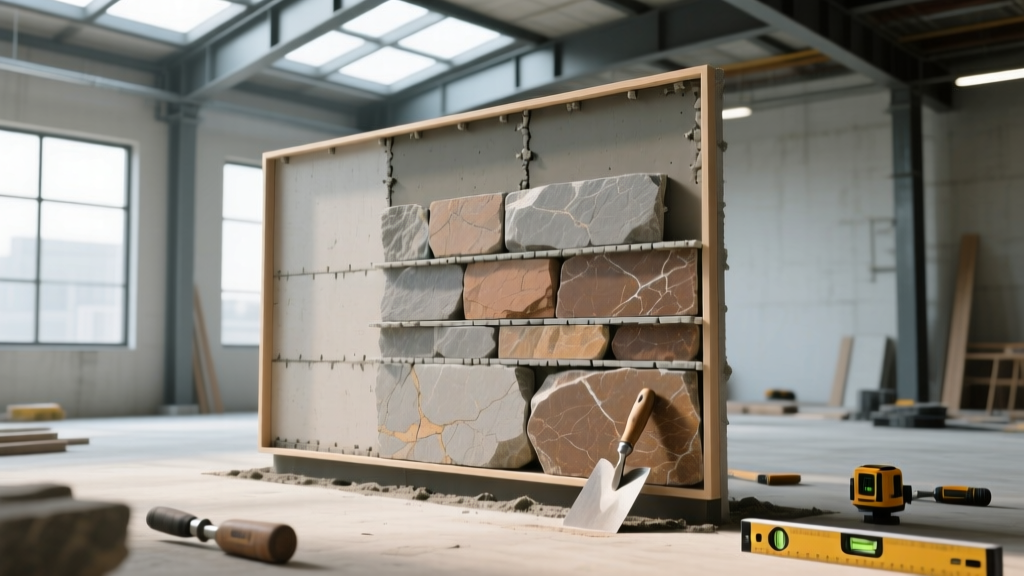
Calculating the true stone veneer cost per square foot requires looking beyond the price tag on the stone itself. A proper installation involves a multi-layered substrate system, specific mortar chemistry, and precise flashing details. In 2026, the total installed cost for stone veneer ranges from $18 to $45 per square foot, depending on whether you choose manufactured stone veneer (MSV) or natural stone, and whether you are paying for professional labor or sourcing materials for a DIY build.
This guide deconstructs the installation process phase-by-phase, assigning exact material and labor costs to each step so you can build an accurate budget and avoid the hidden expenses that derail masonry projects.
The 2026 Stone Veneer Installation Cost Matrix
Before mixing your first batch of mortar, review this baseline cost matrix. These figures represent national averages for 2026, accounting for recent supply chain stabilizations in cement and steel lath pricing.
| Installation Phase | Material Cost (Per Sq. Ft.) | Professional Labor (Per Sq. Ft.) | Total Phase Cost |
|---|---|---|---|
| Substrate Prep & WRB | $0.50 - $1.25 | $1.50 - $3.00 | $2.00 - $4.25 |
| Metal Lath & Fasteners | $1.50 - $2.50 | $2.00 - $4.00 | $3.50 - $6.50 |
| Scratch Coat (Type S Mortar) | $0.75 - $1.50 | $2.50 - $4.50 | $3.25 - $6.00 |
| Stone Veneer (Manufactured) | $6.00 - $12.00 | $10.00 - $18.00 | $16.00 - $30.00 |
| Stone Veneer (Natural) | $12.00 - $25.00+ | $14.00 - $22.00 | $26.00 - $47.00+ |
| Sealing & Cleanup | $0.50 - $1.00 | $1.00 - $2.50 | $1.50 - $3.50 |
Phase 1: Substrate Prep & Weather-Resistive Barrier (WRB)
Stone veneer is a drainage cladding system, not a solid wall. Water will inevitably penetrate the mortar joints. If your substrate is not prepared correctly, trapped moisture will rot your sheathing and cause the veneer to delaminate.
Execution Steps
- Sheathing Inspection: Ensure OSB or plywood sheathing is structurally sound, dry, and free of deflection. Maximum allowable deflection is L/360.
- Flashing Integration: Install corrosion-resistant weep screed at the base of the wall. The weep screed must sit a minimum of 4 inches above grade (or 2 inches above paved surfaces) to prevent ground moisture wicking and soil expansion from pushing against the stone.
- WRB Application: Apply two layers of Grade D asphalt-impregnated building paper or a high-performance fluid-applied membrane. Overlap horizontal seams by 2 inches and vertical seams by 6 inches, shingling from bottom to top.
Omitting the weep screed to save $1.50 per linear foot is the leading cause of efflorescence (white salt deposits) and bottom-course rot in stone veneer installations. The screed creates the necessary air gap for the drainage plane to function.
Phase 2: Lath and Scratch Coat Application
The metal lath provides the mechanical grip for the mortar, while the scratch coat creates a uniform, stable base for the heavy stone pieces. According to the Eldorado Stone Installation Guide, skipping the scratch coat on exterior applications voids manufacturer warranties and drastically increases the risk of stone slippage during the curing process.
Material Specifications & Costs
- Metal Lath: Use minimum 2.5 lb. self-furring, galvanized woven wire lath. Cost: $1.50 - $2.50/sq. ft. Fasten with galvanized nails or staples every 6 inches along studs, penetrating the framing by at least 3/4 inch.
- Scratch Coat Mortar: Use ASTM C270 Type S mortar. You can buy pre-blended bags (approx. $8 per 80-lb bag, covering ~12 sq. ft. at 1/2" thick) or mix it yourself using 1 part Portland cement, 1/2 part hydrated lime, and 4.5 parts masonry sand. Cost: $0.75 - $1.50/sq. ft.
Application Technique
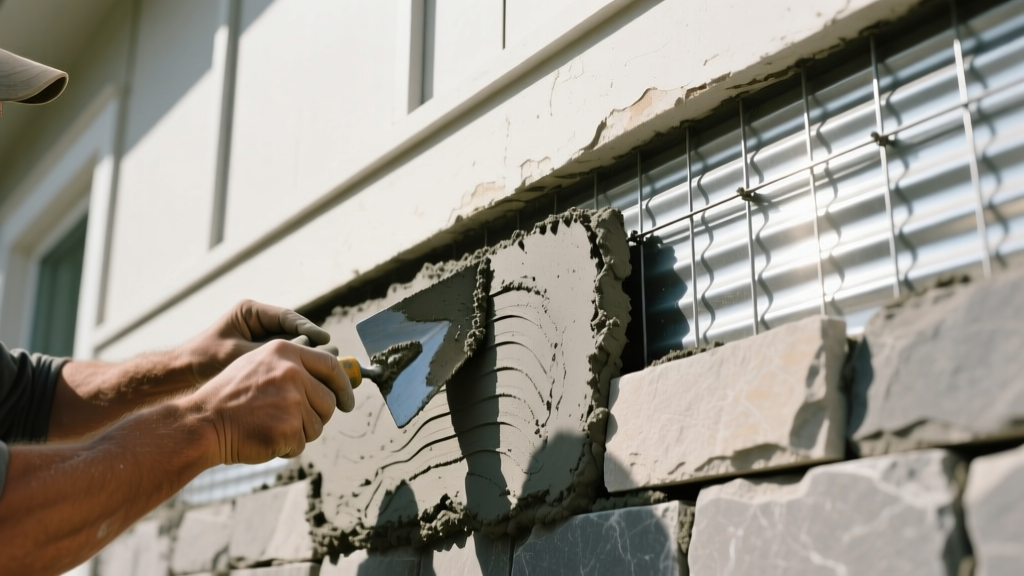
Press the Type S mortar through the lath using a flat trowel to ensure it encapsulates the wire, then pull a notched trowel horizontally across the surface to create deep ridges (the "scratch"). The scratch coat must be 3/8" to 1/2" thick and cure for a minimum of 24 to 48 hours. Keep the scratch coat damp by misting it if temperatures exceed 85°F to prevent rapid moisture loss and shrinkage cracking.
Phase 3: Stone Setting & The Linear Foot Trap
This is where the bulk of your material budget is spent. Manufactured stone veneer (MSV) is cast from concrete and iron oxide pigments, weighing roughly 10-12 lbs per square foot. Natural stone veneer weighs 15-20+ lbs per square foot and requires specialized cutting tools.
Flat stones are sold by the square foot, but corner pieces are sold by the linear foot. A standard corner piece costs between $8 and $15 per linear foot. If your design features multiple windows, doors, and outside corners, corner pieces can consume up to 25% of your total material budget. Always measure linear feet of corners separately and deduct the square footage they cover from your flat stone order.
Installation Steps
- Layout & Dry Fit: Open multiple boxes and blend the stones to avoid color banding. Dry-fit corners first, working your way up from the weep screed.
- Back-Buttering: Apply a 1/2" layer of Type S or Type N mortar to the back of each stone. Press the stone firmly into the scratch coat until mortar squeezes out around the edges. Do not use a "dot and dab" method; full coverage is required to prevent water pockets behind the stone.
- Jointing: Maintain consistent 1/2" to 1" joints. Once the mortar becomes thumbprint-hard (usually 30-60 minutes), use a pointing tool or mortar bag to strike the joints, compacting the mortar to seal out water.
Hidden Costs: Common Installation Failures
When budgeting your stone veneer cost per square foot, you must account for the financial risk of improper installation. Fixing masonry failures is exponentially more expensive than doing it right the first time.
| Failure Mode | Cause | Remediation Cost Impact |
|---|---|---|
| Delamination | Applying stone to a painted surface, or failing to use self-furring lath. | Requires full tear-off and disposal. Adds $8-$12/sq. ft. in demolition costs. |
| Efflorescence | Missing WRB, absent weep screed, or using unwashed masonry sand in the mortar mix. | Chemical cleaning ($3-$5/sq. ft.) and potential stone replacement if salts spall the faces. |
| Mortar Smearing | Attempting to tool joints while the mortar is too wet, or failing to use a stiff bristle brush during cleanup. | Requires specialized masonry acid wash. Adds $2-$4/sq. ft. to cleanup phase. |
Phase 4: Sealing and Long-Term Maintenance
While not strictly required by all manufacturers, applying a breathable sealer is highly recommended for natural stone and exterior MSV in freeze-thaw climates. Do not use acrylic or polyurethane sealers; they trap moisture inside the masonry, leading to spalling when the water freezes and expands.
Specify a silane/siloxane penetrating sealer (such as Prosoco Siloxane PD or equivalent). These sealers line the capillary pores of the concrete and stone, repelling liquid water while allowing water vapor to escape.
Material Cost: $0.50 - $1.00 per sq. ft.
Application: Spray on using a low-pressure garden sprayer until the surface is thoroughly wet, then back-roll to eliminate drips. Reapply every 5 to 7 years.
DIY vs. Professional Installation: The Decision Framework
Is the labor cost of $12 to $20 per square foot worth doing yourself? Use this framework to decide based on your project scope and skill level.
When to DIY (Save $12 - $20 / sq. ft.)
- Scope: Interior applications (e.g., a single fireplace surround or an interior accent wall under 150 sq. ft.).
- Substrate: Existing, unpainted brick, concrete block, or properly prepared cement board.
- Material: Manufactured stone veneer with interlocking, dry-stack profiles that require minimal jointing and no corner pieces.
When to Hire a Professional Mason
- Scope: Exterior applications, multi-story walls, or projects exceeding 300 sq. ft.
- Substrate: Wood-framed walls requiring full WRB, flashing integration, and wire lath installation.
- Material: Natural stone veneer (requires heavy lifting, wet saws with diamond blades, and advanced structural load calculations).
- Climate: Regions with strict freeze-thaw building codes where improper drainage plane installation can lead to structural rot and failed municipal inspections.
According to industry data tracked by Forbes Home Improvement, exterior masonry projects consistently yield a high return on investment, but only when executed to code. Cutting corners on the $3.50/sq. ft. substrate prep phase to save money will inevitably cost you thousands in structural repairs down the line. Budget for the complete system, not just the visible stone.
Written by
David NakamuraDavid Nakamura is a licensed architect (AIA) and construction technology writer focused on sustainable building methods, mass timber engineering, and high-performance building envelopes. He holds a Master of Architecture from the University of Washington and is a certified Passive House Consultant (CPHC). David spent eight years at the Seattle firm Mithun, where he led the design of three LEED Platinum projects, before founding his own practice specializing in net-zero residential design. He serves on the editorial advisory board of GreenBuilder Magazine and has authored peer-reviewed papers on cross-laminated timber (CLT) connections for the Journal of Structural Engineering. In his spare time, David teaches woodworking at Pratt Fine Arts Center and kayaks the Puget Sound.
More from David Nakamura
View all
Construction Cost
Labor Cost to Build a Deck Per Sq Ft: 2026 Installation Guide
Discover the exact labor cost to build a deck per sq ft in 2026. This installation guide breaks down contractor rates, complexity factors, and hidden fees.
Aug 4, 2026

Construction Cost
How Much Does It Cost to Build a 3 Bedroom House? Financing Guide
Learn exactly how much it costs to build a 3 bedroom house and explore 2026 financing options, construction loan types, and budget frameworks for your build.
Aug 4, 2026

Construction Cost
Cost to Build a Tennis Court: 2026 Guide
How much does it cost to build a tennis court in 2026? Breakdowns for asphalt, concrete, and synthetic surfaces plus fencing and lighting.
Jul 30, 2026