Stone Veneer for Exterior Walls: 2026 Selection Guide
Compare manufactured vs natural stone veneer for exterior walls. Explore 2026 costs, moisture management, and top brands for durable facade cladding.
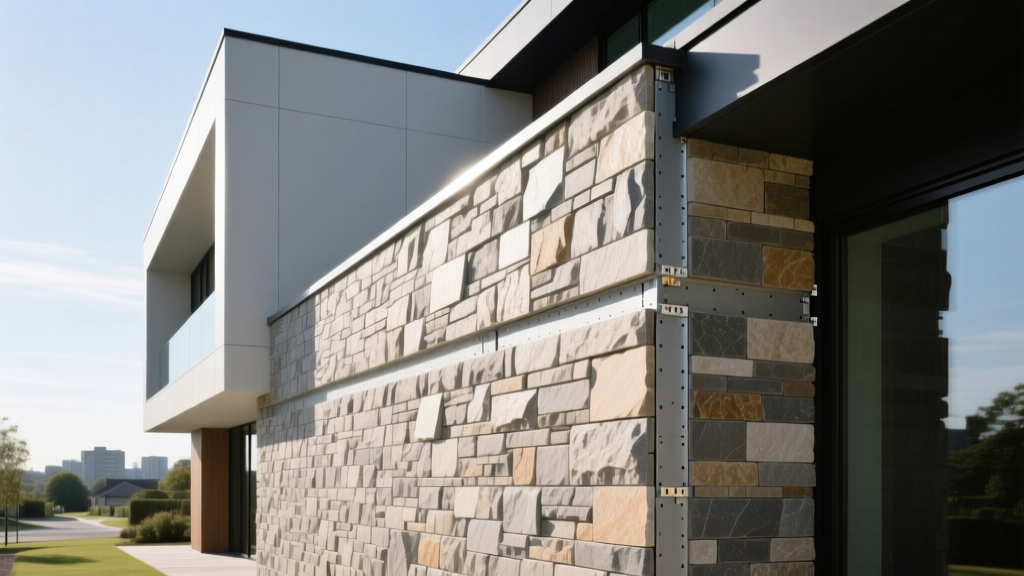
The Core Decision: Manufactured vs. Natural Stone Veneer
Selecting stone veneer for exterior applications requires balancing aesthetic goals with structural and moisture-management realities. The market is broadly divided into two categories: Adhered Manufactured Stone Veneer (AMSV) and Natural Stone Veneer (NSV). While both deliver exceptional curb appeal, their physical properties dictate entirely different installation protocols and long-term maintenance profiles.
AMSV is a Portland cement-based product cast in molds taken from natural stone. It is governed by ASTM C1670 standards, which dictate compressive strength, absorption rates, and density. Because it is engineered, AMSV typically weighs between 10 and 12 pounds per square foot. This lighter weight often eliminates the need for structural footings or brick ledges, allowing it to be adhered directly to properly prepared wall sheathing via metal lath and mortar.
Natural Stone Veneer, conversely, is quarried and sliced to a thickness of 0.5 to 1.5 inches. Depending on the geology—such as dense granite versus porous limestone—NSV can weigh anywhere from 15 to 25 pounds per square foot. While it offers unmatched authenticity and color permanence, the increased dead load frequently requires a structural masonry ledge or engineered steel supports at the foundation level.
Quick Decision Matrix: AMSV vs. NSV
- Choose AMSV if: Your budget is under $18/sq ft (installed), you lack structural brick ledges, or you need a specific, uniform color profile that is difficult to source in natural quarries.
- Choose NSV if: You are building a legacy home, require extreme impact resistance, prefer the natural thermal mass properties of real stone, or are cladding a commercial facade with a 50+ year lifecycle expectation.
Moisture Management: The Hidden Failure Point
The leading cause of exterior stone veneer failure is not material degradation, but trapped moisture. Both AMSV and NSV are absorptive claddings. When driven rain penetrates the mortar joints and stone faces, that moisture must have a clear, unobstructed path to exit the wall assembly. If trapped, it leads to efflorescence (white salt deposits), freeze-thaw spalling, and catastrophic wood framing rot.
According to building enclosure experts at Building Science Corporation, treating stone veneer as a drained and ventilated rainscreen is critical for long-term durability in most North American climate zones.
The Mandatory Drainage Plane Assembly
To prevent moisture-related failures, your exterior stone veneer specification must include the following layers, applied from the sheathing outward:
- Weather-Resistive Barrier (WRB): Two layers of Grade D asphalt-impregnated felt paper or a high-performance fluid-applied membrane.
- Drainage Mat: A 3/16-inch to 1/4-inch dimpled polymeric drainage mat (e.g., Keene DriWall or Enkamat) to create an air gap between the WRB and the lath.
- Corrosion-Resistant Metal Lath: Minimum 2.5 lb/sq yard galvanized or stainless steel woven wire lath (ASTM C847), attached with corrosion-resistant fasteners penetrating the studs.
- Scratch Coat: A 3/8-inch to 1/2-inch layer of Type S mortar, scored horizontally to provide a mechanical key for the setting bed.
- Weep Screed: A code-mandated (ASTM C926) weep screed installed at the base of the wall, positioned a minimum of 4 inches above final soil grade and 2 inches above paved hardscapes to prevent capillary action and block pest intrusion.
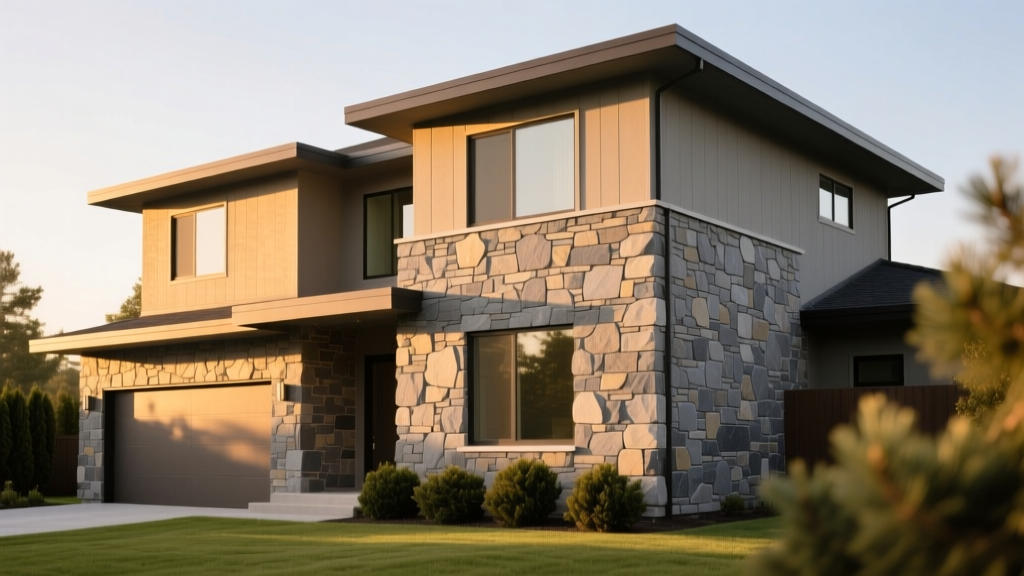
2026 Cost Breakdown: Material and Installation
Pricing for stone veneer for exterior walls has stabilized following the supply chain fluctuations of the early 2020s, though regional labor rates continue to drive total project costs. The table below outlines the expected national average costs per square foot of wall area for 2026.
| Cost Component | Manufactured (AMSV) | Natural (NSV) |
|---|---|---|
| Material (Stone & Trim) | $6.50 - $11.00 | $13.00 - $24.00 |
| Prep (WRB, Lath, Mortar) | $2.50 - $4.00 | $3.00 - $5.50 |
| Labor (Masonry Contractor) | $9.00 - $14.00 | $15.00 - $22.00 |
| Total Installed Cost | $18.00 - $29.00 | $31.00 - $51.50 |
Note: Scaffolding, structural foundation ledges, and complex architectural detailing (like radius walls or deep window returns) will add 15% to 25% to the total labor estimate.
Top Manufacturer Lines for Exterior Durability
When specifying manufactured stone veneer, the manufacturing process (wet-cast vs. dry-cast) heavily influences the product's exterior longevity and color fastness.
- Eldorado Stone (Profile: European Castle Stone & Pro-Fit): Eldorado utilizes a wet-cast process, pouring high-slump concrete into molds. This results in denser, less porous stones with exceptional freeze-thaw durability. Their Pro-Fit modular panels feature interlocking edges that reduce installation labor by up to 30% while minimizing visible repeating patterns.
- Coronado Stone (Profile: Pro-Fit Ledgestone): A direct competitor offering highly realistic color variation through integral iron-oxide pigments. Coronado's dry-tamp and wet-cast hybrid lines offer excellent dimensional consistency, making them ideal for large-scale commercial exteriors where tight joint tolerances are required.
- Dutch Quality Stone: Known for their rigorous quality control and high-density formulations. Dutch Quality stones consistently test well below the 15% maximum water absorption threshold required for severe freeze-thaw climates, making them a top choice for installations in the upper Midwest and Northeast.
Mortar Selection and Jointing Techniques
The mortar used to adhere and joint exterior stone veneer must accommodate thermal expansion, resist moisture penetration, and bond securely to both the stone and the scratch coat. Type S mortar is the industry standard for exterior adhered veneer. It offers a high compressive strength (minimum 1,800 psi) and superior tensile bond strength compared to Type N. For enhanced water resistance and flexibility, specify a polymer-modified veneer mortar, such as SPEC MIX Veneer Stone Mortar or Quikrete Veneer Stone Mortar, which includes proprietary additives to reduce efflorescence and improve workability.
Warning: Avoid Raked Joints in Wet Climates
While raked joints (where the mortar is scraped back 1/4 inch to create a deep shadow line) are aesthetically popular for dry-stack natural stone looks, they create a horizontal shelf that traps water and snow. In regions with heavy rainfall or freeze-thaw cycles, always specify overgrout (mortar smeared over the stone face and brushed) or flush/standard joints that shed water efficiently.
Climate-Specific Selection Framework
The geographic location of your project should directly dictate the material specifications you select for your exterior stone veneer.
Freeze-Thaw Zones (Northern US, Canada)
In climates where temperatures frequently cross the 32°F (0°C) threshold, water absorption is the enemy. When water enters the microscopic pores of the stone and freezes, it expands by 9%, causing the face of the stone to spall or pop off. Requirement: Specify AMSV or high-density natural stone (like granite or quartzite) with a verified water absorption rate of less than 12% per ASTM C140 testing. Avoid porous natural sandstones and soft limestones.
Coastal and High-Salinity Environments
Salt spray accelerates the corrosion of metal lath and degrades standard Portland cement mortar. Requirement: Upgrade the standard galvanized metal lath to stainless steel lath (ASTM C847 Type 304 or 316). Use a sulfate-resistant mortar mix and apply a penetrating, breathable silane/siloxane sealer to the finished stone and joints to prevent chloride intrusion.
High-Wind and Seismic Zones
Adhered veneer relies entirely on the mechanical bond between the mortar, the lath, and the stone. In high-wind (hurricane-prone) or seismic regions, the sheer weight of the stone can cause delamination if the fasteners pull through the sheathing. Requirement: Ensure lath fasteners penetrate a minimum of 1 inch into solid wood studs or steel framing, spaced no more than 6 inches apart vertically and 16 inches horizontally. For walls exceeding 30 feet in height, integrate intermediate structural relief angles to break the vertical load path.
Written by
James ThorntonJames Thornton is a construction industry veteran with 25 years of hands-on experience in wood framing, lumber grading, and residential building codes. He started as a framing carpenter in rural Oregon, earned his ICC Residential Building Inspector certification, and eventually became a senior plan reviewer for the City of Portland Bureau of Development Services. James holds a B.S. in Wood Science & Technology from Oregon State University and is a certified lumber grader through the West Coast Lumber Inspection Bureau (WCLIB). He has inspected over 3,000 residential construction sites and authored the city's internal guide on advanced framing techniques (2x6 at 24" O.C.). James lives in Bend, OR, where he builds custom timber-frame cabins and competes in lumberjack sports.
More from James Thornton
View all
Insulation
Best Home Insulation Materials: Complete 2026 Guide
Compare top home insulation materials for 2026. Find R-values, installed costs per square foot, and best uses for fiberglass, spray foam, and mineral wool.
Aug 4, 2026

Sustainable Building
Certify Your Green Building Material for LEED and WELL
Step-by-step guide to certifying a green building material for LEED v5 and WELL v2. Master EPDs, HPDs, and VOC limits for 2026 project specifications.
Aug 4, 2026

Stone & Masonry
Veneer Stacked Stone Panels: Interior Design & Style Showcase
Discover how veneer stacked stone panels transform interiors. Explore modern design profiles, material pairings, and technical installation specs.
Aug 4, 2026