Cost Calculator for Stucco Repair Materials: 2026 Pricing Guide
Calculate exact costs for stucco repair materials. Get 2026 pricing, quantity formulas, and product picks for hairline to structural exterior fixes.
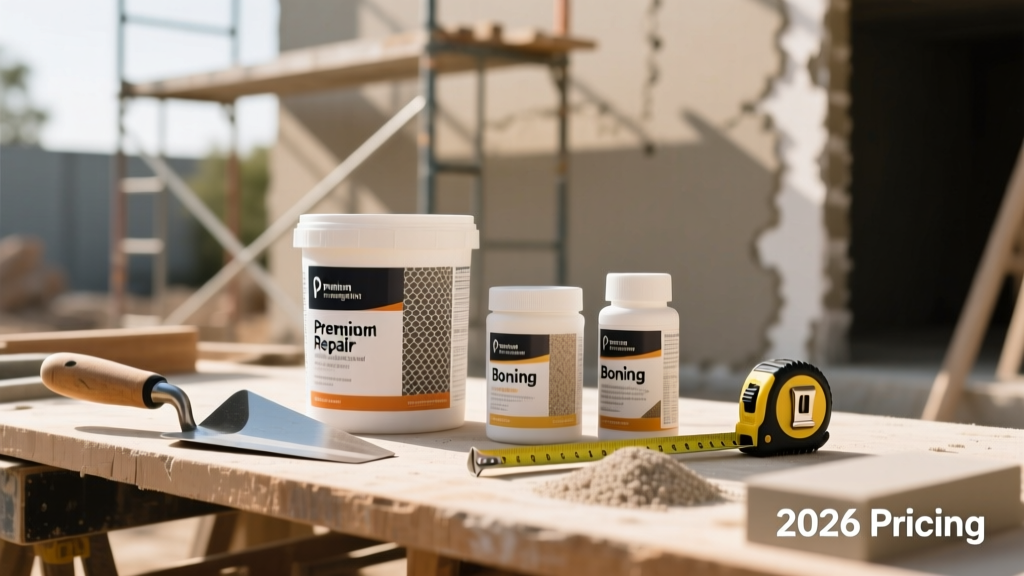
The True Cost of Stucco Repair Materials in 2026
Estimating the cost of stucco repair requires moving beyond simple square-footage averages. In 2026, material pricing is heavily dictated by the specific polymer modifiers, Portland cement blends, and acrylic finishes required for your exact damage profile. While basic cementitious patches remain relatively stable, advanced elastomeric sealants and pre-blended acrylic base coats have seen a 4-6% price increase due to raw material supply chain adjustments.
To accurately budget your project, you must calculate material volume based on the depth and width of the damage, not just the surface area. A hairline crack requires linear feet of elastomeric caulk, while a 1-inch deep spalled area requires cubic feet of base coat plaster. According to industry standards outlined by the American Society for Testing and Materials (ASTM C926), proper stucco application requires distinct base and finish coats, meaning your material ledger must account for both layers when repairing deep structural voids.
- Minor Crack Repair (DIY): $15 - $45 total material cost
- Medium Spalling/Patching (Per Sq Ft): $2.50 - $4.80 per sq ft
- Deep Structural Repair (Per Sq Ft): $6.00 - $11.50 per sq ft (includes lath, base, and finish)
Material Quantity Calculator: Formulas by Damage Type
Use the following formulas to determine exactly how much product to order. Always apply a 15% waste factor to your final calculations to account for irregular crack geometries and trowel drop-off.
1. Hairline Cracks (Under 1/8 Inch)
For cracks narrower than 1/8 inch, do not use standard stucco mix. The aggregate size is too large to penetrate the fissure. Instead, use a high-quality elastomeric stucco caulk or a liquid acrylic patching compound.
- Measurement: Calculate total linear feet (LF) of the crack.
- Formula: Total LF / 15 = Number of 10 oz. tubes required.
- Pro Tip: Over-drill the crack slightly with a masonry bit to create a V-notch, allowing the caulk to bond to the sides rather than just bridging the surface.
2. Medium Cracks and Spalling (1/8 to 1/2 Inch)
Damage in this range requires a pre-mixed, polymer-modified stucco patch. These products contain acrylic polymers that improve adhesion and reduce shrinkage.
- Measurement: Calculate surface square footage (SQ FT) and estimate average depth in inches.
- Formula (Volume): (Length ft × Width ft × Depth in inches) / 12 = Cubic Feet (cu ft).
- Yield Conversion: One gallon of pre-mixed patch yields approximately 0.13 cu ft. Divide your total cu ft by 0.13 to find the required gallons.
3. Deep Structural Damage and Holes (Over 1/2 Inch)
Deep voids require a three-step material approach: a bonding agent, a scratch/brown base coat, and a finish coat. You cannot fill a 2-inch hole with finish coat; it will shrink, crack, and fail within months.
- Measurement: Calculate total cubic feet of the void.
- Base Coat Formula: Total cu ft / 0.45 = Number of 60 lb. bags of base coat required (0.45 cu ft is the standard yield for a 60 lb. bag of Portland cement-based stucco).
- Finish Coat Formula: Total surface SQ FT / 30 = Number of 50 lb. bags of finish coat required (assuming a standard 1/8 inch finish thickness).
2026 Price Matrix: Top Stucco Repair Materials
The table below reflects current 2026 retail pricing for professional-grade and high-end consumer stucco repair materials. Prices are averaged across major national building supply distributors.
| Product / Material | Manufacturer | Application | Unit Size | 2026 Avg Price |
|---|---|---|---|---|
| Stucco Repair Caulk | Quikrete | Hairline cracks | 10 oz. tube | $8.50 |
| Pro-Teck Base Coat | LaHabra | Deep voids / Scratch | 50 lb. bag | $22.00 |
| Stucco Mix (Standard) | Sakrete | Medium spalling | 60 lb. bag | $19.50 |
| Rapid Set Stucco Mix | CTS Cement | Fast-track repairs | 50 lb. bag | $28.00 |
| Premixed Acrylic Finish | LaHabra | Texture / Color coat | 5 gal. pail | $145.00 |
The Auxiliary Material Ledger: Hidden Costs
Contractors rarely quote just for the stucco mix. The following auxiliary materials are mandatory for a code-compliant, long-lasting repair. Failing to budget for these will result in mid-project supply runs and compromised structural integrity.
Never use standard drywall fiberglass mesh for stucco repairs. Wet Portland cement has a highly alkaline pH (between 12 and 13). Standard fiberglass will literally dissolve in this environment within months, leaving your repair with zero tensile strength. You must purchase Alkali-Resistant (AR) fiberglass mesh or galvanized welded wire lath. AR mesh costs approximately $9.50 per 150 ft roll, compared to $4.00 for standard mesh.
- Galvanized Welded Wire Lath (17 gauge): Required for any repair deeper than 1/2 inch or spanning over wood framing. Cost: $1.20 - $1.80 per sq ft.
- Concrete Bonding Adhesive: Painted onto the existing cured stucco edges before applying new base coat to ensure a chemical bond. Cost: $14.00 - $18.00 per gallon (covers ~200 sq ft).
- Corrosion-Resistant Furring Nails/Staples: Used to attach wire lath to the substrate. Must be galvanized or stainless steel to prevent rust bleed-through. Cost: $12.00 per 1 lb box.
- Corner Bead (Galvanized or PVC): Essential for repairing outside corners to ensure a straight, impact-resistant edge. Cost: $4.50 - $7.00 per 10 ft length.
Expert Framework: Material Selection by Climate Zone
Choosing the right stucco repair material is not just about matching the existing texture; it is about matching the thermal and moisture dynamics of your specific climate zone.
Freeze-Thaw Climates (Northern US, Canada)
In regions with severe freeze-thaw cycles, traditional cementitious stucco is prone to micro-cracking as water enters the pores, freezes, and expands. For repairs in these zones, specify polymer-modified acrylic base coats. The acrylic polymers create a flexible matrix that accommodates minor thermal expansion without fracturing. Budget an additional 15% for acrylic modifiers if mixing your own base coat.
High-Heat and Arid Climates (Southwest US)
Rapid moisture evaporation is the enemy of stucco curing. In arid climates, standard stucco mix will dry too quickly, resulting in plastic shrinkage cracking (a network of shallow, hexagonal cracks). Use rapid-setting stucco mixes (like CTS Rapid Set) that chemically cure rather than relying solely on hydration, or add a liquid curing compound to your material list. Curing compounds cost roughly $35 per gallon and are misted onto the repair to trap moisture.
High-Humidity and Coastal Climates (Southeast, Pacific Coast)
Salt spray and constant humidity demand maximum breathability and water resistance. Avoid sealing stucco repairs with non-breathable elastomeric paints, which trap moisture inside the wall cavity and cause the wooden substrate to rot. Instead, invest in a silane/siloxane penetrating water repellent ($45 per gallon) as your final material line item. This penetrates the pores and repels liquid water while allowing water vapor to escape.
Step-by-Step Material Ordering Checklist
Before heading to the supplier, verify your cart against this professional checklist to ensure you have the exact tools and materials required for a seamless repair.
- Substrate Prep: Masonry chisel, wire brush, and masonry cleaner (e.g., TSP substitute).
- Bonding Layer: Concrete bonding adhesive and a 2-inch nylon brush for application.
- Reinforcement: Alkali-resistant mesh or 17-gauge galvanized wire lath, plus corrosion-resistant fasteners.
- Base Coat (Scratch/Brown): Calculate 60 lb. bags based on the 0.45 cu ft yield formula. Add 15% waste.
- Application Tools: Hawk, 14-inch steel finishing trowel, and a scarifier (scratch rake) for the base coat.
- Finish Coat: Premixed acrylic finish or 50 lb. bag of traditional finish coat, color-matched to the existing facade.
- Texture Matching: Dash-blower hopper gun (if matching a roughcast/dash texture) or a float sponge (for smooth/Santa Barbara finish).
- Curing/Sealing: Curing compound for arid zones, or silane/siloxane sealer for coastal zones.
By calculating your stucco repair materials based on volumetric yield rather than superficial square footage, and by investing in alkali-resistant reinforcement and climate-specific polymers, you ensure the repair outlasts the original facade. Accurate material estimation prevents costly mid-project delays and guarantees a structurally sound, weather-tight exterior.