How to Finance the Cost to Build a House in Texas
Master the cost to build a house in Texas with our financing guide. Learn about construction loans, draw schedules, and hidden regional expenses.
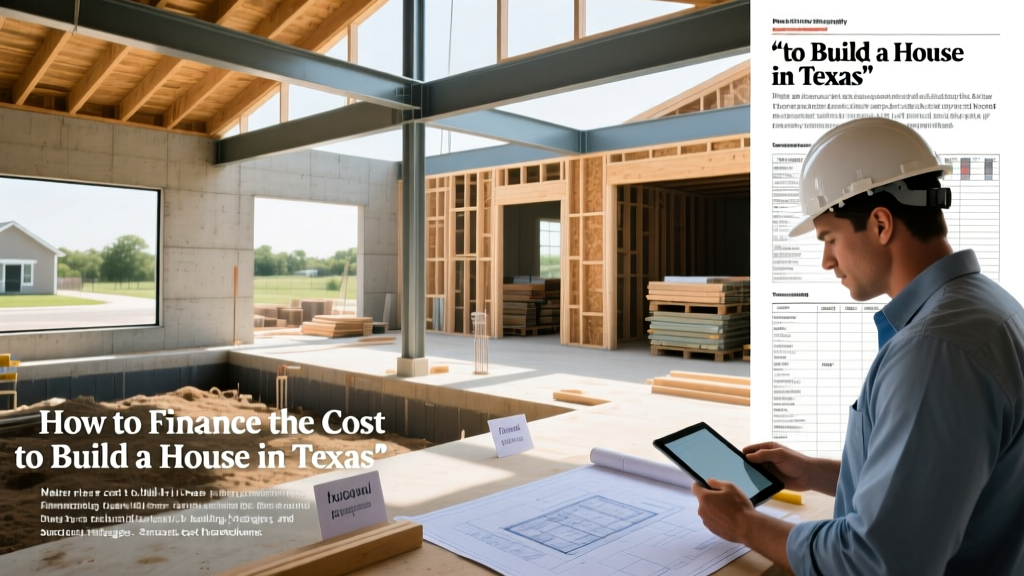
The True Cost to Build a House in Texas: 2026 Baselines
Securing financing begins with an accurate, localized budget. The cost to build a house in Texas varies drastically depending on whether you are building in the sandy soils of East Texas, the expansive clay of the Blackland Prairie, or the rocky terrain of the Hill Country. According to data tracked by the Texas A&M Real Estate Research Center, regional land valuations and municipal impact fees create a wide spread in total project capitalization.
For a standard 2,500-square-foot single-family home in 2026, expect baseline construction costs (excluding land) to range from $165 to $240 per square foot. However, financing the cost to build a house in Texas requires looking beyond just the vertical construction. You must capitalize the land acquisition, site preparation, and soft costs (permits, engineering, and architectural fees).
Estimated Capitalization Breakdown (2,500 Sq. Ft. Build)
| Project Phase | Austin/Hill Country | DFW Metroplex | East Texas/Rural |
|---|---|---|---|
| Land Acquisition (1-2 Acres) | $150,000 - $350,000 | $120,000 - $250,000 | $40,000 - $90,000 |
| Site Prep & Utilities | $25,000 - $45,000 | $12,000 - $20,000 | $15,000 - $35,000 |
| Foundation (Engineered) | $22,000 - $35,000 | $28,000 - $45,000 | $14,000 - $18,000 |
| Vertical Construction | $450,000 - $600,000 | $412,000 - $525,000 | $375,000 - $450,000 |
| Municipal Impact Fees | $15,000 - $25,000 | $10,000 - $18,000 | $0 - $2,000 |
Texas-Specific Construction Loan Options
Traditional mortgages do not fund dirt and lumber. To finance the cost to build a house in Texas, you must utilize specialized construction lending products. Lenders evaluate your debt-to-income (DTI) ratio, the builder's track record, and the future appraised value of the completed home.
Loan Product Matrix
- Construction-to-Permanent (C2P) Loan: Closes once, covering both the build phase and the 30-year mortgage. Best for: Borrowers wanting to lock in a single closing cost and secure an interest rate before the 12-month build finishes.
- Standalone Construction Loan: Short-term (12-18 months), interest-only during the build. Requires a second closing for a permanent mortgage. Best for: Investors or those planning major post-construction landscaping who need flexible draw timelines.
- Texas Veterans Land Board (VLB) Programs: The Texas Veterans Land Board (VLB) offers highly competitive land loans (up to $500,000) and home improvement loans, though veterans often pair a VLB land loan with a VA-backed construction-to-permanent loan from a private lender to fund the vertical build.
Navigating the Draw Schedule: How Lenders Release Funds
Lenders do not hand over $600,000 on day one. Funds are disbursed in 'draws' tied to specific construction milestones. In Texas, lenders typically require third-party inspections (often by TREC-licensed professionals) before releasing the next tranche of capital. A standard Texas draw schedule follows this flow:
- Draw 1: Land & Site Prep (15%) - Covers land payoff (if not owned outright), clearing, grading, and temporary utility poles.
- Draw 2: Foundation (20%) - Released after engineered slab or pier-and-beam foundation is poured and passes municipal inspection.
- Draw 3: Framing & Dried-In (25%) - Covers lumber, trusses, roofing, and exterior windows. The home must be weather-tight.
- Draw 4: MEP Rough-Ins (20%) - Mechanical, electrical, and plumbing lines are run. Must pass city/county rough inspections.
- Draw 5: Drywall & Finishes (15%) - Insulation, sheetrock, cabinetry, flooring, and interior trim.
- Draw 6: Final Completion (5%) - Released only after the Certificate of Occupancy (CO) is issued and final lender appraisal is completed.
Hidden Texas Costs That Derail Construction Budgets
When calculating the cost to build a house in Texas, out-of-state builders and naive buyers frequently underestimate regional geotechnical and environmental mandates. Failing to budget for these will result in mid-build capital calls that your lender may not cover.
⚠️ Geotechnical Foundation Upgrades
If you are building in the Dallas-Fort Worth metroplex or the Austin-San Antonio I-35 corridor, you are likely building on Blackland Prairie expansive clay. This soil swells significantly when wet and shrinks when dry. Standard post-tension slabs often fail here. Structural engineers will mandate drilled concrete piers extending 15 to 25 feet deep to reach stable bedrock. This adds $15,000 to $28,000 to your foundation budget compared to building in the sandy loam of East Texas.
⚠️ TCEQ Aerobic Septic Systems
Building in unincorporated areas of the Hill Country or outside municipal sewer lines requires compliance with the Texas Commission on Environmental Quality (TCEQ). Due to shallow limestone and environmental protection zones, standard anaerobic field lines are frequently denied. You will be forced to install an Aerobic Treatment Unit (ATU) with surface drip irrigation. Budget $18,000 to $25,000 for an ATU system, plus annual maintenance contracts required by county health departments.
Actionable Financing Strategy for Texas Builders
To successfully finance and execute your build, implement this capital preservation framework:
- Mandate a 15% Contingency Reserve: Texas weather events (spring supercells, summer heat halting concrete pours) cause schedule delays. Because construction loans charge interest on drawn funds, delays increase your carrying costs. A 15% contingency built into the loan amount protects you from out-of-pocket interest overruns.
- Lock Rates with a Float-Down Option: If utilizing a C2P loan, negotiate a float-down clause. This allows you to lock a rate to protect against spikes, but capture a lower rate if the bond market improves before your final conversion to a permanent mortgage.
- Pre-Pay Impact Fees: In high-growth municipalities like Frisco, Celina, or Buda, water and wastewater impact fees can exceed $18,000. Pay these directly to the municipality early in the draw schedule to secure your capacity allocation before rate hikes or moratoriums occur.
- Vet the Builder's Financials: Your lender will require the builder's financial statements. Ensure your builder has a dedicated operating line of credit. If a builder relies solely on your draw funds to pay subcontractors from the previous phase, a single delayed inspection will halt your entire project.
Expert Insight: Never sign a construction contract that includes an 'escalation clause' shifting material cost increases to the buyer without a corresponding cap. In the current Texas market, negotiate a fixed-price contract with a maximum 5% contingency allowance for verified lumber and steel market fluctuations.
Written by
James ThorntonJames Thornton is a construction industry veteran with 25 years of hands-on experience in wood framing, lumber grading, and residential building codes. He started as a framing carpenter in rural Oregon, earned his ICC Residential Building Inspector certification, and eventually became a senior plan reviewer for the City of Portland Bureau of Development Services. James holds a B.S. in Wood Science & Technology from Oregon State University and is a certified lumber grader through the West Coast Lumber Inspection Bureau (WCLIB). He has inspected over 3,000 residential construction sites and authored the city's internal guide on advanced framing techniques (2x6 at 24" O.C.). James lives in Bend, OR, where he builds custom timber-frame cabins and competes in lumberjack sports.
More from James Thornton
View all
Insulation
Best Home Insulation Materials: Complete 2026 Guide
Compare top home insulation materials for 2026. Find R-values, installed costs per square foot, and best uses for fiberglass, spray foam, and mineral wool.
Aug 4, 2026

Sustainable Building
Certify Your Green Building Material for LEED and WELL
Step-by-step guide to certifying a green building material for LEED v5 and WELL v2. Master EPDs, HPDs, and VOC limits for 2026 project specifications.
Aug 4, 2026

Stone & Masonry
Veneer Stacked Stone Panels: Interior Design & Style Showcase
Discover how veneer stacked stone panels transform interiors. Explore modern design profiles, material pairings, and technical installation specs.
Aug 4, 2026