Regional Cost to Build Block Wall: 2026 Price Analysis
Discover the regional cost to build block wall in 2026. Compare prices by state, analyze labor rates, and learn how local material costs impact your budget.
The Baseline: National Average Costs for Block Walls
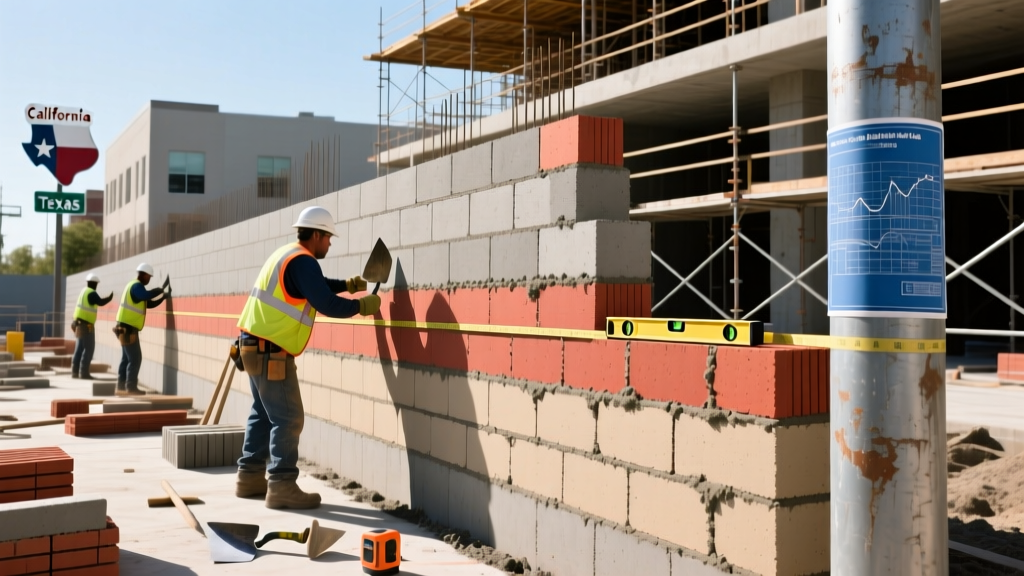
Calculating the cost to build block wall structures requires moving beyond national averages, which often obscure the extreme regional variances inherent in masonry construction. In 2026, the national baseline for a standard 8-inch Concrete Masonry Unit (CMU) wall—encompassing excavation, concrete footing, standard gray 8x8x16 blocks, Type S mortar, vertical #5 rebar, and core-fill grout—ranges from $14.00 to $22.00 per square foot of wall face. However, treating this national average as a hard estimate is a critical error for project budgeting.
Unlike framing lumber or drywall, which are shipped nationally and subject to relatively uniform commodity pricing, CMU blocks are exceptionally heavy (approximately 38 pounds per standard unit) and brittle. This physical reality dictates the '100-mile rule' of masonry: blocks are almost always manufactured and purchased within a 100-mile radius of the job site to prevent freight costs from exceeding the material cost itself. Consequently, the cost to build block wall structures is heavily hyper-localized, driven by regional aggregate prices, local kiln energy costs, and dominant labor market conditions.
- CMU Blocks (8x8x16): $1.85 - $2.50 (1.125 blocks per sq. ft.)
- Type S Mortar & Grout: $0.90 - $1.40
- Steel Reinforcement (#5 Rebar & Wire): $0.60 - $1.20
- Concrete Footing (Allocated per linear ft): $2.50 - $4.50
- Masonry Labor: $8.00 - $16.00+
Regional Price Matrix: Cost to Build Block Wall by Zone
The following matrix breaks down the estimated 2026 costs for a standard 6-foot-tall, unveneered, fully grouted and reinforced structural CMU wall across five major U.S. building zones. These figures assume standard soil conditions and exclude decorative finishes like stucco or stone veneer.
| Region | Material Cost / Sq.Ft. | Labor Cost / Sq.Ft. | Total Cost / Sq.Ft. | Primary Cost Driver |
|---|---|---|---|---|
| Northeast | $6.50 | $15.50 | $22.00 | High union density, deep frost footings |
| Southeast | $5.25 | $8.50 | $13.75 | Lower labor rates, shallow footings |
| Midwest | $5.80 | $11.00 | $16.80 | Extreme frost line excavation costs |
| West Coast | $7.10 | $16.50 | $23.60 | Strict seismic codes, high prevailing wages |
| Southwest | $5.40 | $9.75 | $15.15 | High CMU usage, competitive masonry market |
Deconstructing the West Coast and Northeast Premiums
The West Coast and Northeast consistently post the highest costs to build block wall projects, but for entirely different reasons. In California, Oregon, and Washington, the premium is driven by material complexity and engineering requirements. Seismic design categories D, E, and F mandate heavily reinforced masonry. This means moving from standard vertical rebar to a dense grid of horizontal joint reinforcement (such as Dur-O-Wall truss wire) placed every 16 inches on center, alongside #5 or #6 vertical rebar grouted into every other cell. This doubles the steel tonnage and significantly slows the masons' lay rate.
Conversely, the Northeast premium is almost entirely labor and earthwork driven. States like New York and Massachusetts have dense unionization rates for the International Union of Bricklayers and Allied Craftworkers (BAC). While union masons offer superior productivity and quality control, the fully burdened labor rate (including benefits and insurance) frequently exceeds $95 per hour. Furthermore, the bedrock and dense glacial till common in New England often require rock blasting or specialized trenching equipment just to pour the concrete footing.
Labor Rate Variations: Union vs. Non-Union Markets
Masonry is a highly skilled trade that resists automation; every block is still laid by hand. According to the U.S. Bureau of Labor Statistics, the mean hourly wage for structural masons varies wildly by metropolitan statistical area (MSA). In non-union, right-to-work markets like Florida, Texas, and the Carolinas, open-shop masonry contractors dominate. The cost to build block wall projects in these areas benefits from a deep bench of independent crews, keeping labor costs between $8.00 and $10.00 per square foot of wall face.
"When estimating masonry labor, never calculate based purely on the time it takes to lay the block. A proficient mason can lay 90 to 120 blocks a day, but the true labor cost includes the time spent mixing mortar, setting up scaffolding, cutting blocks for corners and openings, and tooling the joints. In high-wage markets, this prep and cleanup time accounts for nearly 40% of the total labor ticket."
Hidden Regional Costs: Seismic, Frost Line, and Permitting
The most frequent cause of budget overruns in CMU construction is the failure to account for below-grade regional code requirements. The wall you see above ground is only half the structural system; the footing is the other half, and its depth is dictated by local climate and geology.
The Frost Line Factor (Midwest and Northeast)
In regions with severe winters, building codes mandate that footings must extend below the frost line to prevent frost heave from cracking the masonry. According to regional building data and guidelines referenced by FEMA building science publications, the frost line depth dictates massive variations in concrete and excavation costs:
- Central Florida / Deep South: 12-inch footing depth. Minimal excavation, low concrete volume.
- Mid-Atlantic (e.g., Virginia): 18 to 24-inch footing depth. Standard trenching.
- Midwest (e.g., Chicago, IL): 42-inch footing depth. Requires deep trenching, shoring, and significantly more poured concrete.
- Northern Plains (e.g., Minot, ND): 60+ inch footing depth. Excavation costs can sometimes exceed the cost of the above-grade block wall itself.
Seismic and Wind Load Engineering (Coastal and Western Zones)
In High-Velocity Hurricane Zones (HVHZ) like Miami-Dade County, or high seismic zones in Southern California, the TMS 402/602 Building Code Requirements dictate stringent reinforcement protocols. In Florida, this often means filling every single CMU cell with high-strength core-fill grout and using #6 rebar at tight spacing to resist uplift and lateral wind loads. This 'solid grouting' increases the wall's weight by nearly 50%, requiring a wider, deeper concrete footing to support the dead load, directly inflating the overall cost to build block wall structures in these jurisdictions.
Local Material Surcharges and Supply Chain Realities
While a standard 8x8x16 gray CMU block might cost $1.85 in Georgia, that exact same block could cost $2.60 in upstate New York. Why? The raw materials for CMU—Portland cement, sand, and gravel—are cheap, but the manufacturing process is energy-intensive, and the finished product is mostly empty air and heavy aggregate.
Regional energy costs directly impact the price of the blocks. Plants in the Pacific Northwest, where hydroelectric power is cheap, may have a slight manufacturing edge, but the lack of local sand/gravel quarries in certain mountainous regions offsets this. Additionally, if your project requires architectural blocks (split-face, ground-face, or colored CMU), you will likely face regional monopoly pricing. There are far fewer architectural CMU producers than standard gray block producers, meaning you may be forced to pay heavy freight surcharges to ship architectural blocks across state lines.
Actionable Framework: Estimating Your Local Project
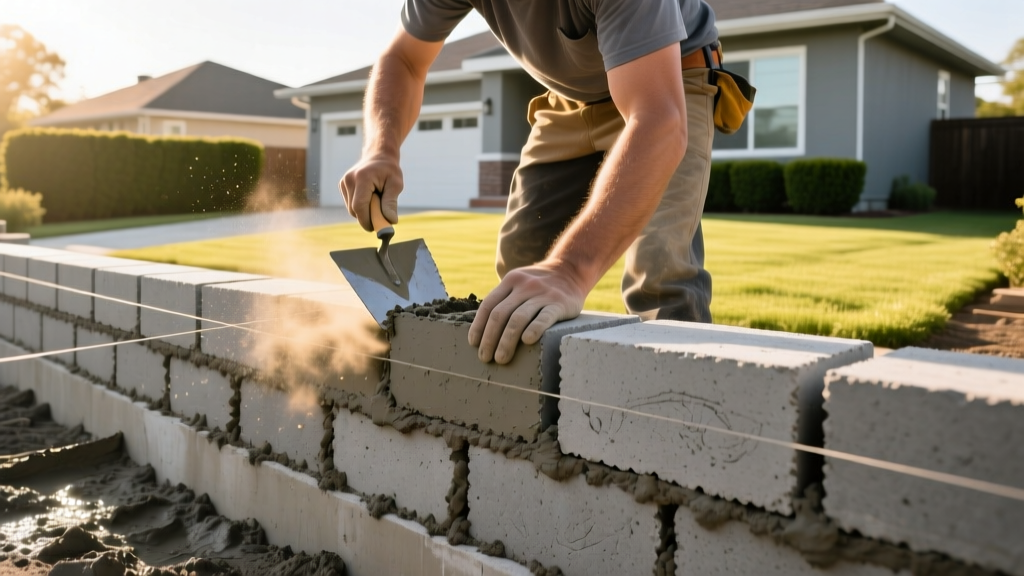
To generate an accurate, region-specific estimate for your 2026 project, follow this sequential framework rather than relying on national online calculators:
Multiply the total linear footage by the desired height. Subtract the square footage of any doors, windows, or beam pockets. Add 5% for block breakage and cutting waste.
Step 2: Determine Local Frost and Seismic RequirementsCall your local municipal building department. Ask specifically for the 'design frost depth' and the 'seismic design category' for your exact zip code. This will dictate your footing dimensions and rebar spacing.
Step 3: Source Local Material QuotesContact the nearest CMU manufacturer (e.g., Oldcastle, Echelon, or a regional independent). Request a delivered quote for standard 8-inch CMU, Type S masonry cement, and masonry sand. Do not rely on big-box store pricing, which includes massive retail markups and lacks bulk delivery logistics.
Step 4: Apply the Regional Labor MultiplierIf you are in a right-to-work southern state, budget $8 - $11 per sq. ft. for labor. If you are in a heavily unionized northern or coastal city, budget $14 - $18+ per sq. ft. Always ensure the labor bid includes scaffolding, mortar mixing, and post-lay cleanup.
By isolating the variables of local freight, municipal code requirements, and prevailing wage conditions, you can transform the cost to build block wall from a vague guess into a highly accurate, defensible construction budget.
Written by
James ThorntonJames Thornton is a construction industry veteran with 25 years of hands-on experience in wood framing, lumber grading, and residential building codes. He started as a framing carpenter in rural Oregon, earned his ICC Residential Building Inspector certification, and eventually became a senior plan reviewer for the City of Portland Bureau of Development Services. James holds a B.S. in Wood Science & Technology from Oregon State University and is a certified lumber grader through the West Coast Lumber Inspection Bureau (WCLIB). He has inspected over 3,000 residential construction sites and authored the city's internal guide on advanced framing techniques (2x6 at 24" O.C.). James lives in Bend, OR, where he builds custom timber-frame cabins and competes in lumberjack sports.
More from James Thornton
View all
Insulation
Best Home Insulation Materials: Complete 2026 Guide
Compare top home insulation materials for 2026. Find R-values, installed costs per square foot, and best uses for fiberglass, spray foam, and mineral wool.
Aug 4, 2026

Sustainable Building
Certify Your Green Building Material for LEED and WELL
Step-by-step guide to certifying a green building material for LEED v5 and WELL v2. Master EPDs, HPDs, and VOC limits for 2026 project specifications.
Aug 4, 2026

Stone & Masonry
Veneer Stacked Stone Panels: Interior Design & Style Showcase
Discover how veneer stacked stone panels transform interiors. Explore modern design profiles, material pairings, and technical installation specs.
Aug 4, 2026