How Much Does It Cost to Build an Indoor Pool? 2026 Regional Data
Discover how much it costs to build an indoor pool across different US regions. Compare labor, materials, and HVAC requirements by climate zone.
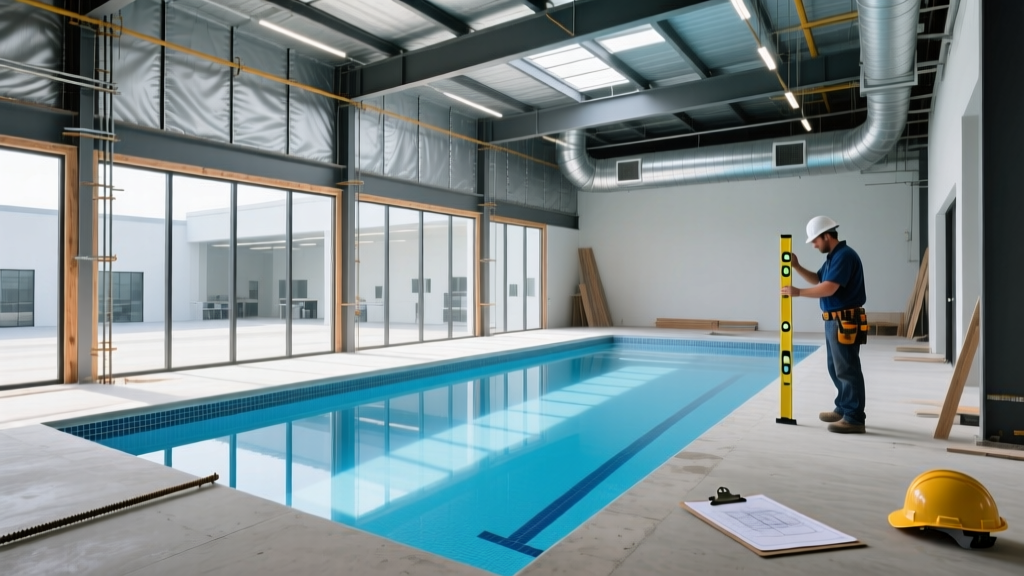
The national average to build an indoor pool ranges from $185,000 to $350,000 for a standard 450-square-foot (15x30 ft) gunite shell with a dedicated enclosure and commercial-grade dehumidification. However, asking how much does it cost to build indoor pool without factoring in your specific ZIP code ignores the massive regional variances in labor rates, frost-line engineering, and climate-specific HVAC loads. A project that costs $210,000 in Texas can easily exceed $420,000 in coastal California due to seismic engineering, union labor, and strict energy codes.
Baseline National Cost Breakdown (15x30 ft Gunite Pool)
- Excavation & Shell (Gunite/Shotcrete): $65,000 - $95,000
- Enclosure & Insulation (Clear-span timber/steel): $55,000 - $110,000
- HVAC & Dehumidification System: $25,000 - $45,000
- Plumbing, Filtration & Automation: $18,000 - $30,000
- Interior Finish (Pebble/Tile) & Decking: $22,000 - $40,000
2026 Regional Price Matrix: Where Your Budget Goes
Regional pricing is dictated by three main factors: local construction wages, soil/frost conditions, and climate-driven mechanical requirements. According to the Bureau of Labor Statistics, construction and extraction occupations see wage variations of up to 60% between the lowest and highest paying states, directly impacting your bottom line.
| Region | Avg. Total Cost | Primary Cost Driver | Avg. Labor Rate |
|---|---|---|---|
| Northeast (NY, MA, CT) | $260k - $410k | Deep frost lines, high union labor rates | $85 - $130/hr |
| Southeast (FL, GA, NC) | $190k - $280k | Extreme dehumidification, sandy soil piers | $55 - $85/hr |
| Midwest (IL, OH, MN) | $210k - $330k | High R-value insulation, freeze-thaw engineering | $65 - $95/hr |
| West Coast (CA, WA, OR) | $280k - $450k+ | Seismic retrofitting, Title 24 energy compliance | $90 - $145/hr |
The Hidden Cost: Climate-Specific HVAC & Dehumidification
The most common point of budget failure in indoor pool construction is underestimating the mechanical requirements of the enclosure. The Pool & Hot Tub Alliance (PHTA) and ASHRAE standards dictate that indoor pool environments must maintain a relative humidity of 50-60% and keep the air temperature 2°F to 4°F above the water temperature to prevent evaporative cooling and condensation.
Humid vs. Arid Climates
If you are building in Florida or the Gulf Coast, the ambient outdoor air already holds massive amounts of moisture. Your make-up air systems and dehumidifiers (such as a PoolPak CL Series or Desert Aire unit) must work exponentially harder. Expect to spend $30,000 to $45,000 on a commercial-grade dehumidification system with 316L stainless steel ductwork to resist chlorine-induced corrosion.
Conversely, building in Arizona or Nevada requires a different approach. The dry air accelerates evaporation, meaning you will lose more water and heat to the atmosphere. Here, the budget shifts toward heavy-duty evaporative cooling systems for the summer and high-capacity make-up air handlers to prevent the space from becoming a stagnant, chemical-heavy sauna.
Foundation, Soil, and Frost Line Engineering
The dirt beneath your pool dictates your excavation and structural costs. In the Midwest and Northeast, frost lines can extend 48 to 60 inches below grade. Footings for the pool shell and the enclosure's load-bearing columns must be poured below this line to prevent frost heave, which can crack the gunite shell and shatter glass enclosure panels. This requires deeper trenching, more concrete, and extended heavy equipment rental times.
In the Southeast and coastal regions, the issue is not frost, but soil composition. Sandy or highly organic soils lack the bearing capacity to support a 120,000-pound water load plus the structural enclosure. Engineers will frequently require helical piers driven 20 to 40 feet into the bedrock to stabilize the pool shell, adding $12,000 to $25,000 to the foundation budget. In Texas and Oklahoma, expansive clay soils require specialized void forms beneath the concrete decking to prevent the soil from swelling and lifting the deck during heavy rains.
State Permitting and Energy Code Variances
Local building codes drastically alter the final invoice, particularly regarding energy efficiency and structural safety.
- California (Title 24): California's strict energy codes mandate the use of variable-speed pumps, specific pipe insulation thicknesses, and mandatory automatic pool covers. An automatic safety cover (like a Cover-Pools track system) is required to prevent evaporative heat loss when the pool is not in use, adding $8,000 to $14,000 to the project. Furthermore, the U.S. Department of Energy notes that using a pool cover can reduce heating costs by 50-70%, making it a mandatory ROI factor in regulated states.
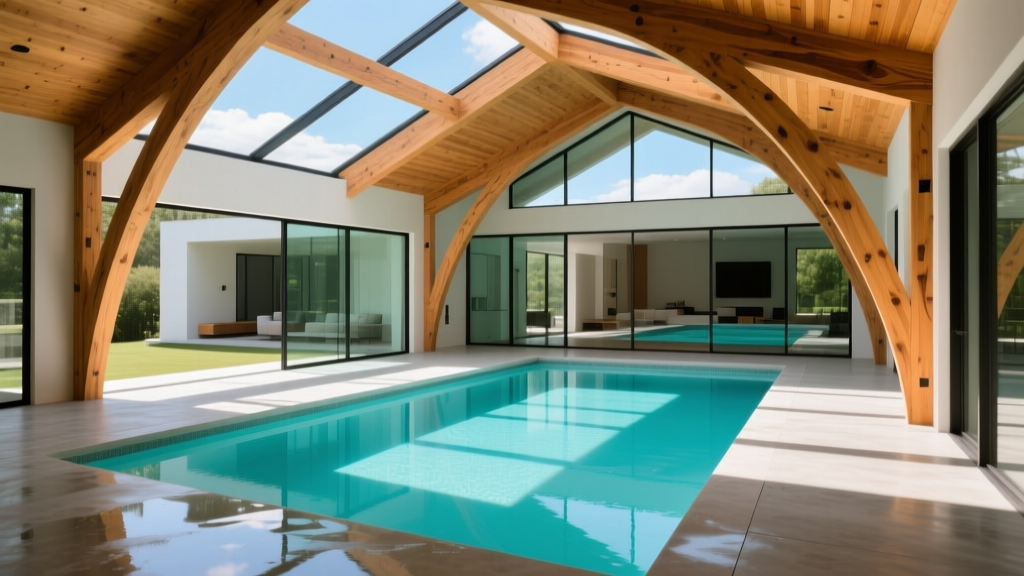
- Pacific Northwest & California (Seismic Zones): If your indoor pool features a glass-enclosed sunroom or large skylights, the structural framing must be engineered to withstand lateral seismic loads. This requires moment frames, specialized structural silicone glazing, and heavier steel or engineered timber trusses, increasing enclosure costs by 15-25%.
- Urban Northeast (Zoning & Access): In dense areas like Westchester County, NY, or Fairfield County, CT, limited lot access often prevents the use of standard excavators. Contractors may need to use conveyor belts to remove spoil or pump gunite through specialized line trucks, adding $10,000+ in logistical surcharges.
Regional Adaptation Framework: How to Optimize Your Build
Use this decision framework to adapt your indoor pool design to your specific region and avoid unnecessary over-engineering.
1. The Cold-Climate Strategy (MN, WI, NY, MA)
Focus: Thermal Envelope & Vapor Barriers.
Action: Invest heavily in the enclosure's insulation. Specify closed-cell spray foam (minimum R-30 for walls, R-50 for the roof deck) to create a seamless vapor barrier. Install triple-pane, argon-filled, low-E glass for any skylights or windows to prevent interior condensation drip. Use a heat-recovery ventilator (HRV) integrated with your dehumidifier to capture waste heat from the exhaust air and pre-heat the incoming make-up air.
2. The High-Humidity Strategy (FL, GA, LA)
Focus: Corrosion Resistance & Airflow.
Action: Prioritize the mechanical budget over aesthetic finishes. Specify 316L stainless steel for all handrails, ladders, and HVAC components. Ensure your dehumidification system is sized for a 90°F water temperature (if using a spa) rather than a standard 82°F pool, as higher water temps exponentially increase the evaporation rate. Design the enclosure with sloped ceilings and integrated gutters to manage inevitable condensation runoff.
3. The Expansive Soil Strategy (TX, CO, OK)
Focus: Subgrade Stabilization.
Action: Do not rely on standard slab-on-grade engineering for the surrounding deck. Use structural void forms (like Waffle Mats or cardboard tubes) beneath the concrete decking to create a gap that allows the expansive clay to swell without exerting upward pressure on the concrete. Isolate the pool shell from the surrounding deck with a 1-inch expansion joint filled with closed-cell backer rod and polyurethane sealant.
"An indoor pool is not just a pool; it is a complex, high-humidity micro-climate housed within your home's structural envelope. The regional climate dictates the mechanical lung of the building. Under-sizing the dehumidification system by even 15% to save money upfront will result in catastrophic mold growth and structural rot within 36 months."
Ultimately, accurately determining how much it costs to build an indoor pool requires moving past national averages. By analyzing your local labor rates, understanding your region's specific soil and frost constraints, and properly sizing your HVAC equipment for your exact climate zone, you can build a precise, defensible budget that prevents mid-construction change orders.
Written by
Elena RodriguezElena Rodriguez is a civil engineer and technical writer specializing in concrete technology, masonry systems, and ASTM/ACI compliance. She earned her B.S. in Civil Engineering from Texas A&M University and spent a decade at a materials testing laboratory, performing over 2,000 concrete compressive strength tests and masonry prism evaluations. Elena is an ACI-certified Field Testing Technician (Grade I) and a member of ASTM Committee C12 on Natural Building Stone. She currently consults on forensic engineering cases involving concrete failures and moisture intrusion. Based in San Antonio, TX, Elena is a proud member of the Society of Women Engineers (SWE) and coaches her daughter's FIRST Robotics team.
More from Elena Rodriguez
View all
Walls & Panels
Cost Analysis: Light Gauge Steel Framing Advantages and Disadvantages
Evaluate light gauge steel framing advantages and disadvantages through a strict cost analysis lens, comparing material, labor, and lifecycle expenses.
Aug 4, 2026

Walls & Panels
Gypsum Board Types: Exact Specifications, Thickness & Dimensions
Compare standard, Type X, and moisture-resistant gypsum board types. Get exact specifications, thicknesses, dimensions, and ASTM standards for your project.
Aug 4, 2026

Fire Resistance
Best Fire-Resistant Outdoor Decking Materials: 2026 Buyer Guide
Discover the best fire-resistant outdoor decking materials for 2026. Compare Class A PVC, aluminum, and hardwood options for WUI compliance and safety.
Aug 4, 2026