The Complete Guide to Contemporary Exterior Stone Veneer Design and Installation
Master contemporary exterior stone veneer with our complete material guide. Explore linear profiles, installation specs, costs, and modern facade design.
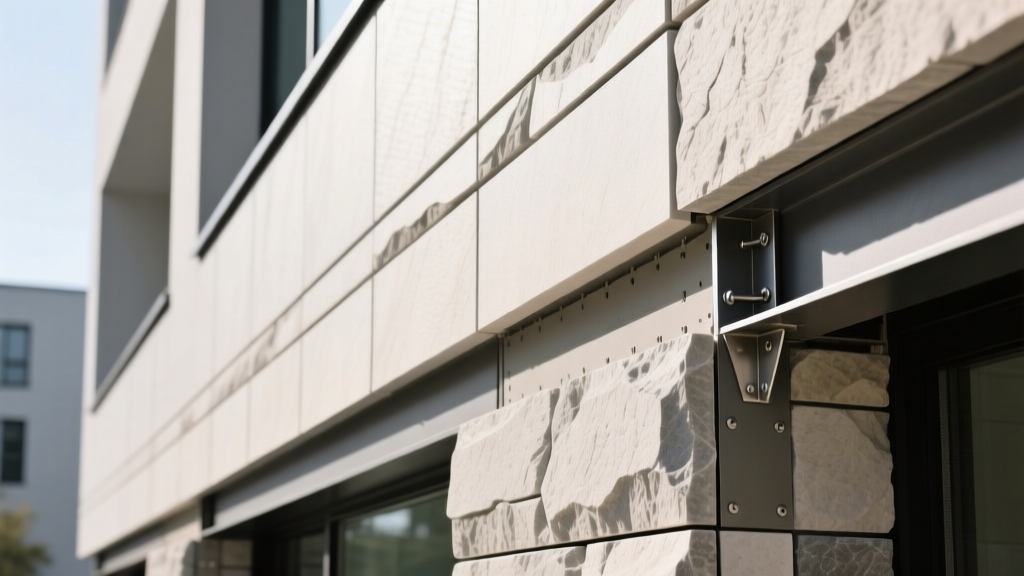
Defining the Contemporary Aesthetic in Stone Veneer
Contemporary exterior stone veneer represents a distinct departure from the randomized, rustic patterns of traditional fieldstone and cobble. The modern architectural approach prioritizes precision, linear geometry, and monochromatic or tightly controlled color palettes. Instead of mimicking natural, centuries-old masonry, contemporary facades use stone as a deliberate, engineered cladding element. This is achieved through dimensional cutting, tight dry-stack joints, and horizontal emphasis that aligns with the clean sightlines of modern and mid-century modern architecture.
Transitioning to a contemporary exterior stone veneer application requires a shift in both material selection and installation methodology. The tolerances for error are significantly lower; a 1/4-inch variance in a traditional stacked stone wall is unnoticeable, but in a linear, tight-joint contemporary installation, it disrupts the entire facade. This guide details the specific materials, structural requirements, and design frameworks necessary to execute a flawless modern stone exterior.
Top Material Choices for Modern Facades
The contemporary aesthetic relies heavily on materials that can be precision-cut into uniform, linear profiles. The two primary categories dominating this space are natural dimensional stone and architectural manufactured veneer.
Natural Linear Basalt and Slate
Natural basalt is the premier choice for high-end contemporary exteriors. Its inherent density and low water absorption rate (typically less than 1%) make it highly resistant to freeze-thaw cycling. For modern applications, basalt is quarried and gang-sawn into strict dimensional strips—commonly 2"x12", 4"x12", or 6"x24". The finish is usually honed or thermal-flamed to provide a uniform, matte texture that absorbs light rather than reflecting it. Black, charcoal, and dark grey basalts are preferred for their ability to create sharp contrasts against lighter cladding materials.
Linear slate is also utilized, though it requires stricter quality control. Only high-density, non-oxidizing slate (such as specific Welsh or North American unfading grades) should be used for exterior veneers, as lower-grade slates can delaminate or rust when exposed to continuous moisture.
Architectural Manufactured Veneer (AMV)
For projects where natural stone weight or budget is a constraint, Architectural Manufactured Veneer provides a highly controlled alternative. Modern AMV is cast from Portland cement, lightweight aggregates, and iron oxide pigments. The advantage of AMV in contemporary design is the ability to manufacture perfectly uniform linear profiles with integrated interlocking edges. Products like linear dimensional profiles allow installers to maintain exact 1/8-inch or 1/16-inch tight joints across hundreds of square feet without the need for constant cutting and trimming required by natural stone.
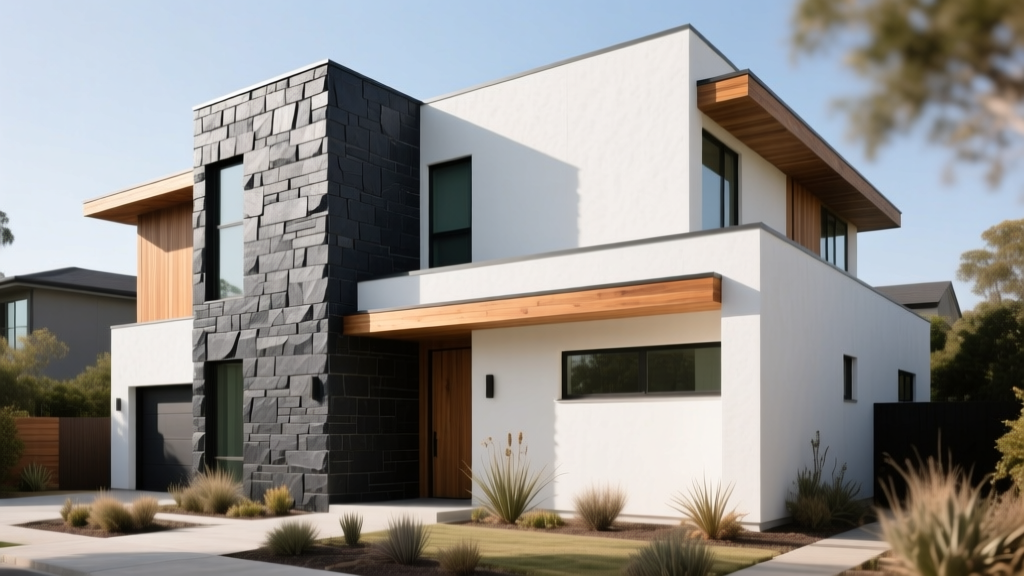
To prevent a contemporary facade from looking visually heavy or chaotic, apply the 70/30 rule. Dedicate 70% of the exterior envelope to smooth, neutral, and planar materials (such as smooth-trowel stucco, fiber cement panels, or standing seam metal). Reserve the remaining 30% for high-texture, high-contrast materials like contemporary linear stone veneer, applying it strategically to anchor the structure, frame entryways, or emphasize horizontal rooflines.
Cost Breakdown: Contemporary vs. Traditional Profiles
Contemporary installations generally command a premium over traditional profiles. While the materials themselves may have overlapping price ranges, the labor required to achieve perfectly plumb, level, and uniform tight joints significantly increases the total installed cost.
| Material Type | Material Cost (per sq. ft.) | Labor Cost (per sq. ft.) | Total Installed | Best Application |
|---|---|---|---|---|
| Natural Linear Basalt | $16.00 - $24.00 | $14.00 - $20.00 | $30.00 - $44.00 | High-end residential, commercial accents |
| Manufactured Linear AMV | $9.00 - $14.00 | $12.00 - $18.00 | $21.00 - $32.00 | Full-facade residential, multi-family |
| Panelized Mesh-Backed Stone | $12.00 - $18.00 | $8.00 - $12.00 | $20.00 - $30.00 | Large commercial facades, speed-critical builds |
| Traditional Fieldstone (Reference) | $7.00 - $12.00 | $10.00 - $15.00 | $17.00 - $27.00 | Rustic, farmhouse, traditional estates |
Critical Installation Specs for Exterior Applications
Installing contemporary exterior stone veneer requires strict adherence to modern building science, particularly regarding moisture management. The tight, recessed, or dry-stack joints characteristic of modern designs do not shed water as effectively as the deep, overhanging mortar joints of traditional masonry.
Moisture Management and Drainage Planes
A standard weather-resistive barrier (WRB) is insufficient for contemporary tight-joint veneer. You must incorporate a three-dimensional drainage matrix (such as Mortairvent or a similar entangled mesh product) between the WRB and the metal lath. This creates a capillary break and a continuous air gap, allowing any water that penetrates the tight stone joints to drain freely down the wall cavity and exit through weep screeds.
According to installation standards outlined in resources like the Eldorado Stone Installation Manuals and ASTM C1780, the weep screed must be installed a minimum of 4 inches (100mm) above finished grade, or 2 inches above paved surfaces, to prevent soil moisture from wicking back into the stone assembly.
Mortar Selection and Joint Treatment
For contemporary linear profiles installed with tight joints (1/16" to 1/8"), traditional Type N or Type S masonry mortar is often impractical due to its coarse aggregate size and rapid moisture loss in thin applications. Instead, use a polymer-modified thin-set mortar meeting ANSI A118.15 standards for improved adhesion and flexibility. For grouted contemporary joints, a fine-sanded, efflorescence-controlled masonry grout is mandatory to maintain the clean, sharp lines without the risk of white salt deposits ruining the dark, monochromatic stone.
Contemporary dark stone (like black basalt or charcoal AMV) makes efflorescence (white salt staining) highly visible. Because tight joints limit the surface area for moisture evaporation, trapped water is forced to migrate through the stone face, depositing salts. Always specify low-alkali Portland cement in your mortar and grout mixes, ensure the wall assembly is fully dried in before sealing, and never use acid-based cleaners on the finished facade.
Panelized vs. Individual Piece Installation
To maintain the rigorous horizontal sightlines required in contemporary design, many commercial and high-end residential projects are shifting to panelized systems. These consist of linear stone strips pre-arranged and mesh-backed in 2'x4' panels. Panelized installation reduces labor time by up to 40% and eliminates the "wavy" joint lines that can occur when individual pieces are laid by hand over long distances. When using panels, it is critical to stagger the vertical seams and blend panels from multiple pallets to avoid repeating color clusters.
Maintenance and Long-Term Durability
Contemporary stone veneers require minimal but specific maintenance. Unlike traditional stone, which develops a desired patina over time, modern facades are designed to look pristine and engineered. To preserve this look, avoid pressure washing, which can erode the pigments in manufactured stone and drive water behind the tight joints. Instead, use a low-pressure garden hose and a neutral pH, non-acidic masonry cleaner for annual washing. For natural basalt and slate, applying a breathable, penetrating siloxane-based sealer every 5 to 7 years will prevent water absorption and subsequent freeze-thaw spalling, ensuring the facade maintains its sharp, contemporary profile for decades.
For further exploration of how these materials are being integrated into global architecture, reviewing project archives on platforms like ArchDaily Stone Facades provides excellent visual case studies on blending linear stone with modern building envelopes. Additionally, consulting LATICRETE Technical Resources can provide exact specifications for the advanced polymer mortars required for these demanding exterior applications.
Written by
James ThorntonJames Thornton is a construction industry veteran with 25 years of hands-on experience in wood framing, lumber grading, and residential building codes. He started as a framing carpenter in rural Oregon, earned his ICC Residential Building Inspector certification, and eventually became a senior plan reviewer for the City of Portland Bureau of Development Services. James holds a B.S. in Wood Science & Technology from Oregon State University and is a certified lumber grader through the West Coast Lumber Inspection Bureau (WCLIB). He has inspected over 3,000 residential construction sites and authored the city's internal guide on advanced framing techniques (2x6 at 24" O.C.). James lives in Bend, OR, where he builds custom timber-frame cabins and competes in lumberjack sports.
More from James Thornton
View all
Insulation
Best Home Insulation Materials: Complete 2026 Guide
Compare top home insulation materials for 2026. Find R-values, installed costs per square foot, and best uses for fiberglass, spray foam, and mineral wool.
Aug 4, 2026

Sustainable Building
Certify Your Green Building Material for LEED and WELL
Step-by-step guide to certifying a green building material for LEED v5 and WELL v2. Master EPDs, HPDs, and VOC limits for 2026 project specifications.
Aug 4, 2026

Stone & Masonry
Veneer Stacked Stone Panels: Interior Design & Style Showcase
Discover how veneer stacked stone panels transform interiors. Explore modern design profiles, material pairings, and technical installation specs.
Aug 4, 2026