2026 Cost to Install Stone Veneer Siding: Full Price Breakdown
Discover the true 2026 cost to install stone veneer siding. We break down material prices, labor rates, and hidden prep expenses for your exterior project.
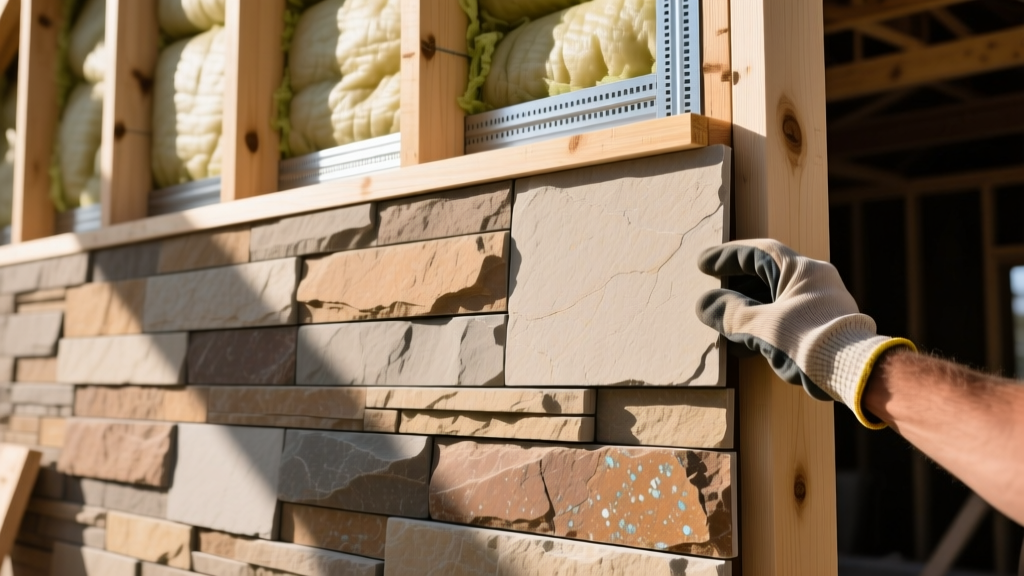
The True Cost to Install Stone Veneer Siding in 2026
The national average cost to install stone veneer siding in 2026 ranges from $19.00 to $35.00 per square foot, with most homeowners spending between $28,500 and $52,500 for a standard 1,500-square-foot exterior application. This price encompasses material procurement, structural preparation, moisture management systems, and specialized masonry labor. However, treating stone veneer as a simple cosmetic overlay leads to severe budget overruns. The final invoice is heavily dictated by substrate preparation, the choice between manufactured and natural stone, and regional masonry labor premiums.
Unlike vinyl or fiber cement siding, adhered stone masonry veneer (ASMV) requires a multi-layered assembly to manage hydrostatic pressure and prevent efflorescence. Understanding the line-item costs of these hidden layers is critical for accurate project forecasting.
2026 National Cost Averages (Per Square Foot)
- Manufactured Stone Veneer (MSV): $19.00 – $27.00 installed
- Natural Stone Veneer: $26.00 – $38.00+ installed
- Siding Tear-Off & Disposal: $1.50 – $3.50
- Water-Resistive Barrier & Lath Prep: $3.50 – $6.00
Material Cost Matrix: Manufactured vs. Natural Stone
The most significant variable in your estimate is the stone itself. Manufactured Stone Veneer (MSV) is cast from architectural concrete and iron oxide pigments in molds taken from real stone, while natural veneer is quarried, sliced, and palletized. Both adhere to strict weight limitations to avoid requiring structural foundation reinforcement, but their pricing structures differ vastly.
| Cost Factor | Manufactured Stone (MSV) | Natural Stone Veneer |
|---|---|---|
| Material Cost (Field Stone) | $7.00 – $13.00 / sq ft | $12.00 – $22.00 / sq ft |
| Corner Pieces (Per Linear Ft) | $10.00 – $18.00 / lin ft | $18.00 – $35.00 / lin ft |
| Weight (Lbs per Sq Ft) | 10 – 12 lbs | 13 – 25 lbs |
| Waste Factor Required | 5% – 8% | 10% – 15% |
| Color Consistency | High (Batch controlled) | Low (Natural variation) |
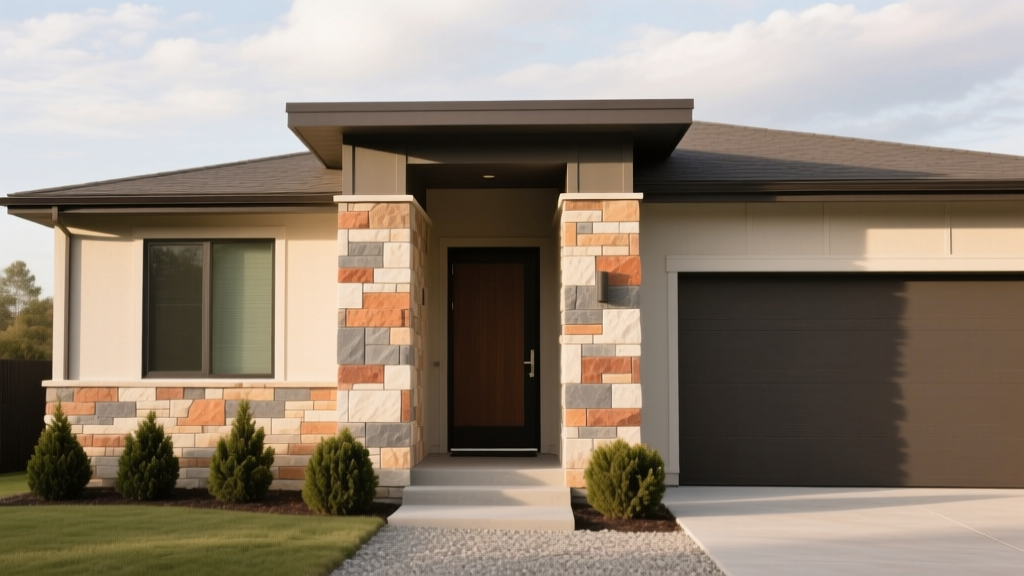
Hidden Assembly Costs: Moisture Management and Lath
Adhered stone veneer is a porous, absorbent cladding. If installed directly over wood sheathing or existing siding, trapped moisture will cause catastrophic rot and mold. The International Residential Code (IRC) mandates specific water management layers, which account for a substantial portion of the prep budget. According to the U.S. Department of Energy, proper water-resistive barriers (WRB) are non-negotiable for managing bulk water and vapor diffusion in exterior wall assemblies.
1. Siding Tear-Off and Substrate Prep
If your home currently has vinyl, wood, or aluminum siding, it must be removed. Tear-off and disposal cost $1.50 to $3.50 per square foot. If the existing sheathing (OSB or plywood) shows water damage, replacement runs $65 to $85 per 4x8 sheet, including labor.
2. Water-Resistive Barrier (WRB)
Two layers of Grade D building paper or a high-performance fluid-applied membrane (like Prosoco R-Guard or Henry BlueSkin) must be applied. Fluid-applied membranes cost more upfront ($1.50 – $2.50 per sq ft) but eliminate the risk of fastener punctures compromising the drainage plane.
3. Metal Lath and Weep Screed
Per ASTM C1063 standards, a minimum 2.5 lb self-furring galvanized welded wire lath must be mechanically fastened to the wall studs (not just the sheathing) using corrosion-resistant fasteners. Crucially, a corrosion-resistant weep screed must be installed at the base of the wall. The weep screed must terminate at least 4 inches above grade or 2 inches above paved surfaces to prevent capillary action from drawing soil moisture into the masonry assembly. Lath and screed installation adds $2.50 to $4.50 per square foot in materials and labor.
Masonry Labor Rates and Regional Variations
Stone veneer installation is not a general carpentry task; it requires skilled masons who understand mortar hydration, joint tooling, and stone blending. According to the U.S. Bureau of Labor Statistics, the median wage for skilled stonemasons has climbed steadily, reflecting a nationwide shortage of specialized tradespeople. In 2026, expect masonry labor to range from $12.00 to $22.00 per square foot, depending on the complexity of the profile and regional unionization rates.
- Northeast & West Coast Metros: $18.00 – $25.00 / sq ft (High union density, strict seismic building codes requiring additional wall ties).
- Midwest & Southeast Suburbs: $12.00 – $16.00 / sq ft (Highly competitive non-union markets, lower cost of living adjustments).
- Rural / Remote Areas: Base rates may be lower, but travel mobilization fees and material freight surcharges for heavy stone pallets can add 15% to the total invoice.
Mortar Selection and Jointing Techniques
The type of mortar and the joint finish directly impact labor time. Standard Type N mortar is sufficient for most MSV applications, but Type S mortar (which has higher compressive and bond strength) is required for heavy natural stone or applications in high-seismic zones. Furthermore, a 'raked' or 'grapevine' joint requires the mason to manually tool every seam with a specialized iron after the mortar reaches a thumbprint hardness. A standard flush or slightly recessed joint is 15% to 20% faster to execute, reducing labor costs on large commercial or full-wrap residential projects.
Step-by-Step Cost Accumulation for a 1,500 Sq Ft Project
To understand how the final invoice materializes, here is a sequential cost buildup for a standard 1,500-square-foot exterior transformation using mid-grade Manufactured Stone Veneer in a suburban market.
- Demolition & Disposal (Existing Vinyl Siding): 1,500 sq ft × $2.00 = $3,000
- Fluid-Applied WRB & Flashing Integration: 1,500 sq ft × $1.80 = $2,700
- Galvanized Lath, Fasteners, & Weep Screed: 1,500 sq ft × $3.50 = $5,250
- MSV Material (Field Stone + 120 Lin Ft Corners): ($9.00 × 1,500) + ($14.00 × 120) = $15,180
- Portland Cement Mortar & Bonding Agents: Flat rate estimate = $1,800
- Skilled Masonry Labor (Prep, Scratch Coat, Setting, Jointing): 1,500 sq ft × $14.50 = $21,750
- Equipment, Scaffolding, & Site Protection: Flat rate estimate = $2,200
- Total Estimated Project Cost: $51,880 (Approx. $34.58 per square foot fully loaded)
Long-Term ROI and Maintenance Realities
Stone veneer consistently ranks among the highest-return exterior upgrades in real estate appraisal data, often recouping 90% to 105% of its installation cost at resale due to its massive curb appeal and perceived permanence. However, the 'zero maintenance' claim marketed by manufacturers requires an asterisk.
While the stone itself will not degrade, the mortar joints are susceptible to freeze-thaw cycling if improperly sealed or if the weep screeds become blocked by landscaping mulch or soil grading. Homeowners must ensure that soil and hardscaping are maintained at least 4 inches below the weep screed flange. Additionally, applying a breathable, siloxane-based penetrating sealer (costing roughly $0.75 per square foot every 5 to 7 years) is highly recommended in northern climates to prevent water intrusion and subsequent efflorescence—the white, powdery salt deposit that forms on masonry surfaces when moisture evaporates through the stone face.
Written by
James ThorntonJames Thornton is a construction industry veteran with 25 years of hands-on experience in wood framing, lumber grading, and residential building codes. He started as a framing carpenter in rural Oregon, earned his ICC Residential Building Inspector certification, and eventually became a senior plan reviewer for the City of Portland Bureau of Development Services. James holds a B.S. in Wood Science & Technology from Oregon State University and is a certified lumber grader through the West Coast Lumber Inspection Bureau (WCLIB). He has inspected over 3,000 residential construction sites and authored the city's internal guide on advanced framing techniques (2x6 at 24" O.C.). James lives in Bend, OR, where he builds custom timber-frame cabins and competes in lumberjack sports.
More from James Thornton
View all
Insulation
Best Home Insulation Materials: Complete 2026 Guide
Compare top home insulation materials for 2026. Find R-values, installed costs per square foot, and best uses for fiberglass, spray foam, and mineral wool.
Aug 4, 2026

Sustainable Building
Certify Your Green Building Material for LEED and WELL
Step-by-step guide to certifying a green building material for LEED v5 and WELL v2. Master EPDs, HPDs, and VOC limits for 2026 project specifications.
Aug 4, 2026

Stone & Masonry
Veneer Stacked Stone Panels: Interior Design & Style Showcase
Discover how veneer stacked stone panels transform interiors. Explore modern design profiles, material pairings, and technical installation specs.
Aug 4, 2026