Technical Specs to Verify When Buying Inexpensive Stone Veneer
Evaluate inexpensive stone veneer using critical ASTM technical specs, including weight, compressive strength, and freeze-thaw durability for code compliance.
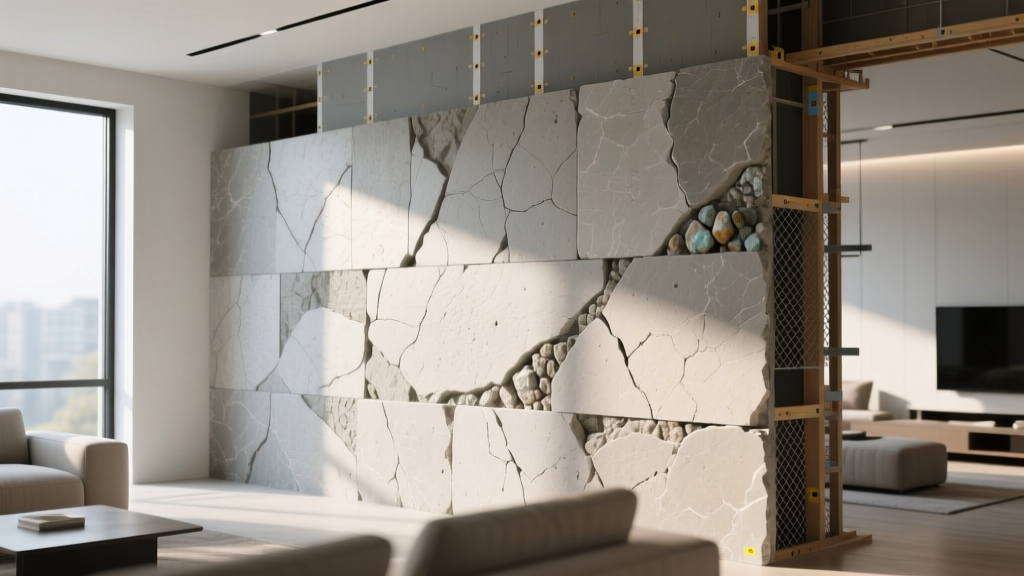
Defining 'Inexpensive' in Manufactured Stone Veneer (MSV)
In the 2026 construction market, the term 'inexpensive stone veneer' almost exclusively refers to budget-tier Manufactured Stone Veneer (MSV). While premium MSV and natural stone cladding typically range from $12.00 to $35.00 per square foot for materials, budget MSV options are priced between $5.50 and $8.50 per square foot. Manufacturers achieve these lower price points by utilizing high-volume, automated casting processes, substituting expensive iron-oxide pigments with cheaper alternatives, and using lighter, more porous aggregates like expanded shale or pumice instead of dense quartz or natural sand.
However, a lower price tag does not exempt the material from strict building codes. When specifying budget-friendly adhered masonry, contractors and architects must rigorously verify the technical data sheets to ensure the product meets the baseline structural and environmental thresholds required by the International Residential Code (IRC). Ignoring these specifications to save $3.00 per square foot frequently results in catastrophic moisture intrusion, spalling, and efflorescence within the first three years of installation.
The Governing ASTM Standards for Budget MSV
Any legitimate manufacturer of inexpensive stone veneer must test and certify their products against two primary standards established by ASTM International. When reviewing a supplier's technical submittal, verify explicit compliance with both:
- ASTM C1670: Standard Specification for Adhered Manufactured Stone Masonry Veneer. This covers the overall system requirements, including the maximum weight limit and the physical properties of the installed assembly.
- ASTM C1671: Standard Specification for Adhered Manufactured Stone Masonry Veneer Units. This dictates the specific physical requirements for the individual cast stone units, including compressive strength, absorption, and dimensional tolerances.
If a manufacturer's spec sheet lists 'ASTM Compliant' without specifying C1670 and C1671, or if they only reference proprietary internal testing, the product should be rejected for exterior or high-moisture interior applications. You can verify standard testing protocols directly through ASTM C1670 documentation.
Critical Physical Specifications Matrix
The following matrix outlines the minimum code-required thresholds for MSV, contrasted with the typical performance metrics of premium brands. Budget manufacturers often engineer their products to barely pass the minimum requirements, which leaves zero margin for error during installation or environmental stress.
| Technical Property | Governing Standard | Minimum Code Requirement (Budget MSV) | Premium MSV Benchmark | Failure Risk if Ignored |
|---|---|---|---|---|
| Maximum Weight | ASTM C1670 | 15 lbs/sq ft (73.2 kg/m²) | 11 - 13 lbs/sq ft | Shear failure of the scratch coat; structural overloading of wood framing. |
| Compressive Strength | ASTM C1671 | 1,800 psi (12.4 MPa) | 3,000 - 4,500 psi | Crushing at bearing points; edge chipping during transit and installation. |
| Water Absorption | ASTM C1671 | Maximum 22% by weight | 8% - 14% by weight | Severe efflorescence; freeze-thaw spalling in cold climates. |
| Freeze-Thaw Durability | ASTM C666 / C67 | < 3% weight loss after 50 cycles | < 1% weight loss after 100+ cycles | Surface delamination and aggregate pop-outs in northern climates. |
| Dimensional Thickness | ASTM C1671 | 0.5 in to 3.5 in (nominal) | 1.0 in to 2.75 in | Excessive thickness increases moment arm, risking bond failure. |
The Freeze-Thaw Vulnerability in Budget Veneers
The most common point of failure for inexpensive stone veneer in northern and midwestern climates is freeze-thaw degradation. Budget MSV relies heavily on lightweight aggregates to maintain the 15 lbs/sq ft weight limit. While expanded shale and pumice reduce weight, they inherently increase the porosity of the concrete matrix.
When a budget veneer unit with 20% water absorption becomes fully saturated during a winter rainstorm, the trapped water expands by approximately 9% upon freezing. If the compressive strength of the concrete matrix is hovering near the 1,800 psi minimum, the internal hydraulic pressure of the expanding ice exceeds the tensile strength of the cement paste. This results in micro-fracturing, surface spalling, and eventually, the complete delamination of the stone face from the mortar bed.
Actionable Specification Rule: If your project is located in a climate zone that experiences more than 15 days of sub-freezing temperatures annually, you must reject any inexpensive stone veneer that lists water absorption higher than 16%, regardless of whether it technically passes the 22% ASTM C1671 maximum. Furthermore, ensure the installation strictly adheres to the National Concrete Masonry Association (NCMA) guidelines for drainage mats and weep screeds to prevent capillary water uptake from the ground.
Dimensional Tolerances and Installation Clearances
Budget manufacturing processes often suffer from poor quality control regarding dimensional consistency. ASTM C1671 allows for specific tolerances in length, width, and thickness. In cheaper product lines, you will frequently encounter 'oversized' units that push the maximum thickness limit of 3.5 inches.
This thickness is not merely an aesthetic issue; it is a structural one. The thicker the veneer unit, the further its center of gravity sits from the substrate. This increases the shear stress on the mortar bond. To mitigate this, the mortar bed must be applied with precise consistency. Additionally, IRC Section R703.7 mandates strict ground clearances to prevent moisture wicking and soil-borne salt contamination:
- Above Grade: MSV must terminate a minimum of 4 inches above finished earth grade.
- Above Paved Surfaces: A minimum 2-inch clearance is required above concrete driveways, patios, or walkways.
- Weep Screed Integration: The bottom edge of the lath and mortar must rest securely in a corrosion-resistant weep screed (minimum 0.019 inch thick galvanized steel or PVC) that extends at least 1 inch below the foundation plate line.
Warning: Red Flags on Budget Spec Sheets
When evaluating technical submittals for inexpensive stone veneer, immediately disqualify the product if you observe any of the following:
- Missing Fire Ratings: The product must pass ASTM E84 with a Flame Spread Index of 0 and Smoke Developed Index of 0. If the spec sheet lists 'Non-combustible' without the E84 test data, it is unverified.
- Vague Aggregate Descriptions: If the mix design simply says 'concrete' without specifying lightweight aggregates or Portland cement types, the manufacturer is likely using high-shrinkage, low-grade slag or fly ash that will warp and crack.
- No Freeze-Thaw Data: If the manufacturer claims the product is 'suitable for all climates' but provides no ASTM C666 test results, the product will fail in freezing conditions.
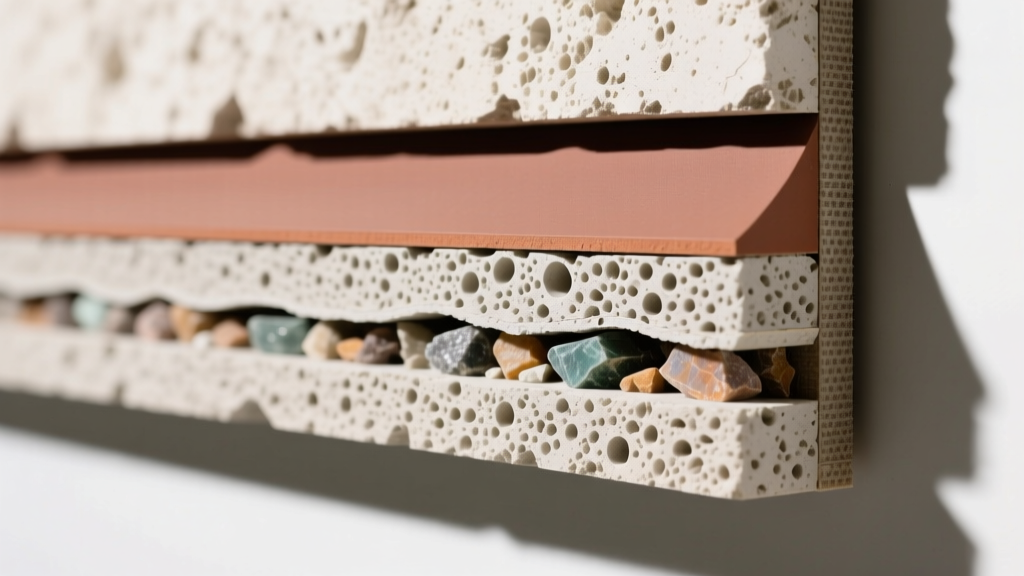
Substrate Preparation and Shear Bond Strength
The technical specifications of the stone itself are only half the equation; the substrate preparation dictates the ultimate shear bond strength of the assembly. Inexpensive stone veneer is an adhered system, meaning it relies entirely on the mechanical bond between the stone, the mortar, the metal lath, and the scratch coat.
For wood-frame construction, the substrate must consist of a water-resistive barrier (WRB) compliant with ASTM D226 (Grade D paper) or ASTM E2556 (house wrap), followed by self-furring, corrosion-resistant metal lath weighing a minimum of 2.5 lbs/sq yard. The lath must be fastened to the structural framing—not just the OSB or plywood sheathing—using corrosion-resistant nails or staples driven directly into the studs at maximum 6-inch intervals vertically and 16-inch intervals horizontally.
The scratch coat must be a Type S mortar (ASTM C270), which provides higher compressive and bond strength than Type N. Budget installers often attempt to use Type N mortar or pre-mixed masonry cements to save time and material costs. This is a critical error. Type S mortar achieves a minimum compressive strength of 1,800 psi, matching the stone units, and provides the necessary shear bond to support the 15 lbs/sq ft dead load of the veneer indefinitely.
Final Verification Checklist for Procurement
Before issuing a purchase order for any budget-tier MSV product, require the supplier to provide a current, third-party tested ICC-ES Evaluation Report. This report independently verifies that the specific manufacturing plant's product meets the ASTM C1670 and C1671 standards. Relying solely on the manufacturer's internal marketing brochures is insufficient for liability protection and long-term building envelope integrity.
Written by
David NakamuraDavid Nakamura is a licensed architect (AIA) and construction technology writer focused on sustainable building methods, mass timber engineering, and high-performance building envelopes. He holds a Master of Architecture from the University of Washington and is a certified Passive House Consultant (CPHC). David spent eight years at the Seattle firm Mithun, where he led the design of three LEED Platinum projects, before founding his own practice specializing in net-zero residential design. He serves on the editorial advisory board of GreenBuilder Magazine and has authored peer-reviewed papers on cross-laminated timber (CLT) connections for the Journal of Structural Engineering. In his spare time, David teaches woodworking at Pratt Fine Arts Center and kayaks the Puget Sound.
More from David Nakamura
View all
Construction Cost
Labor Cost to Build a Deck Per Sq Ft: 2026 Installation Guide
Discover the exact labor cost to build a deck per sq ft in 2026. This installation guide breaks down contractor rates, complexity factors, and hidden fees.
Aug 4, 2026

Construction Cost
How Much Does It Cost to Build a 3 Bedroom House? Financing Guide
Learn exactly how much it costs to build a 3 bedroom house and explore 2026 financing options, construction loan types, and budget frameworks for your build.
Aug 4, 2026

Construction Cost
Cost to Build a Tennis Court: 2026 Guide
How much does it cost to build a tennis court in 2026? Breakdowns for asphalt, concrete, and synthetic surfaces plus fencing and lighting.
Jul 30, 2026